
How to Use Distressed Property Data Profitably
Distressed property data is defined as any public record signal indicating a property owner faces financial, legal, or physical pressure that may force a sale or create a renovation opportunity. Investors and contractors who use distressed property data profitably do so by combining multiple signals, scoring leads by urgency, and timing outreach to foreclosure and delinquency windows. The U.S. foreclosure pre-sale inventory stood at 0.44% in december 2025, with 40,000 foreclosure starts and a 3.68% delinquency rate. That baseline tells you exactly how many motivated sellers are moving through the pipeline at any given time. Platforms like Shovld and tools like the Apify distressed property scraper API transform scattered public records into scored, actionable leads.
How to use distressed property data profitably: key signals and sources
The most profitable distressed real estate strategies start with knowing which signals actually predict motivated sellers. Tax delinquency, pre-foreclosure notices, sheriff sale filings, code violations, vacant property registries, probate filings, and tax liens each tell a different part of the story. No single signal is enough on its own. Stacking them is what separates a real lead from noise.

Here is how the major distress data sources compare:
Data sourceUpdate cadenceReliabilityBest useTax delinquency recordsMonthly to quarterlyHighEarly-stage motivated seller identificationPre-foreclosure filingsWeeklyHighTiming outreach before auctionUSPS vacancy dataMonthlyModerateTriage for site visits, not final statusCode violation recordsVariableModerate to highCondition assessment and contractor scopingProbate filingsWeeklyHighEstate-driven motivated sellersTax lien recordsOngoingHighTitle risk and offer structuring
USPS vacancy data can flag addresses vacant for over 90 days, but it requires cross-checking with field observations to avoid misclassification. The Center for Community Progress confirms that vacancy indicators are probabilistic and may reflect construction activity or reporting errors. Treating USPS data as a triage input rather than a definitive status saves you from mobilizing a crew on a property that is occupied.
Tax delinquency is the earliest signal. Owners who stop paying taxes are often 12–24 months ahead of a foreclosure filing.
Pre-foreclosure notices narrow the window. These owners face a legal clock and are far more likely to negotiate.
Code violations reveal condition. A property with multiple open violations is a contractor’s project waiting to happen.
Probate filings surface estate-driven sellers who often prioritize speed over price.
Pro Tip: Cross-reference at least three distress signals per property before adding it to your outreach list. A single signal produces too many false positives and wastes marketing spend.
Analyzing distressed property trends across multiple signal types gives you a cleaner picture of true motivation. The tax delinquency role in off-market deals is well documented. Owners who are delinquent on taxes and carrying open code violations represent a compounding distress profile that converts at a higher rate than either signal alone.
How do you build a scoring model for distressed leads?
A distress score is a number assigned to each property that reflects how many signals are present and how urgent the timeline is. The higher the score, the more likely the owner needs to act fast. This is the core mechanic behind profitable distressed real estate strategies.
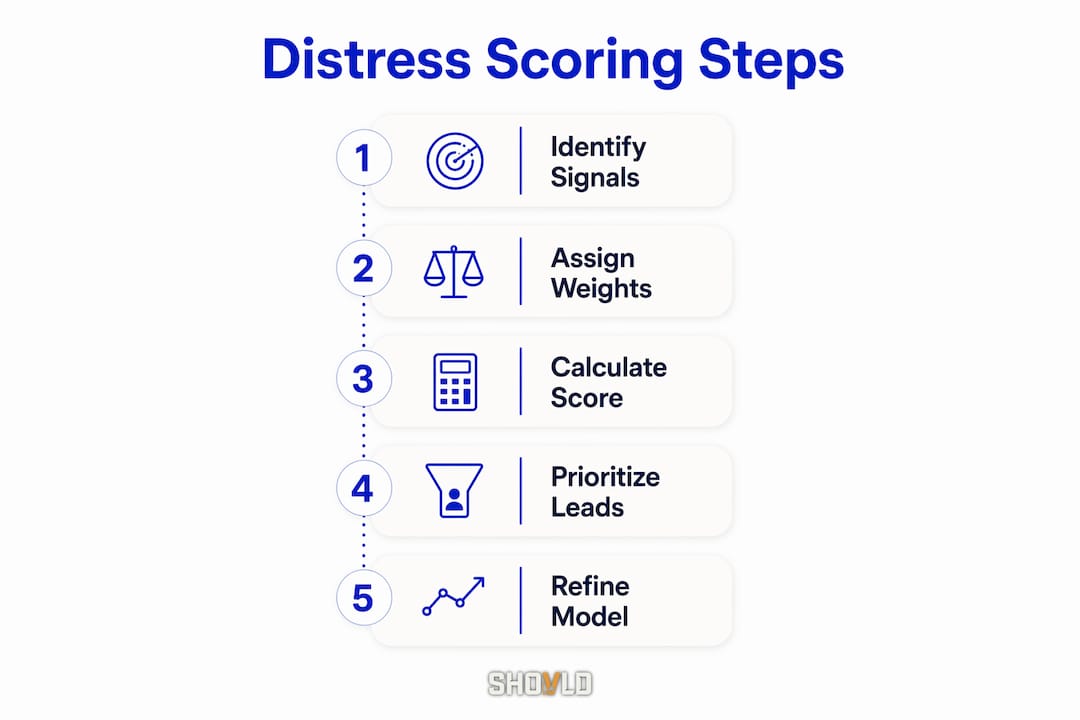
The Apify distressed property scraper API fuses multiple distress signals per property to compute a distress score and enable skip tracing for owner contact. That approach works because it deduplicates signals by parcel key and maintains a signal count per property. Without deduplication, you end up contacting the same owner multiple times through different data sources, which burns goodwill and budget.
Build your scoring model in four steps:
Assign a parcel key to every record. Use the county assessor parcel number as your unique identifier. Every signal you pull gets attached to that key.
Count the signals per parcel. A property with tax delinquency, an open code violation, and a USPS vacancy flag scores higher than one with only a single indicator.
Weight signals by urgency. Days to foreclosure sale carries more weight than a code violation filed two years ago. Days to foreclosure sale is the single most predictive variable for conversion timing.
Set a threshold for outreach. Properties scoring below your threshold go into a watch list. Properties above it get immediate outreach. This keeps your team focused on leads that can actually close.
Practitioners gain better conversion by scoring leads based on days to sale rather than static distress categories. A property 60 days from auction is a different conversation than one that just received its first delinquency notice. Your scoring model should reflect that difference explicitly.
Pro Tip: Build a separate “watch list” tier for properties that score just below your outreach threshold. Review it monthly. Distress compounds, and a borderline lead today can become a top-tier lead in 30 days.
Scoring also informs your marketing budget. High-score leads justify direct mail, skip tracing, and personal outreach. Low-score leads may only warrant a postcard. Matching spend to urgency is how you keep your cost per deal under control.
When should you time outreach for maximum conversion?
Timing is the variable most investors underestimate. Federal rules require at least 120 days of delinquency before a servicer can initiate foreclosure. That rule creates a predictable window. Owners in days 1–120 of delinquency are in a loss mitigation phase where they have the most options and the most flexibility to negotiate.
Once a foreclosure starts, the timeline compresses. A complete loss mitigation application submitted before a foreclosure sale can pause the process entirely. That pause is your window to get in front of the owner with a real offer. Miss it, and you are competing at auction with cash buyers who have no interest in giving you a deal.
Key timing thresholds to build into your outreach calendar:
Days 1–120 of delinquency: Owner has maximum options. Outreach tone should be educational and solution-focused.
Foreclosure start to 60 days pre-sale: Owner is under legal pressure. Outreach should be direct and offer-ready.
Within 37 days of sale: Loss mitigation alternatives shrink significantly. Properties at this stage require a different underwriting approach.
“Properties within 37 days of sale have fewer loss mitigation alternatives and require different approaches.” — Asset Resolution Advisors
The April 2026 ICE data shows a delinquency rate of 3.35%, foreclosure pre-sale inventory at 0.50%, 37,000 starts, and 7,900 sales. Delinquency rose 13 basis points year over year. That upward trend means your lead pool is growing, and your outreach cadence should scale with it. Adjust your pull thresholds and contact frequency quarterly as these numbers shift.
Timing also affects contractor scheduling. If you know a property is 45 days from auction, you can pre-qualify it for a rehab scope and have a contractor ready to mobilize within days of closing. That speed advantage is worth real money on competitive deals.
How do you validate distressed data before committing resources?
Validation is where most investors lose money. They pull a list, run outreach, and then discover the property is occupied, already sold, or carrying a title defect that kills the deal. A structured validation workflow prevents that.
The USPS no-stat flag is a common source of misclassification. A property flagged as no-stat may be under construction, seasonally occupied, or simply have an irregular mail delivery pattern. Field observation is the only way to confirm true vacancy status before you price a project or schedule a crew.
Follow this validation sequence before committing any resources:
Drive-by inspection. Confirm vacancy, visible condition issues, and access points. Take photos with timestamps.
Check local registries. Many municipalities maintain vacant property registries separate from USPS data. Cross-reference both.
Pull the full lien profile. Tax liens remain visible in public records and indicate both motivation and title risk. Resolving liens before making an offer is non-negotiable.
Get a contractor walkthrough. A contractor’s eyes on a property before you finalize your offer price is the most cost-effective form of due diligence available.
Confirm ownership and contact. Skip tracing tools confirm the current owner of record and provide contact information for outreach.
Tax lien presence alters closing risk and financing options directly. Teams that implement a “liens-to-action” workflow confirm payoff responsibilities before bidding. That step alone prevents deals from falling apart at the title company. Knowing the lien payoff amount also sharpens your offer math and protects your margin.
Pro Tip: Build a simple checklist in a shared spreadsheet or project management tool. Every lead that passes scoring gets a validation checklist before it moves to the offer stage. This creates a repeatable process your whole team can follow.
Shovld tracks pre-foreclosure properties early by pulling permit data, code violations, and municipal records across multiple U.S. markets. That kind of integrated signal tracking reduces the manual validation burden significantly. You still need field confirmation, but you start with a much cleaner data set.
Key takeaways
Profitable distressed real estate investing requires stacking multiple signals, scoring by urgency, timing outreach to foreclosure windows, and validating every lead before committing money or crew time.
PointDetailsStack multiple signalsCombine tax delinquency, pre-foreclosure, code violations, and liens to reduce false positives.Score by days to saleLeads scored by foreclosure timeline convert at higher rates than static distress categories.Respect the 120-day ruleFederal rules create a predictable outreach window before foreclosure starts.Validate before committingUSPS vacancy data requires field confirmation before pricing or mobilizing a crew.Resolve liens pre-offerTax lien payoff amounts must be confirmed before bidding to protect deal margins.
Why most investors are working with incomplete data
The real problem is not a lack of distressed property data. There is more of it than ever. The problem is that most investors and contractors are working with one signal at a time, and one signal is almost always wrong.
I have seen investors build entire outreach campaigns on tax delinquency lists alone. The conversion rates are brutal because delinquency without a foreclosure notice is just a financial problem, not necessarily a selling motivation. Add a code violation and a USPS vacancy flag to that same property, and the picture changes completely. That owner is not just behind on taxes. They are likely gone, and the property is deteriorating.
The timing piece is where I see the most money left on the table. Investors who contact owners at day 30 of delinquency are too early. The owner still has options and is not ready to negotiate. Investors who show up at day 150 are often too late. The loss mitigation window has closed, and the property is heading to auction. The sweet spot is the 60-to-120-day window, and hitting it consistently requires a scoring model, not a gut feeling.
Contractors face a different version of the same problem. They get called in after a deal is already under contract, with no visibility into the property’s condition before the offer was made. Getting a contractor’s eyes on a property during the validation phase, not after closing, changes the rehab scope accuracy dramatically. The investors I have seen do this well treat their contractor as a data source, not just a vendor.
The data is available. The frameworks exist. The gap is execution discipline.
— Avi
How Shovld helps you act before the market reacts
Shovld is an AI-powered signal intelligence platform built for investors and contractors who want to find distressed opportunities before they become crowded. The platform pulls permits, code violations, HOA pressure signals, municipal records, and distressed property indicators across multiple U.S. markets and turns them into verified, scored leads. You get a prioritized pipeline without manually cross-referencing five different data sources.
Shovld’s pricing plans are built for professionals who need consistent deal flow, not one-off data pulls. Whether you are a solo investor running targeted outreach or a contractor building a predictable project pipeline, Shovld gives you the signal data to act early. Explore what Shovld does and see how it fits your current workflow.
FAQ
What is distressed property data?
Distressed property data is any public record signal indicating financial, legal, or physical pressure on a property owner. Common signals include tax delinquency, pre-foreclosure filings, code violations, tax liens, and USPS vacancy flags.
How many distress signals should you stack before outreach?
Cross-referencing at least three distress signals per property before outreach reduces false positives and improves conversion rates. A single signal, such as tax delinquency alone, produces too many leads that are not ready to sell.
When is the best time to contact a distressed property owner?
The 60-to-120-day delinquency window is the most productive outreach period. Federal rules require 120 days of delinquency before foreclosure can start, giving owners time to consider alternatives and giving investors a real negotiating window.
Why do tax liens matter before making an offer?
Tax liens appear in public records and directly affect title transfer and financing options. Confirming lien payoff amounts before bidding protects your deal margin and prevents closings from failing at the title company.
What is a distress score?
A distress score is a numeric ranking assigned to a property based on the number and urgency of distress signals present. Tools like the Apify distressed property scraper API compute distress scores by fusing multiple signals per parcel and enabling skip tracing for owner contact.