
Distressed Property Signals: What Investors Must Know
A distressed property signal is a specific, verifiable indicator that a property or its owner is under financial, physical, or operational stress severe enough to motivate a below-market sale. These signals are the industry’s term for what practitioners also call distressed property indicators. Knowing how to read them separates investors who find deals before the crowd from those who compete on the open market. The most reliable signals include pre-foreclosure filings, property tax delinquency, code violations, USPS vacancy flags, and absentee ownership records. Each one points to a different layer of stress, and together they form the foundation of a data-driven acquisition strategy.
What is a distressed property signal?
A distressed property signal is any public-record data point that reveals stress at the property level, the owner level, or both. The distinction matters. A cracked foundation is a physical signal about the property. A notice of default is a financial signal about the owner. Both are useful, but they tell you different things about deal potential.
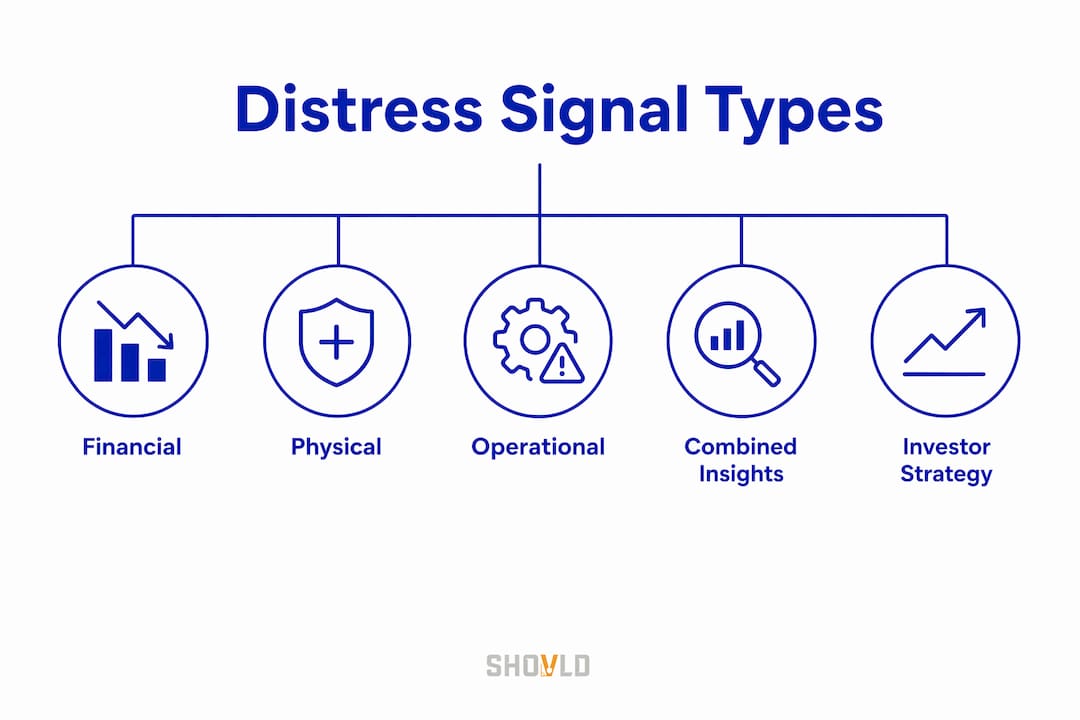
Financial signals are the most time-sensitive. Pre-foreclosure notice of default filings create a window of roughly 90–180 days for investors to contact owners before a lender repossesses the asset. These filings are public record, searchable through county recorders, and updated regularly. An owner in this window faces a hard deadline, which creates real motivation to negotiate.
Physical signals are visible or documented signs of neglect. Code violations, overgrown landscaping, boarded windows, and deferred maintenance all indicate an owner who is either unable or unwilling to maintain the property. Open code violations with accumulating fines add legal pressure on top of physical deterioration, making the owner’s position more urgent over time.

Operational signals are the least obvious but often the most telling. Absentee or out-of-state ownership, USPS vacancy flags, and estate or probate filings all suggest a situation where the owner’s relationship to the property has broken down. Probate and inheritance situations frequently produce motivated sellers who want a fast resolution regardless of price.
What are the main types of pre-market distressed signals?
Understanding the categories of distress signals helps you build a systematic sourcing process rather than relying on chance or visual inspection alone.
Financial distress signals:
Notice of default: Filed when a borrower misses mortgage payments, this is the earliest public record of foreclosure risk.
Tax delinquency: Tax delinquency tracking is one of the most predictive indicators of owner inability to maintain a property. It shows up in county assessor records and tax auction lists.
Judgment liens: Unpaid debts attached to a property title signal financial pressure that may force a sale.
Physical distress signals:
Code violations: Municipal code enforcement databases list open violations by address. Three or more open violations over time flag a property as likely distressed.
Visible deterioration: Peeling paint, broken gutters, collapsed fencing, and overgrown lots are visual cues that confirm what records suggest.
Deferred maintenance patterns: Permit history showing no repairs or improvements over many years indicates neglect, even without active violations.
Operational distress signals:
USPS vacancy flags: USPS vacancy data generated after 90 or more days of undeliverable mail provides a time-bound, objective classification of abandonment. This is more reliable than a visual drive-by.
Absentee ownership: An owner whose mailing address differs from the property address has a weaker emotional attachment to the asset and a higher likelihood of selling.
Estate and probate filings: Heirs inheriting a property they did not plan for often prioritize speed over price.
Pro Tip: Cross-reference absentee ownership with tax delinquency in the same county search. When both appear on the same property, seller motivation is significantly higher than with either signal alone.
Vacancy patterns deserve special attention because vacant homes deteriorate faster than occupied ones. Repair budgets for vacant properties can run 20–50% higher than for occupied homes. That cost difference must factor into your offer from day one.
Why does stacking multiple signals increase confidence?
A single distress signal is a question mark. Multiple signals on the same property form a pattern, and patterns are where deals live.
Consider this: a property with a USPS vacancy flag alone could simply mean the owner is traveling. Add tax delinquency, and the picture sharpens. Add an open code violation and an out-of-state mailing address, and you now have four independent data sources pointing to the same conclusion. Composite signal scoring combines these public-record inputs to prioritize leads by distress intensity, so you spend time on the highest-probability opportunities.
Here is a practical stacking sequence that experienced investors use:
Start with financial signals. Pull tax delinquency lists and notice of default filings from county records. These are your highest-urgency leads.
Layer in operational signals. Cross-reference those addresses against USPS vacancy data and absentee ownership records. Overlap here confirms the owner is disengaged.
Add physical signals. Check municipal code enforcement databases for open violations at the same addresses. Physical neglect confirms the financial and operational picture.
Score by signal count. A property with four overlapping signals ranks higher than one with a single indicator. Prioritize your outreach accordingly.
Confirm with physical inspection. Drive the property or use street-level imagery to verify what the data suggests before making contact.
“The goal is not to find distressed properties. The goal is to find distressed owners. The property is just the address where you reach them.” This distinction shapes every step of the sourcing process.
Combining vacancy data with utility shutoff timelines and physical observations produces the most accurate read on true abandonment versus temporary vacancy. Utility data is often accessible through public records requests or third-party data providers, and it adds a fifth layer to your scoring model.
What are the biggest misconceptions about distress signals?
Distress signals identify opportunity. They do not guarantee a deal. Investors who confuse the two lose money.
The most common mistake is treating a high-distress score as a purchase decision. Signals initiate lead qualification but require detailed financial and legal evaluation before any offer goes out. A property with four distress signals could also carry a clouded title, unpermitted additions, or environmental liens that make it unprofitable at any price.
Pro Tip: Before contacting a distressed owner, run a preliminary title search and pull the permit history. Discovering a major title issue after you have built rapport with a seller wastes everyone’s time and damages your credibility.
A second misconception is that physical distress always means seller motivation. A property can look terrible while the owner has no interest in selling. Deferred maintenance reflects financial capacity, not necessarily intent. You need both physical signals and financial or operational signals to build a confident thesis.
A third mistake is ignoring repair costs in the offer calculation. Underwriting must integrate distress signals with a disciplined after-repair value (ARV) and repair budget approach. Overpaying for a distressed property because the signals looked compelling is a real and common outcome. The discount you expect from distress must exceed the cost to cure it.
Distress signals also do not account for market conditions. A motivated seller in a declining market may still price above what the numbers support. Always anchor your offer to comparable sales, not to the seller’s urgency.
How to use distressed property signals in your strategy
Sourcing and acting on distress signals requires a repeatable process, not a one-time search.
Sourcing from public records:
County tax assessor websites publish delinquency lists, often updated quarterly.
County recorder offices hold notice of default filings, searchable by date range.
Municipal code enforcement portals list open violations by address and violation type.
USPS vacancy data is available through licensed data providers and some municipal databases.
Qualifying leads with signal stacking:
Once you have a raw list, score each address by signal count. A property appearing on the tax delinquency list, the code violation database, and the USPS vacancy report scores higher than one appearing on only one list. Focus outreach on the top-scored addresses first.
Approaching owners:
Timing and tone matter. Owners in pre-foreclosure are under stress. A letter or call that leads with empathy and a clear value proposition outperforms aggressive or transactional language. Acknowledge their situation without exploiting it. Offer a solution, not a lowball.
Incorporating signals into underwriting:
Signal TypeWhat It Tells YouUnderwriting ImplicationTax delinquencyOwner cash flow is strainedSeller may accept below-market priceNotice of defaultForeclosure timeline is activeUrgency window is 90–180 daysCode violationsProperty needs repairAdd cost-to-cure to repair budgetUSPS vacancy flagProperty is likely unoccupiedBudget for 20–50% higher rehab costsAbsentee ownershipOwner is emotionally detachedHigher probability of remote negotiation
Physical distress signals visible during a walkthrough should always be priced into your offer before you submit. Never assume a seller will credit repairs after the fact on a distressed deal.
Distress signals in public records also reveal claim potential for restoration and remediation professionals, not just investors. The same data that flags a deal for a buyer flags a project for a contractor.
Key takeaways
Distressed property signals are most powerful when stacked across financial, physical, and operational categories, because no single indicator reliably predicts a motivated seller or a profitable deal.
PointDetailsDefine the signal typeClassify each indicator as financial, physical, or operational before drawing conclusions.Stack signals for confidenceProperties with four or more overlapping signals carry significantly higher seller motivation.Vacancy costs more to rehabVacant homes typically require 20–50% more in repair budget than occupied properties.Signals require underwritingAlways check title, ARV, and repair costs before making an offer on a distressed property.Pre-foreclosure windows are shortNotice of default filings give a 90–180 day window to act before lender repossession.
Why i think most investors read distress signals backwards
From where I sit, the biggest error in distressed property investing is not missing signals. It is misreading what they mean. Investors see a tax-delinquent, code-violated, vacant property and immediately calculate profit. They skip the part where they ask whether the owner is reachable, whether the title is clean, or whether the neighborhood supports the ARV they need.
I have watched deals fall apart at the title search stage because the investor was so focused on the distress score that they never looked at the lien stack. A property can score perfectly on every distress indicator and still be a money-losing acquisition if the cost to cure exceeds the discount.
The signal is the starting point, not the finish line. What I have found works is treating distress data as a filter, not a verdict. You use it to narrow a thousand addresses down to twenty worth investigating. Then you do the real work: pull the title, walk the property, run the comps, and call the owner. The data gets you to the door. Judgment gets you through it.
Pairing signal stacking with solid market comps and a conservative repair budget is the only approach that holds up over time. Patience matters too. Not every high-signal property will convert in the first contact. The investors who build consistent pipelines are the ones who follow up systematically and communicate with sellers like people, not targets.
— Avi
Find distressed deals faster with Shovld
Shovld is an AI-powered signal intelligence platform built for real estate investors, contractors, and restoration professionals who need to act before the market catches up. The platform tracks permits, code violations, tax delinquency, USPS vacancy flags, absentee ownership, and municipal records across multiple U.S. markets, then scores and surfaces the highest-priority opportunities in one place.

Instead of pulling county records manually and cross-referencing spreadsheets, Shovld does the signal stacking for you. You get verified, scored leads that reflect real distress intensity, not just a raw list of addresses. For investors building a repeatable acquisition pipeline, that early visibility is the difference between competing on price and owning the deal before anyone else shows up. See the Shovld pricing plans to find the tier that fits your market and volume. Learn more about what Shovld does and how the platform turns scattered public data into scored opportunities.
FAQ
What is a distressed property signal in real estate?
A distressed property signal is a verifiable public-record indicator showing that a property or its owner is under financial, physical, or operational stress. Common examples include notice of default filings, tax delinquency, open code violations, and USPS vacancy flags.
How many distress signals should a property have before i pursue it?
Properties with four or more overlapping signals across financial, operational, and physical categories carry the highest probability of seller motivation. A single signal is rarely enough to justify outreach without additional confirmation.
Does a distressed property signal guarantee a below-market deal?
No. Distress signals identify potential opportunities but require full underwriting before any offer. Title issues, unpermitted work, repair costs, and seller unwillingness can all eliminate the expected discount even on high-signal properties.
What is the difference between a physical and a financial distress signal?
A physical signal reflects the condition of the property itself, such as code violations or visible deterioration. A financial signal reflects the owner’s economic situation, such as tax delinquency or a notice of default filing.
Where do i find distressed property signals for free?
County tax assessor websites, county recorder offices, and municipal code enforcement portals publish most financial and physical distress signals at no cost. USPS vacancy data typically requires a licensed data provider or a third-party aggregator.