
How Distressed Property Records Reveal Claim Potential
Distressed property records are the most direct signal of claim potential in real estate, exposing liens, litigation notices, and financial encumbrances that can freeze transactions, reduce asset value, or create negotiation leverage. Understanding how distressed property records reveal claim potential is the difference between a deal that closes cleanly and one that stalls for months in title disputes. Key record types include lis pendens filings, municipal liens, tax delinquencies, code violations, and probate filings. Each one tells a different story about the property’s legal and financial health. Real estate professionals who read these records fluently gain early visibility into opportunities that most investors miss entirely.
How distressed property records reveal claim potential
The core mechanism is constructive notice. When a lis pendens, municipal lien, or tax delinquency is recorded in the public record, it legally notifies every buyer, lender, and lienholder that a claim exists against the property. This constructive notice mechanism converts scattered public data into actionable claim intelligence. The record does not just describe a problem. It defines the problem’s legal weight, its priority against other claims, and the timeline for resolution.
Distressed property analysis starts with knowing which records carry the most transactional friction. A property with a single tax delinquency is a different risk profile than one carrying a lis pendens, two open code violations, and an unresolved nuisance abatement lien. Stacking these signals gives you a clearer picture of seller motivation, transaction complexity, and the true cost of acquisition. Professionals who skip this step are playing in a commoditized market, competing on price alone rather than on information.

What is lis pendens and how does it signal claim potential?
Lis pendens is a recorded notice of pending litigation that directly affects property title, functioning as constructive notice to all market participants that the property’s ownership or possession is under legal dispute. The term translates from Latin as “suit pending,” and its legal effect is immediate. Once recorded, it clouds title and freezes the property’s marketability until the underlying lawsuit is resolved.
Lis pendens is most common in judicial foreclosure states, where lenders must file suit to foreclose rather than proceeding through a trustee sale. States like Florida, New York, and New Jersey see high volumes of lis pendens filings tied to mortgage default litigation. But lis pendens also appears in boundary disputes, divorce proceedings, and contract disputes involving real property.
A critical distinction separates lis pendens from monetary liens like judgments or tax liens. Lis pendens does not assert a monetary claim against the property. It signals that the outcome of litigation may affect ownership. This distinction matters for risk assessment. A judgment lien has a dollar amount you can negotiate around. A lis pendens has an uncertain outcome that could strip title entirely.
Key facts every professional should know about lis pendens:
Wrongful lis pendens filings expose the filer to sanctions and damages, so courts scrutinize them carefully.
Expungement is possible when the underlying claim lacks merit, but it requires a court order and takes time.
Resolution of the underlying lawsuit does not automatically remove the lis pendens. A formal release must be recorded.
Title insurance underwriters treat active lis pendens as a hard stop until the record is cleared.
Pro Tip: Before making an offer on a property with an active lis pendens, pull the underlying court case from the county clerk’s docket. The case status tells you whether the litigation is active, settled, or abandoned. An abandoned case with an uncleared lis pendens is a paperwork problem, not a legal one, and it creates negotiation leverage.
How municipal liens affect claim potential and title clarity
Municipal liens arise from unpaid code violations, nuisance abatements, and utility balances, and they carry a legal characteristic that surprises most buyers: super-priority status. In many jurisdictions, municipal liens rank ahead of first mortgages in the payment hierarchy. This means a lender’s security interest can be subordinated to a city’s claim for unpaid grass-cutting fees or boarding costs on a vacant property.
The practical impact is significant. A buyer who closes without identifying all municipal liens inherits them. Title insurance policies vary in how they treat municipal liens, and many standard policies exclude code enforcement fines that have not yet been formally recorded. This is where due diligence gaps create the most expensive surprises in real estate transactions.
Here is a practical sequence for identifying municipal lien claim potential before closing:
Pull the county recorder’s index for the property address and search for any recorded municipal or code enforcement liens.
Contact the city or municipality’s code enforcement department directly and request a lien search by address. Many departments maintain separate databases not reflected in county records.
Verify utility account status with the local water, sewer, and electric providers. Unpaid utility balances often attach to the property, not the account holder.
Request a formal municipal lien search from a title company or a specialized municipal lien search firm, particularly in Florida, where these searches are standard practice.
Review the property’s permit history for open or expired permits, which can trigger code enforcement action after closing.
Pro Tip: Code enforcement fines often begin accruing daily before a lien is formally recorded. A property with a $500 recorded lien may carry $15,000 in accrued fines that have not yet been filed. Always ask the code enforcement department for the full accrued balance, not just the recorded amount.
Using tax delinquency records to evaluate claim timing and negotiation potential
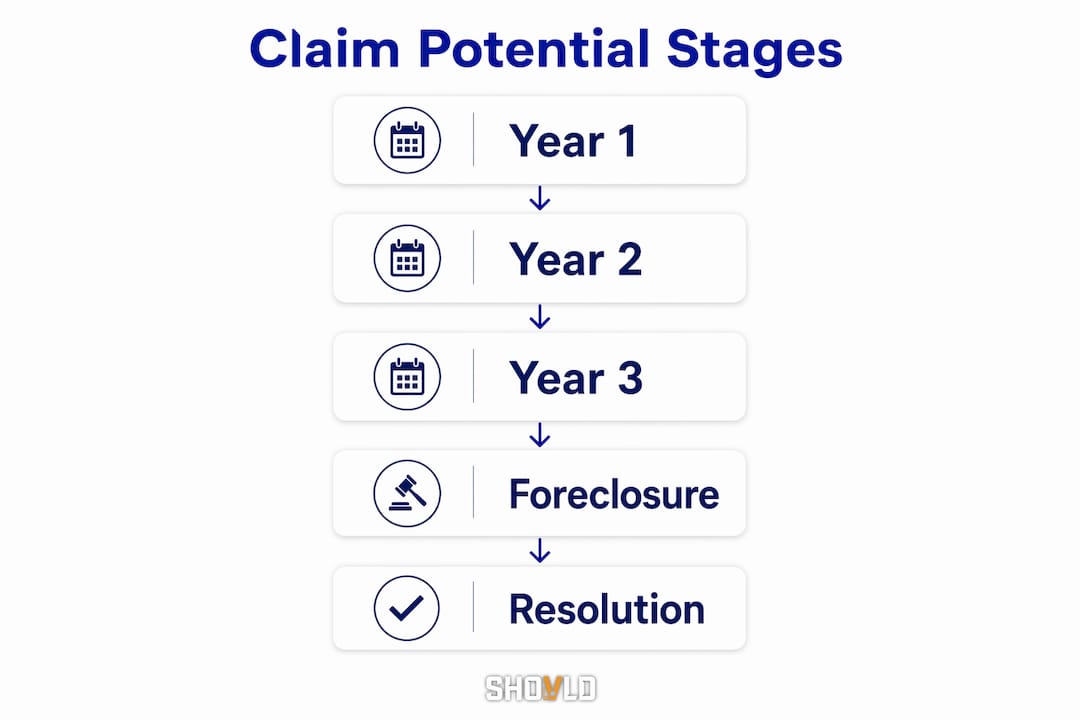
Tax delinquency is both a distress indicator and a claim trigger. When a property owner fails to pay property taxes, the taxing authority acquires a statutory lien that accrues interest and penalties automatically. The timeline from first delinquency to title loss varies by state, but the stages of tax foreclosure create distinct negotiation windows with different risk profiles.
Michigan’s tax delinquency pipeline illustrates this clearly. The state’s process runs approximately 25 months from first delinquency to forfeiture and eventual foreclosure. Early in that cycle, the owner retains full redemption rights and is typically motivated to resolve the debt. Late in the cycle, the property may be headed to a county land bank, and the negotiation dynamic shifts entirely.
StageTimelineClaim PotentialFirst delinquencyYear 1High owner motivation, full redemption availableDelinquent transfer to countyYear 2Moderate leverage, owner facing deadline pressureForfeitureMonth 25Low negotiation window, title transfer imminentForeclosure and land bankPost-month 25Claim resolved, but property may carry other liens
The practical takeaway is that stage identification determines your outreach strategy. Contacting an owner in year one of delinquency yields a different conversation than contacting one in month 24. Most investors crowd around the same fire, targeting properties already in foreclosure. The professionals who act earlier, when the owner still has options, close more deals with less competition.
Public portals like the Maricopa County Assessor allow searches by address, owner name, or APN and display full tax payment history, assessed values, and delinquency status. Tarrant County in Texas publishes recording fees and trustee sale schedules that help professionals track the administrative costs associated with claim filings and foreclosure proceedings.
How to combine multiple records for a comprehensive claim assessment
Single-record analysis is a starting point, not a conclusion. The real signal comes from stacking records. Combining indicators like absentee ownership, tax delinquency, open code violations, and probate filings narrows your target list to properties where seller motivation is high and claim complexity is manageable.
Consider a scenario: a property in Phoenix shows absentee ownership, two years of tax delinquency, an open code enforcement case for exterior violations, and a probate filing from six months ago. Each record alone is interesting. Together, they describe a property where heirs are managing an estate, the property has been neglected, and the financial pressure is building. That is a motivated seller profile with a clear claim structure you can evaluate and price.
The practical workflow for stacking records draws on multiple sources:
County assessor portals for ownership, tax history, and assessed value
County recorder indexes for recorded liens, lis pendens, and deed history
Municipal code enforcement databases for open violations and accrued fines
Probate court filings for estate-related ownership changes
Permit portals for open, expired, or unpermitted work
The operational impact of this approach is real. Properties with multiple overlapping claims require more administrative management at closing. Recording fees and claim-related filings add to transaction costs, and each unresolved claim extends the timeline. Knowing this in advance lets you price the deal correctly and avoid surprises that kill closings.
Distress does not start with foreclosure. The signals appear months or years earlier in public records, and professionals who monitor those signals consistently build predictable pipelines rather than chasing deals reactively.
Key takeaways
Distressed property records reveal claim potential through layered signals: lis pendens clouds title, municipal liens carry super-priority status, and tax delinquency stages define both risk and negotiation timing.
PointDetailsLis pendens signals litigation riskIt clouds title and freezes transactions until the underlying lawsuit is formally resolved.Municipal liens can outrank mortgagesSuper-priority status means buyers inherit unpaid fines if not identified before closing.Tax delinquency stage determines leverageEarly-stage delinquency offers the highest owner motivation and negotiation potential.Record stacking increases confidenceCombining absentee ownership, tax delinquency, and code violations identifies the most motivated sellers.Municipal lien searches require multiple systemsCounty records alone miss accrued fines; direct code enforcement and utility checks are required.
Why most investors are reading these records wrong
The most common mistake I see is treating the presence of a record as the signal, when the real signal is the stage and combination of records. An investor who sees a lis pendens and walks away is leaving money on the table. An investor who sees a lis pendens tied to an abandoned lawsuit, combined with two years of tax delinquency and an absentee owner, is looking at a motivated seller with a solvable problem.
The second mistake is relying on a standard title search as the complete picture. Title searches pull county-recorded documents. They miss code enforcement fines that have not yet been formally recorded, utility balances that attach to the property, and municipal abatement costs that are in the billing cycle but not yet filed. I have seen deals close with five-figure municipal liabilities that a county title search showed as clean. The multi-system approach is not optional. It is the minimum standard for professional due diligence.
The third mistake is ignoring the calendar. Tax delinquency timelines are statutory. They run on a fixed schedule regardless of market conditions. If you are not tracking those deadlines, you are not managing your pipeline. You are reacting to it. Professionals who calendar statutory redemption deadlines and monitor tax delinquency cycles consistently reach owners at the right moment, before the competition and before the window closes.
— Avi
How Shovld helps you find claim potential before the market does
Shovld is built for professionals who want to act on distressed property signals before they become crowded opportunities. The platform monitors public records across multiple U.S. markets, including permits, code violations, municipal liens, tax delinquency indicators, and HOA pressure, and scores them into verified opportunities you can act on immediately.

For real estate investors and agents running distressed property analysis at scale, Shovld eliminates the manual work of pulling records from a dozen different portals. The platform surfaces stacked signals automatically, so you see the full claim picture on a property without spending hours on county websites. If you want to understand what Shovld’s signal intelligence can do for your pipeline, or you are ready to see the pricing structure, explore Shovld’s plans and find the right fit for your market.
FAQ
What is lis pendens in real estate?
Lis pendens is a recorded public notice that pending litigation affects a property’s title. It functions as constructive notice to buyers and lenders, freezing the property’s marketability until the lawsuit is resolved.
Can municipal liens survive a property sale?
Yes. Municipal liens attach to the property, not the owner. Buyers who close without identifying and resolving all municipal liens inherit them, regardless of what the seller discloses.
How do I find tax delinquency records for a property?
County assessor and treasurer portals publish tax payment histories and delinquency status. Portals like the Maricopa County Assessor allow searches by address, owner name, or APN and display full tax histories at no cost.
What does record stacking mean in distressed property analysis?
Record stacking means combining multiple public record indicators, such as absentee ownership, tax delinquency, open code violations, and probate filings, to build a complete picture of seller motivation and claim complexity on a single property.
Why is a standard title search not enough for distressed properties?
Standard title searches pull county-recorded documents but miss accrued code enforcement fines, utility balances, and municipal abatement costs that have not yet been formally filed. A complete due diligence review requires direct checks with municipal code enforcement departments and utility providers.