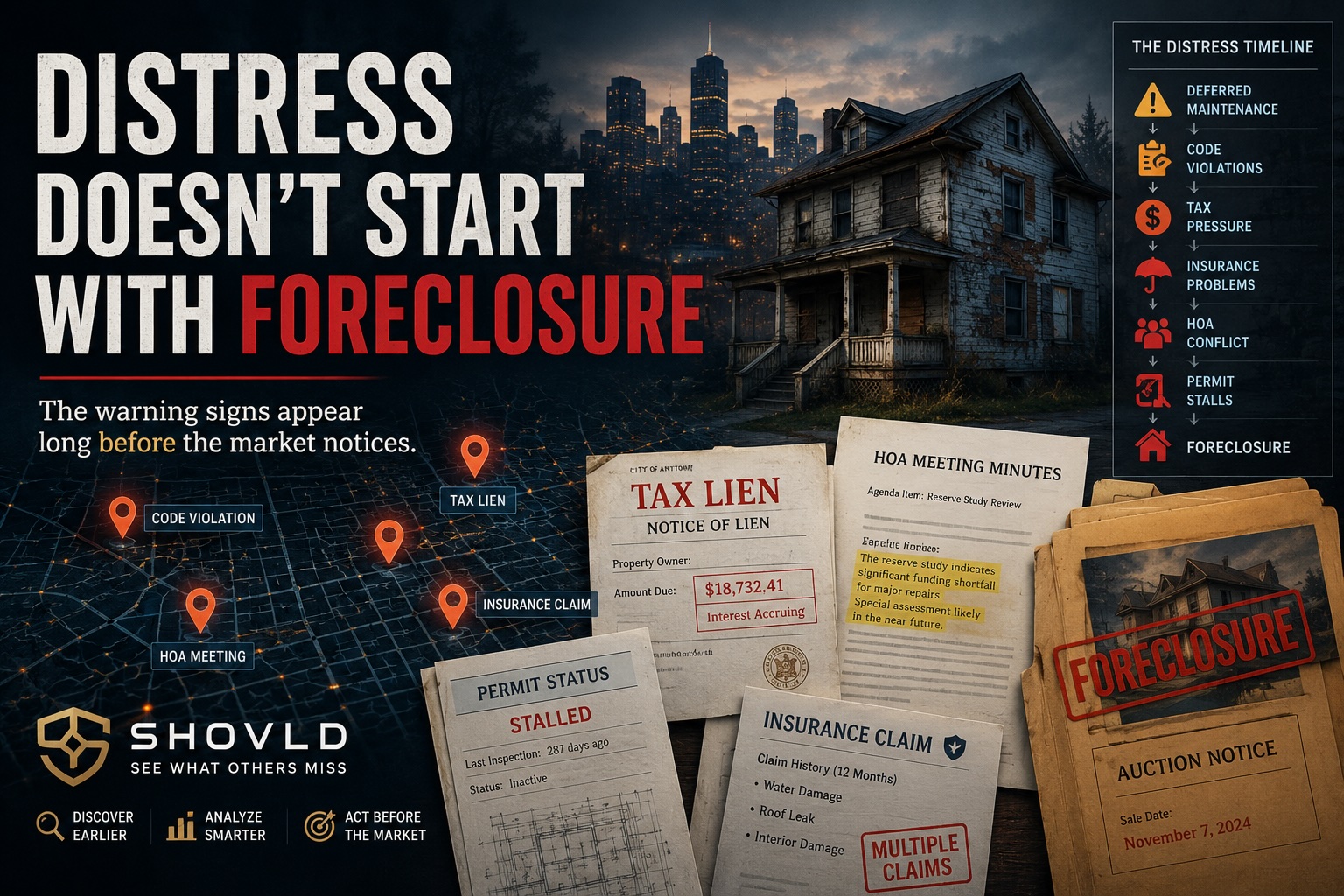
The Story Hidden in Public Records—and Why You're Seeing It Too Late
It's November when the notice drops. A 28-unit apartment building in a mid-market neighborhood hits the public foreclosure auction list, and within hours, you see the notification like everyone else.
You pull the property details. The numbers look interesting. Distressed asset, delinquent owner, clear path to acquisition. You call a contractor friend for a quick assessment. They drive by the next morning and send a text: "This place is worse than the listing says. Roof's been leaking for years. Water damage everywhere. Someone's been ignoring this for a long time."
Of course they have.
But here's what kills the deal: by the time you're seeing this property on a foreclosure list, at least six other investors are seeing it too. The contractors are already getting called. The cash buyers are already running numbers. The margin you thought you saw—the thing that made you excited when you first clicked the link—it's already been cut in half by the time you're halfway through your coffee.
You lose the auction by 8% to someone who'd already been watching this building for eighteen months.
This is the story of late arrival. And it's not because you're slow. It's because you're playing a game where everyone else got a nine-month head start.
The real narrative of distress doesn't begin with a foreclosure notice in November. It began back in February when a city inspector noticed the roof condition. It was already visible in April when the owner skipped a property tax payment. It was written into the HOA minutes in June when board members debated the cost of structural repairs. It was screaming by September when the insurance company issued a notice of cancellation.
Foreclosure is the ending, not the story. And by the time you see the ending, everyone who was actually reading the story has already made their move.
The operators building real wealth in construction and real estate aren't the ones reacting to notifications. They're the ones who learned to read the first chapters long before the book hit the public bestseller list.
Why Foreclosure Lists Feel Like Gold (But Are Actually Crowded Auctions)
Foreclosure notifications have an almost seductive simplicity. They're packaged, timestamped, and official. You get an email notification, you pull the data, and boom—there's a clear deadline, a documented loss, and a path to transaction. It feels like the market is handing you an opportunity.
That feeling is the problem.
The moment a property hits formal foreclosure, it's already been under private scrutiny for months. Local agents have their networks activated. Tax lien specialists are already reviewing title. Cash buyer syndicates have internal databases that flag properties weeks before public notice. By the time the notification lands in your inbox, the people who actually found value in this asset have already done their homework and positioned themselves.
Real talk: the foreclosure list is confirmation, not discovery.
This has real consequences. A property that might have penciled at 35-40% returns in March—when only a handful of people knew it was failing—is struggling to hit 15-20% by November when fifty people are bidding. The math gets harder not because the property got worse, but because everyone's chasing the same list now.
And you're competing against people with advantages you didn't have. They know the contractor situation intimately because they've been vetting rehab scope for six months. They have capital ready to deploy on this exact asset type. They've already passed on three similar buildings this year and understand the real value ceiling. They're not calculating margins on auction day—they calculated them months ago and this bid is just confirmation.
Meanwhile, you're running your numbers in real time, trying to close a funding gap, and competing against operators who saw this coming six months before you got an alert.
The foreclosure list isn't worthless. But it's also not where the advantage lives anymore. The advantage lives in the months before the notice.
Where Distress Actually Whispers (Before It Screams)
The intelligent operators aren't waiting for foreclosure notices. They're monitoring the early murmurs—the unglamorous moments when properties start to fail in the public records, long before anyone calls it a distressed asset.
It starts quietly.
When an Owner Stops Fighting: Code Violations
A code violation looks mundane. It's a notice, usually. Nothing dramatic. But it's actually a confession.
A code violation means an owner decided that fixing the problem costs more money than they want to spend right now. Or more accurately, it means they don't have the money. They've triaged their obligations, and compliance lost. This happens when the property stops generating income, or when the owner's own circumstances changed.
When you see one violation, it's usually fixable and temporary. When you see three violations in six months, something deeper is broken.
Here's what happens next: The bank that holds the mortgage sees the violations in public records (yes, they monitor this too). They call the owner. "Fix this or we're moving to acceleration." Insurance companies see them. Some won't renew. Tenants see them (and start looking for new places). The property gets harder to finance, harder to insure, harder to occupy.
Each violation creates friction that eats into already-thin margins. The owner gets trapped between the cost of fixing things and the cost of not fixing them. Pretty soon, they're losing money every month just holding the asset.
That's when you see them reconsidering their options.
Tax Liens: The Moment an Owner Surrenders
A tax lien is what happens when an owner stops fighting.
Property taxes aren't optional. Everyone knows this. They're the most senior obligation. You can skip the mortgage for a few months, but you skip property taxes? That's when the government gets involved.
When an owner stops paying property taxes, it means they've looked at their options and decided there aren't any—not good ones anyway. They know the lien is coming. They know the interest compounds. They know the title cloud it creates makes refinancing impossible. And they've decided to let it happen anyway.
It's the financial equivalent of waving a white flag.
The psychology here is worth understanding: an owner doesn't arrive at this decision casually. They usually spend months trying to fix things first. Then months trying to accept the situation. Then months hoping for a miracle (property values recovering, tenants paying rent on time, cost of repairs dropping). By the time the tax lien shows up in the public record, that owner has usually exhausted their emotional and financial reserves.
They're not just stressed anymore. They're done.
And here's the critical part: every month this drags on, the lien accrues interest, the title gets cloudier, and the owner's options get fewer. This plays out over a predictable timeline. There's usually a 6-12 month window between that first lien appearing and the moment foreclosure becomes inevitable. In that window, an owner who was holding on by their fingernails finally gets open to actual conversation.
When Buildings Start Falling Apart in the Minutes: HOA Conflicts and Reserve Studies
Building distress shows up first in board meetings.
A reserve study is what happens when a building gets honest about what it actually costs to survive. The inspector walks through and documents what's failing: the roof is original and has 3 years left. The HVAC is holding on by prayer. The foundation has settling. The electrical is undersized for modern loads. That's $2.1 million in capital improvements over the next 10 years.
Some owners can stomach that number. Most can't.
When the HOA board presents the reserve study at a meeting, you get the real story in the minutes. Owners start to panic. They calculate what the assessment means for their monthly costs. Some already-stretched budgets just broke. You start seeing owners refuse to pay assessments. The board can't fund critical repairs. Now you've got deferred maintenance creating more problems, which creates more expenses, which makes more owners angry.
This isn't subtle. Read the HOA minutes and you can literally watch a building's community start to fracture.
Buildings in this position become harder to sell, harder to refinance, and increasingly owned by people who are themselves stretched thin. The property's value trajectory starts pointing down. And somewhere in those minutes, you can see the exact moment the owner realizing this property isn't an investment anymore—it's a liability.
Abandoned Construction: The Slow Bleed
Stalled construction projects are even clearer signals.
You drive past a property with active construction permits dated two years ago. The work just... stopped. The contractor left. The framing sits exposed. Water's getting in. The owner's facing code violations now because the unfinished work created new problems.
This isn't mysterious. The money ran out. Or the numbers didn't work. Or unexpected costs broke the budget. Now the owner faces a choice: spend $200k to finish what they started, or spend $150k to remediate an incomplete demolition. Either way, they're throwing good money after bad money they don't have.
These properties bleed cash every month they sit incomplete. Municipalities pressure owners to finish or remediate. Lenders get nervous. The carrying costs compound.
An owner standing in front of an incomplete construction project isn't thinking about opportunity cost anymore. They're thinking about how to stop losing money.
When Insurance Gets Expensive: The Maintenance Obituary
A property's insurance history tells a story.
Multiple water intrusion claims. Repeated foundation issues. Roof leaks that keep happening. This isn't bad luck. This is a building telling you that nobody's maintaining it properly—or nobody can afford to.
Insurers notice these patterns. They raise premiums aggressively. Some companies just refuse to renew. When you can't get insurance at any price, you've got a problem that no investor wants.
An owner getting cancellation notices from insurance companies has entered the end game. They're expensive to carry now, impossible to finance, and worth less every month this drags on.
How an Owner Loses a Building (And Why It Takes Years)
Distress doesn't happen overnight. It happens through a hundred small decisions, each one reasonable in the moment, each one slightly worse than the last.
It usually starts with hope.
An owner buys at the top of the market or takes on a property thinking they can manage it. Then cash flow gets tight. Maybe occupancy dips. Maybe expenses spike. The property that was supposed to be a solid investment suddenly needs money every month instead of generating it.
So they defer the roof repair. It's not critical right now. It's $15,000 they don't have. They'll do it next year when things stabilize. Next year the property got worse, cash flow got tighter, and now that roof is causing water damage. Now it's not $15,000 anymore. It's $50,000 in water remediation plus the original $15,000. That's real money—serious money they definitely don't have.
They start skipping the property tax payment. Just this quarter. Just until cash flow recovers. It doesn't recover. Now there's a late fee. Now interest is accruing. Now there's a lien.
At this point most owners try to refinance. But the lien's on the title. The property's got open code violations. The insurance company's getting nervous. The bank declines the application.
Now they're trapped.
The property's a monthly drain. They're in denial about how bad it is because admitting the full scope feels like failure. They deferMainte more. They let tenants wait longer for repairs. The property's reputation starts to slip. Good tenants leave. You get a different tenant profile now—the kind who can't pay rent consistently.
Somewhere in this spiral, usually 18-24 months in, the owner finally has the moment of clarity. They've lost this property. It's not coming back. The question isn't whether they're going to lose it, but how much worse it gets before they formally surrender.
That surrender—the one that looks like a foreclosure filing—it's not the beginning of the story. It's the ending of a book that started a couple of years earlier.
And if you were paying attention to the public records, you could've seen that entire story unfold months before the final chapter.
The Intelligence System Your Competitors Never Built
Most investors treat foreclosure databases like lottery ticket scratchers. Check the list, move fast, hope your numbers are right.
But the actual story lives in the spaces between those lists.
Municipal complaint logs show exactly which properties have code violations—and how many, and how long they've been open. Tax lien databases track ownership pressure before anything else. Permit tracking systems show which projects have stalled—and for how long. HOA minutes reveal community conflict and deferred maintenance decisions. Insurance claim histories map maintenance failures. Contractor lien filings show who's pulling out of projects.
All of this is public. All of it is digital now. Most of it is searchable.
The constraint isn't access. The constraint is attention.
Building a systematic view across these databases is real work. It's not sexy. It doesn't fit a neat algorithm. It requires actually caring about HOA meeting minutes and understanding what they mean. It requires tracking permit status changes month after month until you see the pattern. It requires thinking like a detective, not a trader.
But this is exactly where the real information lives.
A sophisticated operator isn't waiting for the foreclosure notification. They're the ones who saw the first code violation notice, tracked it through municipal records for eight months, watched the tax lien appear, monitored the escalating HOA minutes, and then were already positioned when the property finally hit the public foreclosure list.
By that point, they didn't discover an opportunity. They confirmed one they'd been tracking for over a year.
Code Violations Are Owner Surrender Flags
A code violation is usually straightforward to fix. That's not the point.
The point is: an owner with an open code violation is an owner who's chosen not to fix it. That's a choice made from weakness, not strategy. They either don't have the cash, or they've decided the property isn't worth fixing, or they've given up enough that they're just letting the system do what it's going to do.
That flag matters.
When a violation sits open for six months, eight months, a year—you're watching an owner in psychological freefall. They had the option to fix it. They chose not to. That choice compounds their other problems. Now the bank notices. Now the insurance company raises premiums or declines renewal. Now tenants start to look elsewhere. Now there are two problems instead of one.
The code violation wasn't the cause of the distress. It was the symptom that tells you the distress is real and accelerating.
An investor who tracks code violations systematically across their market isn't looking for cheap rehab jobs. They're looking for owners who've run out of options. Those violations are admission tickets to a conversation that gets harder to have the longer you wait.
The Owner's Interior Monologue (And Why Understanding It Matters)
An owner doesn't decide to let a property fail. They decide not to fix it. And then they decide again the next month. And the month after that.
The psychology here is painfully human.
An owner who bought at $800,000 and is now worth $600,000 won't immediately sell at a loss. That loss feels like failure. So they hold instead. They defer maintenance ("just for a year"). They hope appreciation comes back ("the market cycles"). They cut corners ("maybe I don't need that roof repair yet"). The property gets worse. The owner gets more trapped.
The longer they hold, the more they're psychologically invested in the "it'll come back" narrative. It becomes identity. They're not an owner of a failing asset—they're someone waiting for their break. That story matters to them.
Meanwhile, the property is deteriorating. Code violations multiply. Insurance gets expensive. Tenants get worse. Cash flow goes negative. The owner is now losing $2,000 a month, but they're so committed to the "wait and see" story that stopping the bleed feels like admitting they were wrong.
This can go on for years.
But here's what changes it: there comes a moment when the owner stops believing their own story. When the code violation has been open for two years. When the insurance company has cancelled them twice. When they've missed three property tax payments. When they face a choice between fixing a $50,000 roof problem or walking away.
That's the moment when a strategic operator with a thoughtful offer becomes interesting to them.
The sophisticated investors don't chase desperation. They understand that owners need permission—psychologically speaking—to accept reality. A well-timed offer isn't pressure. It's permission. It's someone saying: "I see what's happening here. I have a solution. Here's what it looks like."
At that specific moment in the owner's journey—not when they're drowning, but when they've finally accepted that they're in the water—that's when real conversations become possible.
Why Reactive Operators Lose Margin
Picture this: it's auction day. You've done your numbers the night before. You think the property pencils at 28% returns. You feel pretty good about it.
Then you step into the auction room and realize there are twelve other people running the same mental calculation. The opening bid is higher than you expected. By the time someone wins, the margin you thought you had—the thing that got you excited—is cut in half. Maybe cut in thirds.
This is the cost of arriving late.
When you're operating on the same list as everyone else, using similar data, with similar analysis timeframes, the competition becomes purely symmetrical. Everyone has the same information, the same deadline, the same pressure to move fast. In that environment, the only differentiator is aggression. And aggression compounds losses.
The signal-based operator plays a completely different game.
They discovered the property in February when the first code violation appeared. They've been tracking it for six months. They've already assessed the actual rehabilitation scope—not from one drive-by, but from quarterly inspections and permit review. They know the market rental rates better because they've been watching comps for months. They've already determined their capital requirements and lined up financing that matches their timeline, not some auction deadline. By the time foreclosure arrives in November, they're not deciding whether to bid. They're confirming a thesis they've already made.
This changes the mathematics entirely:
Capital becomes cheaper because it's prepared. When you show up to a lender and say "I've been monitoring this property since February, here's my rehab scope, here's my exit strategy, here's what I need," you get better terms than "I need $400k by Thursday." Prepared capital beats pressured capital every single time. The interest rates are better. The terms are more favorable. Your cost of money is lower.
Rehab costs stop surprising you. You haven't just driven by the property once. You've been inside it. You've photographed the foundation settlement. You know the electrical actually needs complete rewiring—you've had a specialist walk it. When you budget for the rehab, you're not guessing. You're accounting. This means fewer change orders. Fewer delays. Fewer "we found additional problems" surprises that blow the budget.
Competition stays low because you moved early. When you're positioning in February, there's no crowd. The other operators aren't monitoring the same signals. They're still waiting for the foreclosure list. By the time they arrive, you're already funded, already positioned, already committed. You're not bidding against them—you've already extracted the value.
Margins stay healthy because you entered strategically. The reactive operator at auction is competing for whatever profit margin remains after everyone else bid. The signal-based operator decided their entry point and margins months ago. They entered when the property was less visible, less contested, less expensive. The returns that should have been 35-40% in March—when few people knew about the distress—they capture those returns because they moved when it mattered.
The real edge of signal intelligence isn't just about finding properties earlier. It's about finding them early enough that your preparation, your assessment, and your positioning are actually valuable. It's about avoiding the crowded auction floor entirely by making your move in the quiet months when only a handful of people are paying attention.
The Market Shift: From Reactive Lists to Signal Intelligence
Something fundamental has shifted in how the best operators discover opportunity.
Ten years ago, the story was simple: the foreclosure list arrives, you move faster than the other guy, you win. It was a pure speed game. Reaction time was destiny.
That model still works. People still win on auction day. But the margins have been cut so aggressively that this path is no longer where the real money lives.
The operators building the biggest businesses—the ones who hit consistent 30%+ returns year after year, the ones who aren't grinding on every single deal—those operators stopped racing foreclosure lists. They switched to something different: proactive signal intelligence.
Instead of waiting for the list, they're systematically monitoring the early signals. Instead of discovering opportunities at auction, they're discovering them months before. Instead of competing on speed, they're competing on information.
This shift happened for structural reasons that won't reverse:
The data infrastructure changed. Twenty years ago, public records were scattered across municipal offices, county courthouses, and paper files. You needed relationships, time, and insider access to see the full picture. Now all of it is digital. Municipal violations are online. Tax records are searchable. Permit databases exist. HOA minutes are documented. The data is there—it's just not centralized. An operator with the right system can aggregate it across thousands of properties continuously.
Technology made systematic monitoring actually possible. Running manual searches on property records is heroic effort. Building a system that tracks code violation patterns, tax lien filings, permit stalls, and HOA conflicts across hundreds of thousands of properties—that used to be impossible. Now it's just engineering. The technical barrier to systematic intelligence isn't high anymore.
The speed advantage evaporated. Everyone has internet. Everyone can get to the auction list in seconds. "I found it faster" isn't an edge anymore because everyone found it at roughly the same time. The advantage that remains is "I found it months before anyone else even knew it existed."
The economics forced the evolution. Foreclosure auction margins got cut from 40%+ down to 20-25% because of crowding. When the old model stops delivering historical returns, operators with capital start looking for different entry points. Signal intelligence is where they found them.
The smartest operators—the ones with patient capital, with systems thinking, with the discipline to monitor boring public records—they're winning by moving before the crowded list even exists. They're not faster. They're earlier. And earlier is infinitely better than faster.
FAQ: Distress Signals and Opportunity Discovery
Q: Are code violations actually that predictive of distress, or am I reading too much into them?
They're genuinely predictive. A code violation doesn't prove distress yet—it proves an owner made a choice to let something fail rather than fix it. When violations persist for months, when there are multiple violations stacked up, when the owner still hasn't corrected them—that's when you know the choice is real. The owner is out of money or out of energy or out of hope. Code violations are where the story starts to show.
Q: How far ahead of foreclosure can you actually see these signals?
In practice, 6-18 months is the common window. A tax lien usually appears 6-12 months before foreclosure becomes official. Code violations can precede by a year or more. The timeline isn't exact—some owners surrender quickly, others hold on for years—but there's consistently a substantial window between the first clear signal and the final public filing. That window is where the value lives.
Q: So I should just ignore foreclosure lists entirely and focus only on signals?
No, but flip your thinking. Foreclosure lists are confirmation, not discovery. Once a property hits the list, use it to validate that your signal-based thesis was correct. The real work—the hard work of finding distress early—happens before the list ever appears.
Q: This all sounds great in theory, but how do I actually monitor code violations and tax liens across my whole market without hiring three researchers?
That's the operational challenge. The data exists and it's public, but it's scattered across municipal systems, county tax offices, and county clerk records. Building this monitoring infrastructure manually is genuinely labor-intensive. You can do it yourself if you have the time and obsession required, but it scales better with systems—whether that's paying someone to do quarterly searches, using municipal data APIs, or working with signal intelligence platforms that aggregate this data continuously. The constraint was always attention and infrastructure, not access.
Q: Does this signal approach work for single-family houses, or is it only for multifamily and commercial properties?
Both. Single-family properties display the same signal patterns. Code violations show up. Tax liens appear. Insurance cancellations happen. HOA violations and assessment issues are present. The underlying psychology is identical—owners make sequential small decisions that compound into distress. The monitoring approach scales across asset classes.
Q: Okay, so I identify a property showing multiple distress signals. What do I actually do with that information?
It depends on your market and your approach. Some operators use signals to build a list for traditional outreach—calling owners, sending letters, making offers. Others use signals to validate targets before spending time on deeper due diligence. Some use them to build thesis conviction before deploying capital. Some just use them to understand which properties to monitor more closely. The information is a tool that informs strategy—it doesn't prescribe a single action.
The Bottom Line: See What Others Miss
Here's what separates the operators building real wealth from the ones grinding deal after deal for declining margins:
The ones building wealth stopped playing the foreclosure list game.
They realized something fundamental: by the time a property appears on a list, all the value discovery has already happened. The people who found real opportunity already moved. The property that was worth 40% returns in March is now worth 15% in November. The crowd doesn't create opportunity—it destroys it.
So they switched their obsession from "How fast can I react?" to "What can I see that nobody else is paying attention to?"
They started pulling municipal records. They started tracking code violations like other people track weather. They realized that HOA meeting minutes—the most boring document imaginable—actually contains a blow-by-blow account of a building's descent into distress. They noticed that a stalled construction project isn't random bad luck—it's a clear signal that an owner ran out of money and options.
They built systems to monitor these signals continuously. Not obsessively reviewing a foreclosure list three times a day, but systematically watching a hundred different properties against a dozen different signal parameters. Waiting. Watching. Understanding.
And then, when they see the pattern—when a property shows multiple overlapping signals, when the timeline aligns, when the owner's psychology shifts from "I'm holding" to "I'm done"—they move. Not to an auction. To a conversation. With leverage, with preparation, with capital ready, with an understanding of the property's actual condition.
The difference in margins is staggering. Not from being smarter. From being earlier.
The market hasn't slowed down. If anything, it's gotten faster. But speed only works if you're racing for something scarce. The mistake most operators make is treating opportunity as scarce—treating foreclosure lists like lottery tickets where speed determines winners.
The real scarcity isn't opportunity. The real scarcity is attention.
Most operators aren't watching municipal records. Most aren't thinking about what a persistent code violation means. Most aren't reading HOA minutes like they contain investment signals. Most are waiting for centralized lists because that's easier than building systematic intelligence.
That inattention is the edge.
Every property in distress today has already left breadcrumbs. The distress isn't hidden. It's just not visible to the people still waiting for someone else to package it officially.
The ones seeing earliest—the ones reading public records like they're reading a story—those are the ones capturing the returns that everyone else thinks are gone. Not because they're smarter. Because they're monitoring earlier.
The future of real estate and construction opportunity discovery belongs to the operators who learned to read the story before it hits the bestseller list. And that story is written every day in public records, municipal databases, and the thousand small signals that scream distress to anyone willing to actually listen.