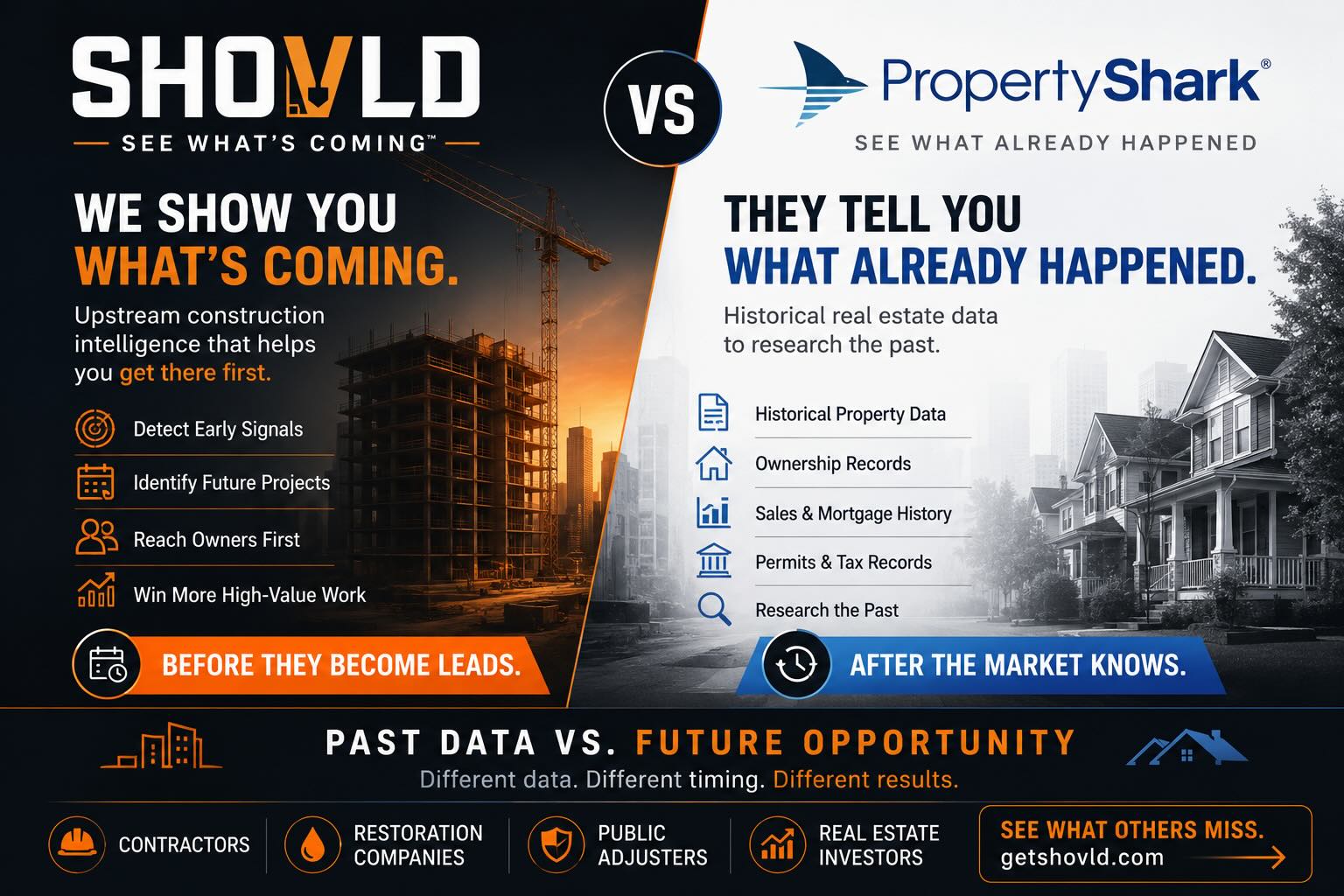
There's a version of this article that compares features. Pricing tiers. Data coverage maps. User interface screenshots.
That's not this article.
This article is about something more fundamental: the difference between a tool that shows you the past and a platform that shows you the future. Because if you're a contractor, restoration company, public adjuster, or real estate investor trying to grow your business on construction intelligence, that distinction isn't academic. It's the difference between chasing work and being positioned for it before anyone else knows it exists.
Let's talk about that.
What PropertyShark Actually Is
PropertyShark is a real estate data platform. It aggregates property ownership records, mortgage history, pre-foreclosure filings, sales comps, tax data, and permit records. It's used primarily by real estate investors, agents, and wholesalers who want to research a specific property or find distressed assets.
It's a solid tool for what it was built to do. The data coverage is strong in major metros. The interface surfaces detailed ownership chains. If you want to understand what happened to a property — who owns it, what it sold for, what liens are attached, whether it has open violations — PropertyShark gives you a clear picture.
That's exactly the problem.
PropertyShark is a rearview mirror. It tells you what already happened. It answers the question: what is the status of this property right now? What it cannot answer — what it was never designed to answer — is the question that actually matters to contractors and construction operators:
What projects are developing right now that nobody has bid on yet?
If you're searching for a PropertyShark alternative that goes beyond static property data into active opportunity intelligence, that question is where the conversation starts.
What SHOVLD Actually Does
SHOVLD is a property intelligence platform built around a fundamentally different question: what are the signals that precede construction projects, and how do you surface them before they become leads?
This is upstream intelligence. Not property data — project intelligence. There's a difference.
Think about how construction projects actually develop. A multifamily building doesn't need a roof replacement because someone finally called a contractor. It needs a roof replacement because years of deferred maintenance, aging materials, capital planning delays, and insurance pressure finally converged into a decision. Long before that decision is made, signals exist: reserve study findings, HOA board discussions, aging HVAC systems, water intrusion patterns, code violations, prior inspection reports, insurance-driven repair mandates.
Those signals don't show up in ownership records. They don't appear in sales comps or mortgage history. They live in the operational reality of the building itself — and they're visible to anyone who knows where to look.
But SHOVLD doesn't just show you the signals. It completes the workflow that most contractor lead generation platforms leave unfinished.
Here's what that looks like end-to-end:
Signal Detection → AI Scoring → Opportunity Delivery → Owner Identification → Outreach → Win
Specifically, SHOVLD:
Aggregates pre-project signals — HOA distress, deferred maintenance indicators, aging infrastructure patterns, insurance-driven repair cycles, code violations, and permit activity
AI-scores every opportunity — so you're not sifting through raw data; you're seeing ranked, prioritized properties most likely to need your services in the near term
Delivers daily opportunity reports — your pipeline refreshes automatically, organized by opportunity type and urgency
Enriches contact data — identifying property owners, decision-makers, HOA board members, and management company contacts associated with each opportunity
Generates AI-drafted outreach — personalized messaging built around the specific signal that triggered the opportunity, so your first contact is relevant and timed correctly
Executes SMS and email campaigns — directly from the platform, so the gap between identifying an opportunity and reaching the right person is measured in minutes, not weeks
Tracks opportunity progress — so you know which properties you've contacted, which are in conversation, and which have converted to active projects
PropertyShark shows you who owns the building. SHOVLD shows you which buildings are about to need your services, who makes the decision, and gives you the tools to reach them first.
The Real Question Nobody Is Asking
Here's something the construction industry consistently gets wrong about real estate investing tools and lead generation platforms: it conflates data access with market timing.
Contractors and investors spend thousands of dollars on platforms that give them access to more data — property records, ownership lookups, tax delinquency lists, pre-foreclosure notices. And they walk away thinking they've solved the problem of finding work.
They haven't. They've just gotten faster at finding what everyone else already knows.
By the time a property appears on a pre-foreclosure list, dozens of investors have already made offers. By the time a permit gets pulled on a real estate data platform, two or three contractors have already visited the site. By the time a homeowner posts a project on a lead generation platform, the property has already entered a stage where urgency — not expertise — wins the bid.
The contractors and investors who consistently win high-margin work aren't better at searching databases. They're better at reading signals before the database catches up.
That's not a subtle distinction. It's the entire game.
The Opportunity Timeline
Most real estate investor software and contractor tools operate at the bottom of the opportunity timeline — after the need is obvious, the owner is motivated, and the market has already responded.
SHOVLD operates at the top.
Here's what both timelines look like in practice:
The SHOVLD Timeline (Upstream)
Deferred Maintenance Detected
        ↓
HOA Discussions & Reserve Studies
        ↓
Permit Activity & Code Violations
        ↓
AI Opportunity Score Generated
        ↓
Daily Delivery to Your Pipeline
        ↓
Owner & Decision-Maker Identified
        ↓
AI-Generated Outreach Sent
        ↓
Project Awarded — Before Competitors Know It Exists
The Traditional Timeline (Downstream)
Property Distress Becomes Visible
        ↓
Owner Searches Google
        ↓
Project Posted to Lead Platform
        ↓
Multiple Contractor Quotes Requested
        ↓
Price Competition
        ↓
Race to the Bottom
The gap between those two timelines — from "deferred maintenance detected" to "owner searches Google" — can be anywhere from two months to two years depending on property type. In that window, the relationship is there to be built, the scope is there to be shaped, and the trust is there to be established. All before the first competitor shows up.
That window is where the money is. And it's invisible to every real estate investor software tool built around downstream data, including PropertyShark.
Understanding this timeline also changes how you think about distressed property data — distress doesn't start with foreclosure. It starts months or years earlier, in the operational signals of the building itself.
SHOVLD vs PropertyShark: Feature Comparison
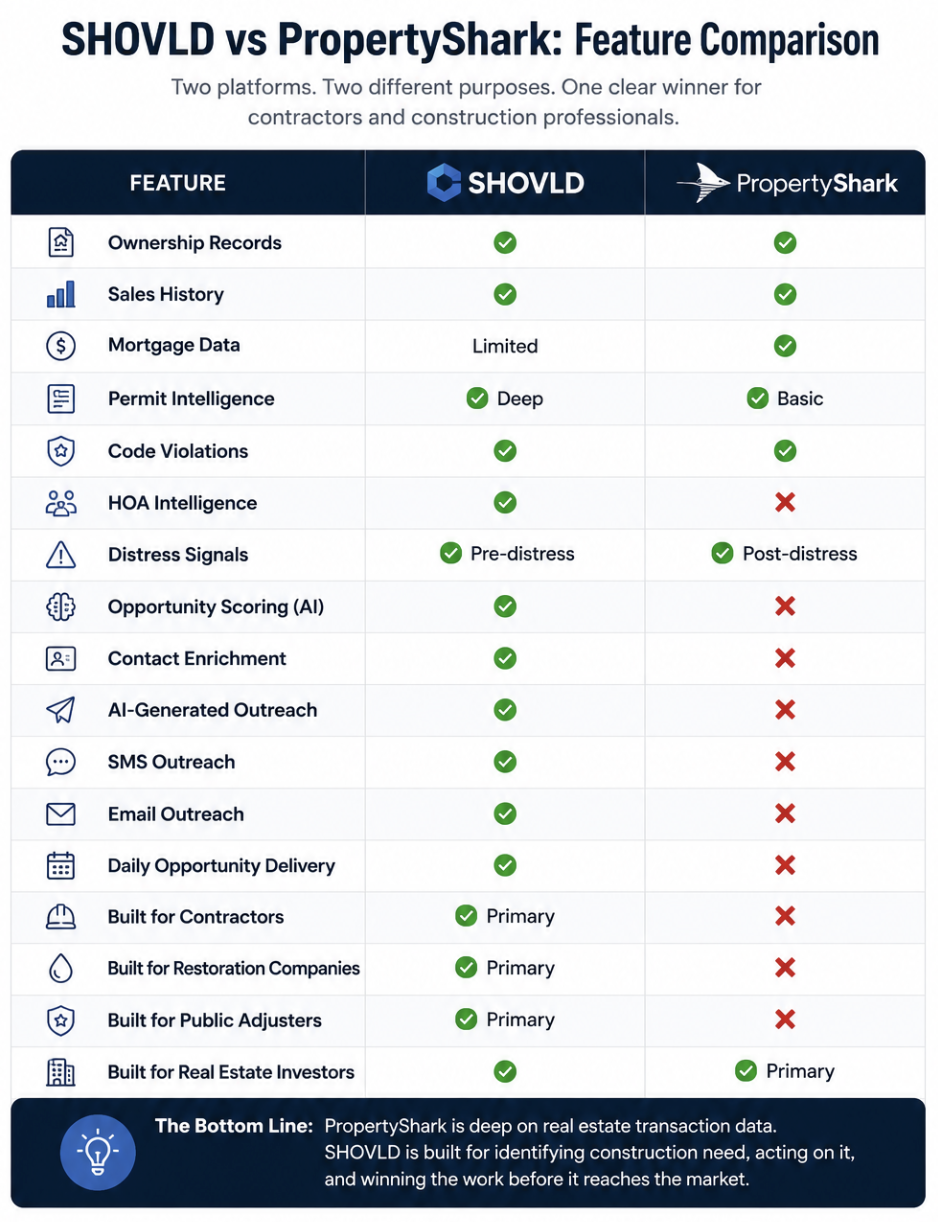
The pattern is clear. PropertyShark is deep on real estate transaction data. SHOVLD is built for identifying construction need, acting on it, and winning the work before it reaches the market.
Who Should Use SHOVLD vs PropertyShark?
The honest answer is that these aren't competing for the same user. Here's how to think about which platform fits your business.
Contractors (General, Roofing, HVAC, Plumbing) Use SHOVLD. Your revenue comes from construction projects, not property transactions. You need to know which buildings are approaching a maintenance threshold — not who bought what at what price. SHOVLD's daily opportunity delivery, AI scoring, and outreach tools are built for exactly this workflow. PropertyShark gives you property data with no path to a project.
Roofers Use SHOVLD. Roof replacement cycles are predictable. Storm patterns create geographic opportunity clusters. Insurance-driven repair mandates are signals. SHOVLD surfaces all of these before the homeowner or HOA board makes a single call.
Restoration Companies Use SHOVLD. Water intrusion, mold conditions, and structural deterioration leave detectable signals well before emergency calls come in. Proactive identification of at-risk properties — and direct outreach to property managers and owners — is a fundamentally better growth model than waiting for the phone to ring. See what SHOVLD is for a full breakdown of how restoration operators use the platform.
Water Mitigation and Mold Remediation Firms Use SHOVLD. These businesses live and die on timing. A water mitigation company that reaches a property manager before they've Googled anyone is in a completely different position than one submitting a quote alongside three others. SHOVLD identifies the properties with active risk signals. You get there first.
Public Adjusters Use SHOVLD. Public adjusters need to find policyholders with legitimate claims before they've signed with the wrong adjuster or accepted an undervalued settlement. SHOVLD's distress signal detection and contact enrichment create exactly the early-identification workflow public adjusters need.
Real Estate Investors Both, for different purposes. PropertyShark is legitimately useful for investor due diligence — ownership chains, liens, sales history, pre-foreclosure filings. If you're researching a specific property you've already identified, PropertyShark is worth having. If you're looking for properties to target before they become widely known as distressed opportunities, SHOVLD's upstream signals give you an edge that PropertyShark can't. Review our public record investor due diligence checklist for a broader picture of what robust pre-acquisition research looks like.
Wholesalers SHOVLD with PropertyShark for verification. SHOVLD can surface motivated-seller signals before distress is public. PropertyShark can verify the ownership and financial picture once you've identified a target. Used together, they cover the full research workflow.
Property Managers Use SHOVLD. Forward-looking infrastructure monitoring — identifying which properties in your portfolio are approaching maintenance thresholds — is exactly what SHOVLD's signal intelligence provides. It turns reactive maintenance into planned capital improvement.
The Compounding Effect of Early Intelligence
One more thing worth understanding: the value of upstream intelligence isn't just about winning individual projects earlier. It's about what compounds over time when your business runs on proactive positioning rather than reactive bidding.
When a contractor or investor consistently shows up early — consulting, advising, building trust before the bid — they stop being a commodity vendor. They become the default call. The relationship doesn't start at the bid table; it starts months earlier, when someone noticed the signal and reached out with something relevant.
That positioning is nearly impossible to replicate through late-stage lead generation. By the time a competitor finds the project on a platform, the relationship is already built. The bid is almost a formality.
No amount of ownership records and permit history will put you in front of a building owner six months before they've decided to act.
SHOVLD can put you there. And then help you send the right message, to the right person, at the right time — automatically.
Where PropertyShark Wins
This isn't a takedown piece. PropertyShark does specific things well, and it's worth being precise about them.
Ownership research: If you've identified a property and need a complete ownership picture — current owner, prior sales, lien history, tax records — PropertyShark is fast and thorough. For real estate investors doing due diligence on a specific asset, it's genuinely useful.
Pre-foreclosure lists: PropertyShark surfaces pre-foreclosure filings early. If your business model involves finding distressed owners before the bank forecloses, this is relevant data — though understand you're operating at the bottom of the opportunity timeline, not the top.
Market analysis: Real estate professionals using PropertyShark for sales comps and neighborhood-level market analysis get solid coverage in the markets where PropertyShark's data is strong.
For real estate professionals doing transaction research, PropertyShark is a legitimate tool. For contractors, restoration operators, and construction-focused investors looking to find opportunity before it goes to market, it's the wrong instrument for the job.
If PropertyShark alternatives are what you're evaluating, the key question is: do you need better property research, or do you need earlier opportunity visibility? Those are different problems that require different platforms.
The Platform Mismatch Nobody Admits
Here's the uncomfortable reality about how most contractors and investors evaluate real estate investing tools: they compare feature lists without asking what problem the tool was actually designed to solve.
PropertyShark was designed for real estate investors and agents. It solves a real estate research problem. When contractors adopt it — because the data sounds relevant, because ownership records are useful, because permit history is something they understand — they're using a real estate tool to solve a construction problem. The fit is partial at best.
SHOVLD was designed for contractors, restoration operators, public adjusters, and construction-focused investors. Every data layer it surfaces is organized around the question of where construction need is developing and who can be reached before anyone else gets there.
These are related markets, but they're not the same market. Treating them as interchangeable is why a lot of operators end up with expensive subscriptions to platforms that give them data without giving them competitive advantage.
The Bottom Line
If you need to research a specific property — who owns it, what it's worth, what its transaction history looks like — PropertyShark is a legitimate tool. Use it for what it was built for.
If you're a contractor, restoration company, public adjuster, or real estate investor trying to find work before it becomes a lead, before it hits a bid platform, before the timing gap closes and you're competing on price alongside four other operators — PropertyShark is the wrong answer to the right question.
The right question isn't who owns the building.
It's which buildings are about to need me — and how do I get there first, reach the right person, and win the project before the market wakes up?
That's the question SHOVLD was built to answer. From signal detection to AI scoring to daily delivery to owner identification to outreach — the entire workflow, in one platform.
Try SHOVLD Free for 7 Days
Contractors, restoration companies, public adjusters, and real estate investors use SHOVLD to identify opportunities before they become leads — then act on them with AI-powered outreach before competitors know the project exists.
Your first week is free. No commitment. Real opportunities in your market, delivered to your pipeline starting day one.
If you're still evaluating your options, these resources are worth reading first:
What Is SHOVLD? — A full breakdown of how the platform works
Best Alternative to Lead Generation for Contractors — Why timing beats volume every time
How to Identify Pre-Foreclosure Properties Early — Upstream signals most investors never see
Distress Doesn't Start With Foreclosure — Understanding the full opportunity timeline
SHOVLD Pricing — Plans for contractors, restoration companies, public adjusters, and investors
SHOVLD is a construction market intelligence platform helping contractors, restoration companies, public adjusters, and real estate investors identify project opportunities before they become leads.