
Signal Intelligence in Real Estate: 2026 Investor Guide
Signal intelligence in real estate is defined as the automated use of AI-driven data aggregation to identify off-market investment opportunities by monitoring legal filings, demographic shifts, permit activity, and buyer behavior in real time. The industry term for this practice is real estate market intelligence, but signal intelligence captures its most powerful function: reading weak signals before they become loud listings. Platforms like Shovld have made this approach accessible to investors and agents who want to act before the market reacts. If you are still relying on MLS data alone, you are seeing opportunities after everyone else already has.
What is signal intelligence in real estate?
Signal intelligence in real estate is an automated process that leverages diverse data streams to identify opportunities missed by traditional MLS analysis. It pulls from municipal records, behavioral data, and predictive modeling to surface deals that have not yet reached public portals like Zillow or Realtor.com. The goal is simple: find motivated sellers and emerging markets before the crowd does.
Traditional real estate analysis tells you what happened. Signal intelligence tells you what is about to happen. That difference is the entire competitive advantage.
AI plays the central role here. It processes thousands of data points across court filings, permit records, and lead engagement patterns simultaneously. No human team can match that speed or scale. The result is a continuous, scored feed of opportunities ranked by urgency and likelihood of conversion.

How does signal intelligence differ from traditional real estate data?
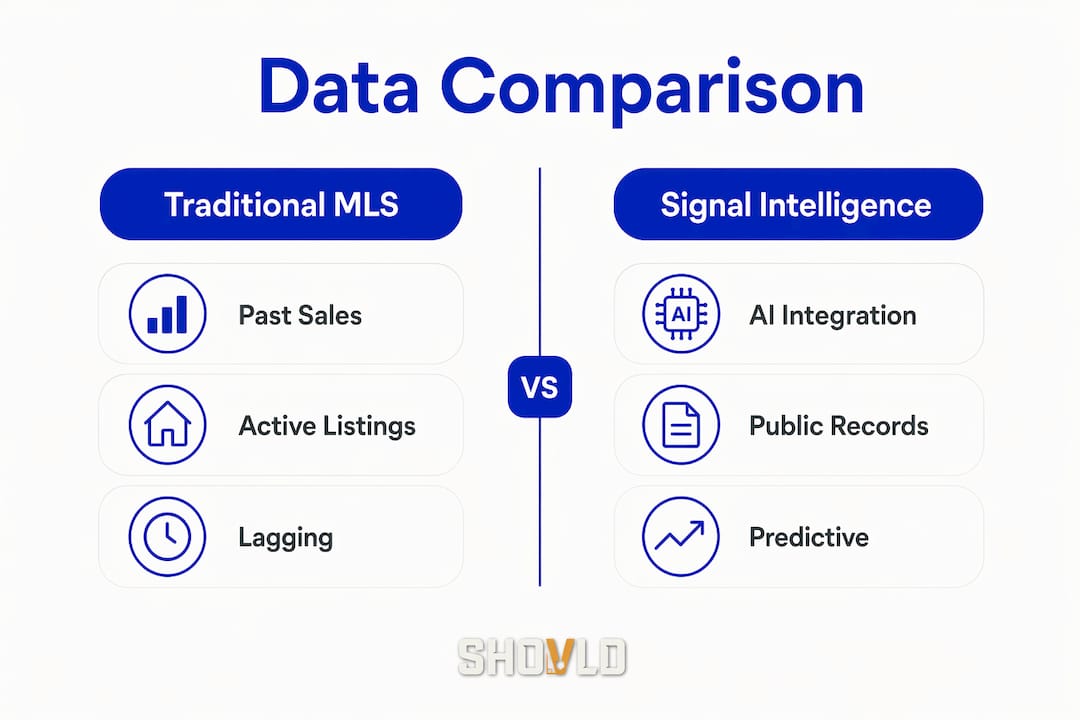
Traditional real estate data relies heavily on past sales records and lacks the predictive analytics available through signal intelligence. MLS data shows closed transactions. Signal intelligence shows what is in motion right now.
The contrast becomes clear when you look at what each method actually tracks:
FeatureTraditional MLS DataSignal IntelligenceData sourceClosed sales, active listingsMunicipal records, court filings, permits, behavioral dataTimingLagging indicatorLeading indicatorPredictive powerLowHighOff-market visibilityNoneCore functionAI integrationMinimalCentral to operationUpdate frequencyDays to weeksDaily or real-time
Signal intelligence integrates demographic and economic data to predict market shifts and future value. That means you are not just tracking what sold last quarter. You are tracking which neighborhoods are about to shift, which owners are under financial pressure, and which properties are heading toward distress before anyone lists them.
The practical implication is significant. An investor using MLS data competes with every other buyer who saw the same listing. An investor using signal intelligence often reaches the seller weeks or months before that listing ever appears.
What data sources power real estate signal intelligence?
Authorities Having Jurisdiction (AHJs) provide the primary raw data sources for signal intelligence. These include courts, county recorders, tax collectors, assessors, and code enforcement agencies. Direct data pulls from AHJs deliver filing data daily or monthly, offering a speed advantage over aggregated platforms that sanitize and delay that same information.
The most valuable signals fall into two categories: distress signals and behavioral signals.
Distress signals from public records:
Foreclosure filings and lis pendens notices
Probate filings triggered by inheritance or estate settlement
Tax delinquency notices from county tax collectors
Eviction filings from local courts
Code violations and repeated municipal citations
HOA enforcement actions and lien filings
Behavioral signals from digital engagement:
Repeated property views on listing platforms within a short window
Lead re-engagement after weeks of inactivity
Inquiry language that signals urgency or financial pressure
Social media follows of investor or agent accounts after property searches
Distress intelligence monitors probate filings, tax delinquencies, and code issues to contact motivated sellers 30–120 days before listings appear publicly. Early insights on life events such as inheritance or divorce create outreach windows that simply do not exist for agents relying on portal data.
Pro Tip: Pull raw data directly from AHJs rather than relying on resale data lists. Aggregators clean and delay the same records. Going to the source gives you a timing edge that no competitor using a third-party list can match.
How does AI improve signal intelligence accuracy?
AI consolidates multi-channel behavioral signals into composite scores that improve lead quality and targeting. Cross-channel stacking of website visits, social media follows, and call interactions refines intent assessments in ways that manual review cannot replicate.
The behavioral scoring model works by weighting signals based on their predictive strength:
High-intent signals: Multiple property views within a single week, re-engagement after 30 or more days of inactivity, inquiry language containing words like “as-is,” “quick close,” or “cash offer”
Medium-intent signals: Single property view, email open without reply, social media follow after a property search
Low-intent signals: Generic form submission, one-time site visit with no return
AI-driven behavioral scoring classifies leads by repeated visits, inquiry language, and re-engagement timing, saving agents 8–12 hours per week. That time savings compounds. Over a month, it frees up 32–48 hours that would otherwise go to manually sorting cold leads from warm ones.
The real power comes from stacking signals. A lead who views a property three times in five days, re-engages after two weeks of silence, and submits an inquiry using urgency language is not just a warm lead. That is a high-probability seller. AI identifies that pattern instantly. A human reviewing a CRM spreadsheet might catch it eventually, or might not catch it at all.
Pro Tip: Integrate your AI scoring model directly into your CRM workflow using tools like automated lead follow-up systems. Scored leads should trigger automated outreach sequences so that high-intent contacts receive a response within minutes, not hours.
What are the practical applications for investors and agents?
Signal intelligence changes market strategy from assumption-driven to evidence-based investment decisions. Here is how that plays out in practice across five core applications:
Early motivated seller identification. Probate and tax delinquency filings flag owners under financial or life-event pressure before they list. An investor who reaches out at this stage faces no competition from other buyers because no listing exists yet.
Neighborhood value shift prediction. Permit data reveals where construction activity is accelerating. A cluster of renovation permits in a previously quiet zip code signals rising demand before price appreciation shows up in MLS comps. Shovld tracks permit data patterns across multiple U.S. markets for exactly this reason.
Speed as a competitive weapon. Investors who see filings the day they happen gain a 30–120 day lead time over commercial aggregators. That window is the difference between a direct conversation with a motivated seller and a bidding war on a publicly listed property.
Pipeline building without cold outreach. Signal intelligence replaces random prospecting with a scored list of properties and owners who already show signs of readiness. Your pipeline becomes predictable because it is built on real indicators, not guesswork.
Market entry timing. Investors entering new markets can use signal intelligence to validate demand before committing capital. Monitoring eviction rates, code violation density, and permit velocity in a target market gives you a data-backed picture of where that market is heading.
The 30–120 day lead time is not a minor edge. It is the difference between playing offense and playing defense. Agents and investors who act on signals early are not crowded around the same fire as everyone else. They have already closed the deal before the fire gets lit.
Key Takeaways
Signal intelligence in real estate gives investors and agents a measurable timing advantage by surfacing motivated sellers and emerging markets before public listings appear.
PointDetailsSignal intelligence definedIt is AI-driven data aggregation that identifies off-market opportunities from public records and behavioral data.Lead time advantageDirect AHJ data pulls deliver a 30–120 day head start over investors using aggregated commercial lists.AI behavioral scoringComposite lead scores save agents 8–12 hours per week by automating high-intent lead identification.Key data sourcesCourts, tax collectors, code enforcement, and permit offices provide the raw signals that matter most.Practical applicationEarly outreach to distressed owners, permit-based neighborhood tracking, and scored pipelines replace reactive prospecting.
Why most investors are still leaving signals on the table
The biggest mistake I see is treating signal intelligence as a data problem when it is actually a speed problem. Investors spend months building data subscriptions, cleaning spreadsheets, and setting up dashboards. By the time they act on a signal, three other investors already have. The data was never the bottleneck. The gap between signal and action was.
The second mistake is confusing noise for signals. A single property view is noise. Three views in five days followed by a re-engagement inquiry is a signal. Most agents cannot tell the difference without a scoring model because they are looking at raw activity logs, not behavioral patterns.
I have also seen investors over-rely on sanitized resale lists sold by data brokers. Those lists are real, but they are also available to every competitor who pays the same subscription fee. The actual edge comes from pulling directly from AHJs and seeing filings the day they happen. That is not a marginal improvement. It is a structural advantage.
Looking at 2026 and beyond, the role of market intelligence in real estate is shifting from a specialty tool used by institutional investors to a standard operating practice for any serious agent or investor. The professionals who build signal-reading into their daily workflow now will not be playing catch-up when the rest of the market figures this out.
— Avi
How Shovld turns public record signals into scored opportunities
Shovld is built for real estate investors, agents, and contractors who want to stop reacting to the market and start getting ahead of it. The platform monitors permits, code violations, HOA pressure, distressed-property indicators, and municipal records across multiple U.S. markets, then scores each opportunity so you know exactly where to focus.

You do not need to build your own data pipeline or manually track AHJ filings. Shovld does that work automatically and delivers verified, scored leads directly to your workflow. Whether you are sourcing off-market acquisitions or building a predictable project pipeline, the platform gives you the early visibility that separates proactive investors from reactive ones. Review Shovld’s pricing plans to find the right fit for your market and volume, or learn more about how Shovld works before you commit.
FAQ
What is signal intelligence in real estate?
Signal intelligence in real estate is the automated use of AI and public record monitoring to identify off-market investment opportunities before they appear on listing portals. It draws from court filings, permit data, tax records, and behavioral signals to surface motivated sellers and emerging markets early.
How does signal intelligence differ from MLS data?
MLS data is a lagging indicator showing what has already sold or listed. Signal intelligence is a leading indicator that tracks distress filings, permit activity, and behavioral patterns to predict what is about to happen in a market.
What is the lead time advantage of signal intelligence?
Investors who pull data directly from Authorities Having Jurisdiction can gain a 30–120 day lead time over competitors using commercial aggregators. That window allows direct outreach to motivated sellers before any public listing exists.
How does AI behavioral scoring work for real estate leads?
AI scores leads by weighting signals like repeat property views, re-engagement after inactivity, and urgency-based inquiry language into a composite intent score. This process saves agents 8–12 hours per week by automating lead prioritization.
What public records are most useful for signal intelligence?
The most predictive records include foreclosure filings, probate notices, tax delinquency notices, eviction filings, and code violation reports. These come directly from courts, county recorders, tax collectors, and code enforcement agencies at the local level.