
How AI Helps Public Adjusters Find Clients Earlier
AI turns scattered public signals into scored, prioritized opportunities so public adjusters can contact property owners before competitors even know a loss occurred. The fastest next step: connect a permit or storm-event feed to your CRM and set a 5-minute response SLA.
TL;DR:
AI monitors building permits, code violations, weather events, and HOA notices to surface high-probability claim opportunities in near real time.
Predictive scoring ranks leads by damage likelihood, property value, and owner contactability so you work the best prospects first.
Automated outreach sequences fire within hours of detection, compressing the contact window that separates winners from also-rans.
Table of Contents
How AI helps public adjusters find clients through signal intelligence
Which AI capabilities actually move the needle for prospecting
A 6-step playbook to start finding clients with AI this month
U.S. legal and ethical rules you must follow for AI-driven outreach
How Shovld helps public adjusters act earlier than the competition
How AI helps public adjusters find clients through signal intelligence
Most adjusters are still waiting for the phone to ring or chasing the same storm-chaser lists everyone else bought. AI flips that dynamic by monitoring public records continuously and surfacing opportunities before the crowd arrives.
The core data sources AI aggregates include:
Building and roofing permits pulled from municipal portals, which signal active construction or repair that may reveal prior damage.
Code violations and enforcement notices, which often precede insurance disputes or deferred-maintenance claims.
HOA repair notices and municipal filings, which indicate property stress the owner may not have escalated to a carrier yet.
Storm footprint data from hail, wind, and fire events, cross-referenced against parcel maps to identify affected addresses.
Foreclosure and tax-lien activity, which correlates with underfunded repairs and contested claims.
Imagery-based deferred-maintenance signals, where AI flags visible deterioration that property-level attributes confirm as high-risk.
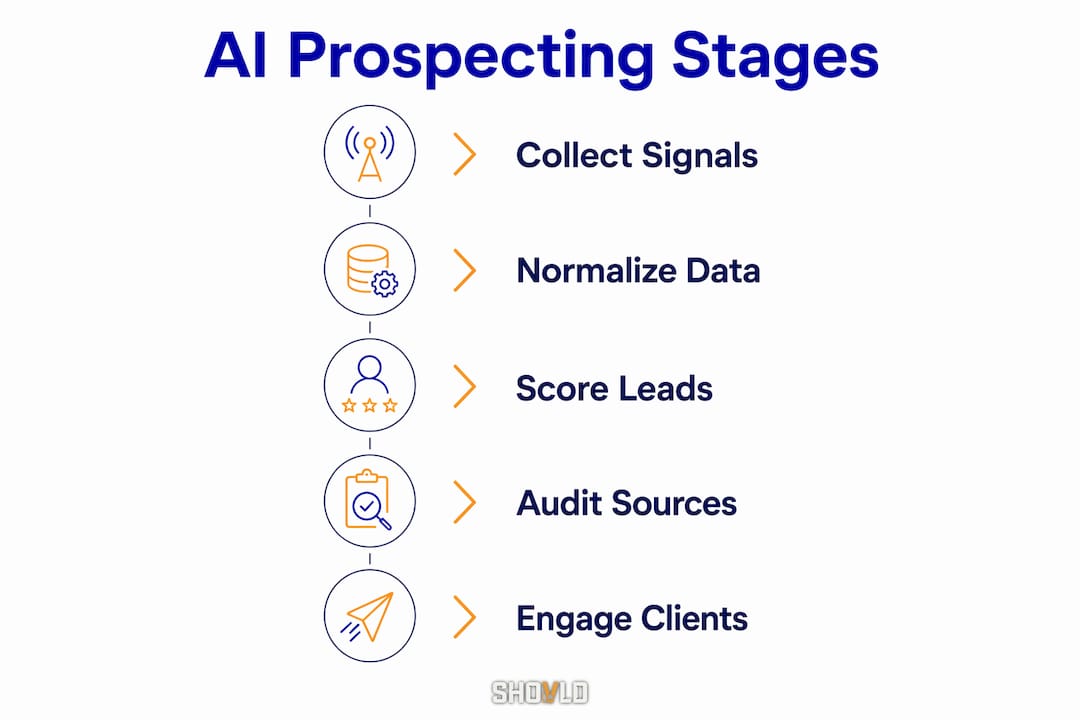
The pipeline runs in four stages: collect raw signals from public APIs and data vendors, normalize and deduplicate across sources, enrich each record with ownership data and property attributes (roof age, year built, estimated value), then score by damage probability and business fit. Storm footprints and large permitting spikes indicate urgency. Deferred-maintenance patterns are longer-lead but often less competitive.
Which AI capabilities actually move the needle for prospecting
Not every “AI-powered” tool delivers the same value. The capabilities that genuinely drive client acquisition for adjusters are:
CapabilityWhy It MattersSignal aggregationPulls permits, violations, and weather data into one feed so nothing slips throughGeospatial event detectionMaps storm footprints to parcels for immediate, address-level targetingLead scoring / predictive modelsRanks by damage probability, property value, and ICP fit to cut wasted outreachContact enrichment (reverse-append)Attaches owner name, phone, and email to a parcel record automaticallyNLP outreach personalizationDrafts event-specific messages referencing the actual permit or storm dateCRM / webhook integrationPushes scored leads directly into your workflow without manual data entrySource auditabilityLinks every AI suggestion back to the underlying permit, weather report, or filing

Auditability is the capability most adjusters overlook. Platforms that surface the source document behind each recommendation let you validate before you dial. Without it, you are trusting a black box, and one bad outreach call based on a hallucinated address can cost you a referral relationship.
Pro Tip: Before signing with any AI prospecting vendor, ask them to show you the source citation for a sample lead. If they cannot display the underlying permit or weather snapshot, that is a red flag worth acting on.
A 6-step playbook to start finding clients with AI this month
A repeatable client-acquisition engine beats reactive storm-chasing every time. Here is a practical sequence a solo adjuster or small firm can run in the first 30 days.
Define your ICP. Identify the claim types, property values, and ZIP codes where your firm closes fastest and earns the most. This filters signal noise immediately.
Connect signal feeds. Subscribe to permit webhooks, storm-event APIs, and code-violation feeds for your target geography. Start with one or two ZIP codes.
Map signals to your CRM. Use webhooks or a native integration to auto-create lead records the moment a qualifying signal fires.
Build scoring rules. Weight leads by event severity, roof age, property value, and owner-occupied status. High scores go to the top of the daily call list.
Automate prioritized outreach. Set up a sequence: SMS or email within the first hour, a follow-up call script for day two, and a partner referral ping if no response by day three.
Measure and iterate. Track lead volume, contact rate, appointment rate, and cost per lead weekly. Adjust scoring weights based on what actually converts.
Roles and tools at a glance:
RoleResponsibilityToolsOwner / principalICP definition, scoring rules, compliance sign-offSignal platform, CRMIntake coordinatorLead triage, CRM hygiene, outreach sequencingCRM, SMS/email providerField adjusterRapid verification, first-call opener, site inspectionMobile CRM, checklistMarketing leadPartner content, GBP updates, paid targetingGBP, social ads, email
Rapid-verify checklist for the first call:
Confirm property address and ownership match the signal record.
Ask one open question about the event (“Did you notice any roof or interior damage after the storm?”).
Qualify carrier status: filed, pending, or not yet reported.
Offer a free, no-obligation damage review as the next step.
Tactics and templates you can use in days, not months
Speed matters most right after an event. Automated storm-lead systems can detect hail or wind events, identify properties in the footprint, and fire outreach within 2–4 hours of detection. Here are templates you can deploy immediately.
Storm-affected homeowner email:
Subject: Quick question about [City] storm damage on [Date] “Hi [Name], I noticed your property at [Address] was in the path of last week’s hail event. Many homeowners in your area are finding damage their carrier missed on the first inspection. I offer a free review at no cost to you. Would 15 minutes this week work?”
Investor / commercial property manager email:
Subject: Permit activity flagged at [Address] “Hi [Name], a recent permit pull at your property caught my attention. If there’s an open or underpaid claim tied to that work, I can review it at no charge. Happy to connect this week.”
First-call phone script bullets:
Open with the specific event or permit date, not a generic pitch.
Lead with the free review offer in the first 20 seconds.
Ask about carrier response before mentioning your fee structure.
Close with a specific time slot, not “let me know when you’re free.”
Google Business Profile quick wins:
Add “storm damage claim review” and “insurance claim help” as service keywords in your GBP description.
Post a field photo with a brief caption within 24 hours of a local event.
Local SEO for adjusters works best when educational content is consistent, not just event-reactive.
Ask every closed client for a Google review that mentions the claim type and city.
U.S. legal and ethical rules you must follow for AI-driven outreach
Automated prospecting carries real compliance exposure. Follow this checklist before scaling any outreach campaign.
TCPA compliance: Obtain prior express written consent before sending marketing SMS messages. Scrub lists against the National Do Not Call Registry before any phone outreach.
CAN-SPAM compliance: Every commercial email must include a physical mailing address, a clear opt-out mechanism, and an honest subject line. Honor opt-outs within 10 business days.
State insurance department rules: Several states restrict how public adjusters solicit clients after a declared disaster. Check your state’s department of insurance regulations before launching post-event campaigns.
Data vendor contracts: Require contract language that prohibits your vendor from reselling your client data or using it to train external AI models.
Record-keeping: Log consent records, opt-out requests, and outreach timestamps. If a complaint arises, documentation is your defense.
Legal counsel: Before running a large-scale automated campaign across multiple states, consult an attorney familiar with both insurance solicitation rules and the FTC’s guidelines on automated marketing.
Key compliance principle: Public records are legally accessible, but how you use them for outreach is regulated. The data source being public does not make the outreach automatically lawful. Consent, opt-out, and state solicitation rules apply regardless of where the lead originated.
This article is general information, not legal advice. Confirm current rules with your state’s department of insurance or a qualified attorney before launching automated outreach campaigns.
How to measure ROI and set realistic milestones
Set these KPIs before you launch, not after.
KPIDefinition30-Day Target90-Day TargetLead volumeScored leads entering CRM per weekBaseline established20+ per weekContact rate—Track only—Appointment rateLeads converting to site visitTrack only>15%Close rateAppointments converting to signed PATrack only—Cost per leadTotal platform cost / leads generatedEstablish benchmarkTrending down
Milestone roadmap:
Days 1–30: Connect feeds, establish baseline KPIs, run first outreach sequences manually to validate messaging.
Days 31–90: Optimize scoring weights based on real conversion data, automate top-performing sequences, hit appointment targets.
Days 91–180: Scale to adjacent ZIP codes or counties, add partner co-marketing automation, and build a referral loop with local contractor partners who can flag damage before permits are even pulled.
For attribution, tag every CRM lead with its source signal (permit, storm event, code violation) at creation. When a deal closes, that tag tells you which feed is generating real revenue, not just volume.
How Shovld helps public adjusters act earlier than the competition
Shovld is built around one premise: the adjuster who arrives first wins. The platform aggregates public signals across permits, code filings, HOA notices, and deferred-maintenance indicators, then scores each opportunity against your ICP before routing it to your CRM.
Core features for public adjusters:
Real-time permit and code-violation feeds across multiple U.S. markets.
Storm-event detection with parcel-level matching and owner contact enrichment.
Opportunity scoring weighted by event severity, property vulnerability, and business fit.
CRM webhooks that create lead records automatically, no manual import required.
Source citations on every AI suggestion so you can audit the underlying permit or weather snapshot before outreach.
Example workflow: A hail event triggers in your target ZIP. Shovld detects the storm footprint, matches affected parcels to ownership records, scores each property, and pushes the top 10 leads into your CRM within hours. Your intake coordinator sees a prioritized call list with the event date, property details, and owner contact already populated. The field adjuster calls from a verified record, not a cold list.
Why source citations matter: Every Shovld recommendation links back to the primary public record that generated it. Adjusters can open the underlying permit or weather snapshot before making a single call, which means no hallucinated addresses and no wasted outreach on properties that were never in the event footprint.
A 30-day single-ZIP pilot is the fastest way to validate signal quality and conversion before committing to broader coverage. It surfaces false-positive rates, contact enrichment accuracy, and downstream conversion data with minimal upfront investment.
Key Takeaways
AI-driven signal intelligence gives public adjusters a decisive timing advantage by converting public records into scored, contact-ready leads before competitors arrive at the same properties.
PointDetailsAct on public signals firstPermits, code violations, and storm footprints are the earliest indicators of upcoming claims.Score before you dialWeight leads by event severity, roof age, and property value to prioritize the highest-conversion prospects.Speed to contact winsReaching a property owner within the first hour after an event materially increases close odds.Compliance is non-optionalTCPA, CAN-SPAM, and state solicitation rules apply to every automated outreach campaign, regardless of data source.Shovld as your signal feedShovld routes scored, source-verified opportunities directly into your CRM so your team works verified leads, not raw lists.
Why programmatic prospecting beats reactive storm-chasing
The public adjusting industry has a timing problem, and most firms are solving it the wrong way. They invest in better sales scripts when the real gap is earlier visibility. By the time a storm-chaser list hits your inbox, every adjuster in your market has the same names. You are not competing on skill at that point. You are competing on price.
Programmatic signal monitoring changes the math. When your pipeline is fed by permit activity, code-enforcement patterns, and weather events rather than purchased lists, you are consistently reaching property owners before the conversation becomes a commodity. That is not a marginal improvement. It is a structural advantage that compounds over time as your contact rates, referral relationships, and local reputation all build on the same foundation.
The adjusters who will own their markets in the next three years are not the ones with the biggest ad budgets. They are the ones who built a predictable pipeline from public data and showed up first, every time.
See what Shovld can do for your prospecting pipeline
Public adjusters who are tired of chasing the same storm lists as everyone else have a concrete alternative. Shovld delivers scored, source-verified opportunities from permits, code violations, and weather events directly into your CRM, so your team spends time on verified prospects instead of raw data cleanup.
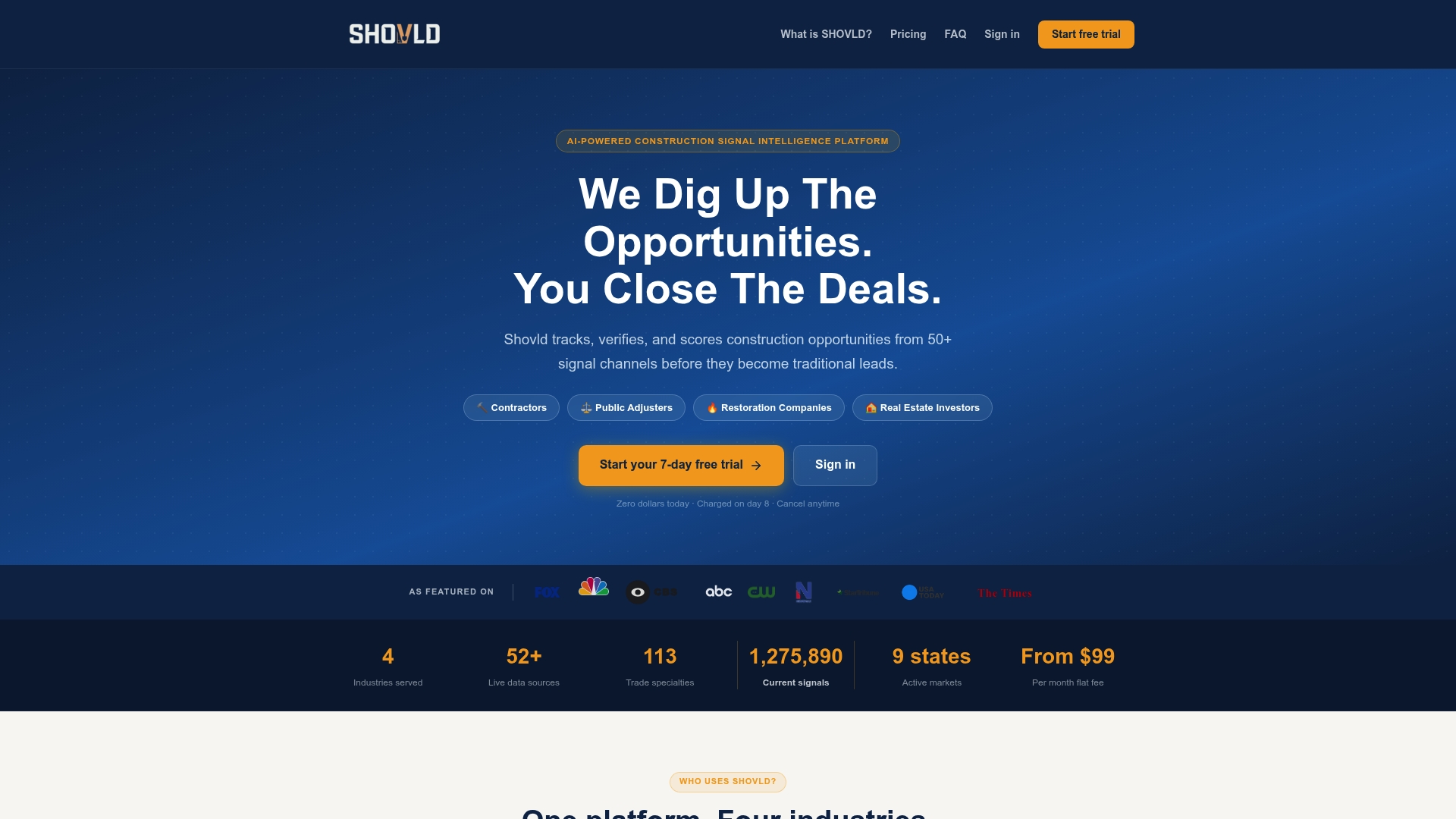
Single adjusters typically start on an entry-level plan covering one to three ZIP codes. Small firms running multiple adjusters scale to county or state coverage as conversion data justifies it. Either way, the recommended starting point is a 30-day pilot on one ZIP code to validate signal quality, contact enrichment accuracy, and conversion before expanding. No large upfront commitment, no guesswork about whether the signals match your market.
Request a demo or review plan options at getshovld.com/pricing and connect your first feed this week.
Useful sources and further reading
The claims and guidance in this article draw from the following authoritative sources. Compliance references point to primary regulatory bodies; workflow and signal-source guidance draws from practitioner playbooks and platform documentation.
How to get leads as a public adjuster — local SEO and GBP optimization tactics for adjusters.
Creating a Client Acquisition Playbook for Public Adjusters — partner referral systems and repeatable acquisition frameworks.
Storm Lead AI Machine — end-to-end automated storm-lead pipeline and speed-to-lead benchmarks.
Shovld Signal Intelligence Platform — signal feeds, scoring methodology, and pilot program structure.
Shovld Pricing Plans — plan tiers for single adjusters and small firms.
How AI finds contractor opportunities — signal aggregation and co-branded content strategies.
FTC — Federal Trade Commission — CAN-SPAM Act guidance and automated marketing compliance standards.