
Find Commercial Renovation Projects Early: A Signal Playbook
The fastest repeatable method to find commercial renovation projects early is to monitor five public-record signal types, score each one against a lightweight rubric, and reach the property owner before a permit is even issued. Most contractors wait for a permit to appear on a municipal portal — by then, the GC slot is often filled. The contractors winning those jobs consistently are pulling signals two to eight weeks earlier, from code violations, zoning variance filings, and county assessor ownership changes.
The timing problem is the whole game. A permit posted on a city portal is already a crowded opportunity. The signal that precedes it — a stop-work order, a variance application, a tax-delinquency notice — is where the real lead lives.
Shovld’s AI-powered signal intelligence platform is built around exactly this logic: ingest public records, apply a scoring model, and deliver CRM-ready leads before the broader market reacts.
Table of Contents
Which public-record signals reliably predict commercial renovation work?
The Paisley Project: what early signals would have looked like
Shovld turns public-record signals into your next commercial job
Which public-record signals reliably predict commercial renovation work?
Not all signals carry equal weight. Here are the top signals ranked by usefulness, with typical lead times and project-size indicators.
Building permits (alteration/tenant improvement) — High priority. Lead time: 0–14 days after submission. These confirm intent and budget. Structural or MEP permits signal larger scopes; cosmetic permits flag smaller retrofits. False positives are low, but check permit valuation — anything under $10,000 is often a minor repair, not a renovation contract.
Code violations and stop-work orders — High priority. Lead time: 2–8 weeks before any permit is filed. A code violation on a commercial property almost always triggers remediation work. Multiple violations on the same parcel compound the signal. Distressed properties and foreclosure activity frequently carry stacked violations that convert into remodel jobs.
Zoning variances and conditional-use applications — High priority. Lead time: 4–12 weeks. A variance filing means the owner is planning a use change or expansion. These projects tend to be larger and more complex, often involving structural work and extended permit timelines. Large reconfiguration projects that start with a variance often have long construction schedules.
County assessor ownership changes — Medium priority. Lead time: 2–6 weeks post-close. New ownership on a commercial parcel is a strong renovation predictor, especially when the prior owner held the property for more than a decade. Pair with a tax/distress indicator to sharpen the signal.
Tax delinquency and foreclosure filings — Medium priority. Lead time: weeks to months. These signal financial pressure that often forces deferred maintenance into active remediation. Properties emerging from foreclosure frequently need water, fire, or mold remediation before any cosmetic work.
Utility disconnects and reconnect requests — Medium priority. Lead time: 1–4 weeks. A commercial utility disconnect followed by a reconnect request is a reliable pre-construction indicator, particularly for gut renovations.
HOA and property management enforcement actions — Low priority. Lead time: variable. Useful as a confirming signal when stacked with a permit or violation, but rarely sufficient on its own.
Where do you actually pull these records?
Each signal maps to a specific source. The challenge is that data accessibility varies sharply by city and county — some municipalities publish structured permit feeds; others still post PDFs.
SignalPrimary SourceRecommended CadenceBuilding permitsMunicipal building dept. portalDailyCode violationsCity code enforcement databaseWeeklyZoning variancesPlanning dept. / clerk of courtsWeeklyOwnership changesCounty assessor / parcel searchWeeklyTax delinquency / foreclosureClerk of courts, county treasurerMonthlyUtility disconnectsUtility customer-service recordsWeeklyHOA enforcementHOA public notices, management co. filingsMonthly
For permit portals specifically, check the permit application status, not just issued permits. A permit in “plan review requested” status can surface a project four to six weeks before issuance. Miami-Dade’s process is a useful model: the commercial renovation permit checklist illustrates how permit types and submission stages map to project scope.
Pro Tip: Set up email or RSS alerts on municipal portals for permit types “commercial alteration,” “tenant improvement,” and “change of occupancy.” Many city portals support keyword-filtered alerts at no cost — this alone eliminates most manual checking.

How do you score raw signals into a prioritized lead list?
A five-factor rubric keeps triage fast. Score each lead 0–100 and act on the bands below.
FactorMax PointsNotesPermit type and valuation—Structural/MEP = —; cosmetic only = 5Permit stage (pre-issuance vs. issued)20Application/plan review = 20; issued = 10Distress indicator (violation, tax, foreclosure)20Two or more stacked = 20; one = 10Ownership change within 12 months15Recent new owner = 15; long-term owner = 5Property size and commercial use type20Multi-tenant or mixed-use = 20; single-tenant = 10
Score bands:
0–30: Low priority. File for quarterly review.
31–65: Prospect. Add to CRM, assign 30-day follow-up.
66–100: Immediate outreach. Assign to your SDR or PM within 24 hours.
Red flags that drop a lead regardless of score:
Owner is a national chain with a prequalified vendor list.
Permit is demolition-only with no build permit filed or pending.
Duplicate filings from the same parcel within 30 days (consolidate into one lead).
Multi-year, high-complexity projects — like a three-year farmhouse renovation driven by site-specific value — score high on ownership intent and budget potential, but carry longer sales cycles. Weight your pipeline accordingly.
How do you verify a signal and convert it into a bid?
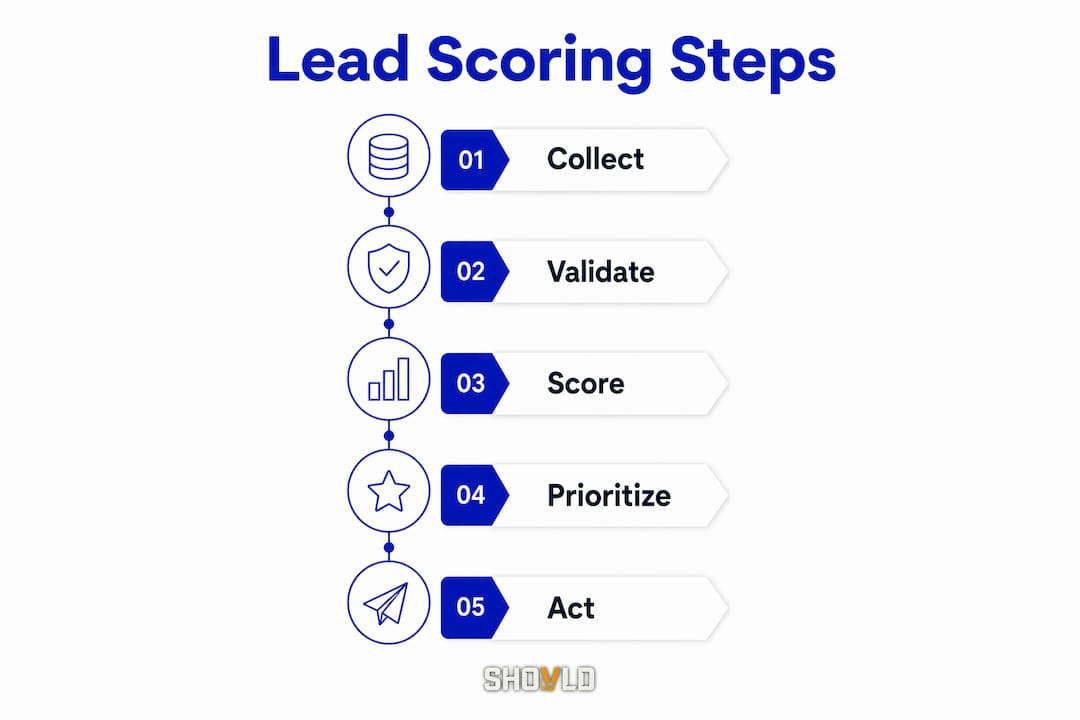
The conversion path runs in five steps, and speed matters at every one.
Same day — Initial outreach. Send a brief discovery email or SMS. Keep it under five sentences. Reference the public record by type only (“I noticed a permit application on your property at [address]”) — never claim you have private information.
Within 48 hours — Follow-up call. Leave a 20-second voicemail if no answer: your name, company, the property address, and one specific service you offer. No pitch.
Day 3–5 — Site visit. Confirm scope, access, permit holder, and budget cues in a 15–30 minute walk-through.
Day 5–7 — Preliminary scope. Deliver a one-page scope summary while the owner’s attention is still on the project.
Day 7–14 — Formal estimate. Submit the full bid with timeline and materials breakdown.
Site-visit qualification checklist:
Who holds the permit — owner, GC, or architect?
Is the scope defined, or is the owner still in design?
What is the target occupancy or reopening date?
Are there active code violations that must be resolved first?
Any signs of water, mold, or fire damage that expand scope?
Public records are public for a reason. Using permit data, assessor records, and court filings to identify opportunities is entirely legal and standard practice in the construction industry. The ethical line is accuracy: never misrepresent the source of your information or imply you have access to non-public data.
For outreach timing and templates, contacting property owners before competitors do is a skill that compounds over time.
What does the operational workflow look like day to day?
Embedding this process into daily operations requires four tool categories working together.
Tool CategoryRole in WorkflowPractical NoteAggregator / alert platformIntake and signal collectionShovld automates this layerCRMLead storage, scoring, follow-up schedulingAdd fields: signal type, permit number, score, source URLOutreach automationLow-risk follow-ups (email sequences, SMS)Human triage required for site-visit schedulingScraping / APICustom municipal feeds where no aggregator coversUse only for portals with public data terms
The daily lead queue should take a single SDR no more than 30 minutes to triage when scoring is automated. Reserve human judgment for the 66–100 band and for any lead where the permit holder is an architect or owner-builder — those require a different conversation than a standard GC inquiry.
Pro Tip: Add a “signal stack count” field to your CRM. Any lead with three or more overlapping signals (e.g., code violation + ownership change + permit application) should jump to the top of the queue regardless of individual factor scores.
AI-powered approaches to contractor opportunities are maturing fast — the contractors building these workflows now will have a structural advantage within 12 months.
The Paisley Project: what early signals would have looked like
The Paisley Project is a documented full gut renovation in San Diego that illustrates the economics of early identification. The project required a $234,000 renovation budget and sold during its first weekend on the market after roughly 11 months from acquisition to completion, with about five months of active construction.
A project with a $234,000 renovation budget and a first-weekend sale outcome is exactly the kind of lead that rewards early identification. The contractor who was on-site at permit submission had weeks of advantage over anyone who found it on a public portal after issuance.
For a project at this scale, the earliest signals would have been an ownership transfer in the county assessor records, followed by a building permit application for a full interior alteration. A contractor monitoring both sources with a weekly cadence would have had a four-to-six-week window before the permit was issued and visible to the broader market. The lesson: renovation case reports that document acquisition, scope, and outcome give contractors a calibration point for what a scored lead at this tier actually produces.
Key Takeaways
Monitoring a short stack of public-record signals and scoring them with a five-factor rubric is the most repeatable way to find commercial renovation projects early, ahead of the permit-issued crowd.
PointDetailsStart with high-priority signalsBuilding permits, code violations, and zoning variances deliver the earliest and most reliable lead times.Score before you callApply the five-factor rubric; only pursue leads scoring 31 or above to protect your team’s time.Speed drives conversionMoving from signal to outreach the same day and to site visit within five days separates winners from the field.Stack signals for confidenceThree or more overlapping signals on one parcel is a strong buy indicator regardless of individual factor scores.Shovld automates the intake layerShovld ingests public records, applies AI scoring, and delivers CRM-ready leads so your team focuses on site visits and bids.
Why the “just check permits” advice misses the point
The conventional guidance tells contractors to monitor permit portals. That is not wrong — it is just late. By the time a permit clears plan review and appears as “issued” on a public portal, the GC conversation has usually already happened. The real edge is in the signals that precede the permit: the code violation that forces the owner’s hand, the variance that signals a use change, the ownership transfer that resets deferred maintenance decisions.
What most guides also miss is the scoring step. Raw signal volume is noise. A contractor who pulls 200 permit applications a week and calls every one is burning their sales team. The rubric matters as much as the data source. Weighting permit stage and distress indicators heavily — and red-flagging national-chain ownership immediately — cuts that list to the 10–15 leads worth a phone call.
The other underrated factor is the site visit itself. Spending 20 minutes on a property before submitting a bid surfaces scope items that change the number significantly. Reusing existing structural elements, identifying hidden water damage, or confirming that a prior tenant left behind usable infrastructure — these are the details that separate a competitive bid from a losing one.
Shovld turns public-record signals into your next commercial job
Contractors who want to find commercial renovation projects early without building a manual research operation have a direct path: Shovld ingests permits, code violations, HOA pressure, and distress indicators across U.S. markets, applies AI scoring, and delivers verified, CRM-ready opportunities to your team daily.

The platform handles the intake and scoring layers that typically consume hours of SDR time each week, freeing your field team to focus on site visits and estimates. Every lead arrives with signal metadata, a score, and a suggested follow-up date — no manual data entry, no chasing duplicates.
See the plan options and start a pilot at Shovld’s pricing page.
Useful sources and further reading
The Paisley Project — full renovation case study: Documents acquisition, renovation scope, $234,000 budget, and first-weekend sale outcome. Use to calibrate project economics for scored leads.
Victorian Home Renovation — Modern Makeover: 15-month construction timeline example; useful for understanding permit types on large reconfiguration projects.
Hudson Valley Farmhouse Renovation — Mansion Global: Three-year multi-phase project; illustrates long-horizon, high-complexity leads and owner intent signals.
Commercial Renovation Permit Checklist — MiamiPermitAI: Practical permit type and submission-stage guidance for Miami-Dade; a useful model for understanding portal behavior in other markets.
How Distressed Properties Create Remodel Jobs — Shovld Blog: Explains how foreclosure and tax-delinquency signals convert into contractor work.