
Types of Pre-Construction Opportunity Data Explained
Pre-construction opportunity data is the set of public and private signals that reveal a property or project before formal bidding opens. The core categories are: building permits and applications, zoning and land-use filings, code violations and inspection reports, tax and ownership records, pre-foreclosure and lien filings, insurance and disaster reports, HOA enforcement actions, public RFPs and municipal capital projects, vacant/abandoned property registries, and private developer disclosures. Professionals who monitor these signals consistently find opportunities weeks or months before competitors even know a project exists.
The essential signal categories at a glance:
Building permits and permit applications
Zoning filings: rezones, variances, conditional use permits
Code violations, inspection reports, and notices of violation
Certificate of occupancy, demolition permits, change-of-use applications
Tax assessments, tax delinquency records, and tax sale notices
Ownership transfers, probate filings, and recorded deeds
Pre-foreclosure notices, lis pendens, and bankruptcy filings
Insurance claims and storm/disaster incident reports
HOA enforcement actions and architectural review requests
Public RFPs/bids and municipal capital projects
Vacant/abandoned property registries, nuisance complaints, and 311 data
Mechanic’s liens and lien releases
Private developer disclosures and industry reports
“Opportunity data often appears before tender and can include planning submissions, zoning activity, permit applications, public procurement notices, infrastructure funding, environmental filings, design firm announcements, and owner press releases.” — Construction data sourcing & bid intelligence programs
Shovld aggregates and scores signals across all these categories from 50+ U.S. public-record sources, so contractors, restoration companies, public adjusters, and investors receive verified, prioritized leads rather than raw data dumps.
Table of Contents
What does pre-construction opportunity data actually include?
How to collect, verify, and prioritize signals without drowning in noise
Why signal intelligence is the competitive edge most teams ignore
Shovld turns scattered public records into your next booked project
What does pre-construction opportunity data actually include?
Pre-construction opportunity data is planning and procurement intelligence used to qualify opportunities, estimate early budgets, and surface decision-makers before formal bidding begins. That definition separates it cleanly from project-execution data, which tracks schedules, daily reports, and site productivity after a contract is signed.

The practical aim is different too. Execution data answers “how is the project going?” Pre-construction signals answer “where is the next project forming, and who controls it?” One feeds project managers; the other feeds business development teams, estimators, and acquisition specialists.
Pro Tip: When a permit amendment appears on a parcel that already has an active permit, treat it as a scope-change signal rather than a new project. Cross-reference the original permit date and the assessed value before deciding whether to act — amendments often mean a larger budget is in play.
The full signal catalog: what each type reveals and when
Early-stage indicators appear across a wide range of public and private sources. The table below maps each signal to what it reveals, its typical lead time before procurement, and the action it should trigger.
Signal CategoryWhat It RevealsLead TimeTrigger ActionBuilding permit applicationsConfirmed scope, trade type, estimated valueseveral months aheadOutreach to owner/GC; bid prepZoning/land-use filings (rezone, variance, CUP)Developer intent, project scale, land use shift12–36 monthsMonitor; add to pipelineCode violations and inspection reportsDeferred maintenance, forced repair scope0–6 monthsField visit; outreachCertificate of occupancy / demolition / change-of-useProject completion or new use cycle0–3 monthsImmediate bid or follow-upTax assessments and delinquency recordsOwner financial stress, forced sale risk3–18 monthsOutreach; acquisition analysisOwnership transfers, probate, recorded deedsNew owner, estate liquidation, flip potential0–6 monthsOutreach to new ownerPre-foreclosure, lis pendens, bankruptcy filingsDistressed asset, imminent disposition0–6 monthsImmediate outreach or acquisitionInsurance claims and storm/disaster reportsDamage scope, insurance-funded repair0–30 daysInspect and bid within 7 daysHOA enforcement and architectural reviewsRequired repairs, community-wide scope1–6 monthsOutreach to HOA board or ownerPublic RFPs, bids, municipal capital projectsConfirmed public work, budget allocated3–12 monthsBid preparationVacant/abandoned registries, nuisance/311 dataNeglected asset, remediation scope1–12 monthsField visit; outreachMechanic’s liens and lien releasesContractor disputes, distressed project0–6 monthsAcquisition or subcontract outreachPrivate developer disclosures and industry reportsEarly project intent, financing stage6–24+ monthsMonitor; relationship building
Mechanic’s liens and bankruptcy filings deserve special attention. These distressed-asset signals appear in county recorder and court databases and often indicate that a project is stalled, an owner is under financial pressure, or an asset is about to change hands. For restoration companies and public adjusters, storm and disaster incident reports are the highest-urgency signal in the catalog — the window to capture insurance-funded work closes fast.
Statistic callout: Private developer disclosures and industry reports can surface project intent 6–24 months before a public permit is filed, giving teams a meaningful head start on relationship building and early budgeting.
How each professional type turns signals into booked work
Different trades need different triggers. Here is how each audience should operationalize the signal catalog.
General contractors should watch zoning filings and permit applications together. A rezone followed within 90 days by a permit application is a high-confidence signal. Build the lead in your CRM immediately, schedule a site visit, and request the permit package from the building department.
Roofing contractors get their best leads from storm/disaster incident reports combined with insurance claims. A hail event logged in a county damage report plus a subsequent homeowner insurance claim means the scope is funded. Inspect and submit a bid within 7 days — the window is narrow.
Remodeling contractors should prioritize ownership transfers and probate filings. New owners and estate executors frequently need full interior renovations before listing or occupying a property. Outreach within 30 days of a recorded deed transfer consistently outperforms cold prospecting.
Restoration companies and water/fire/mold contractors live on insurance claims and code violations. A notice of violation citing water intrusion or fire damage is a direct referral signal. Pair it with the insurance claim record and you have scope, funding confirmation, and owner contact data in one record set.
Public adjusters should monitor the same insurance claim and disaster report feeds, but with a different lens: they are looking for underpaid or denied claims where a property owner needs representation. HOA enforcement actions tied to storm damage are a particularly underused signal for this audience.
Real estate investors and wholesalers: Pre-foreclosure notices, lis pendens, and tax delinquency records are the core feed. Cross-reference with ownership transfer data to identify absentee owners.
Land investors: Zoning filings and municipal capital project announcements reveal where infrastructure is heading. A utility upgrade plan filed with a municipality often precedes a rezone by 12–18 months.
How to collect, verify, and prioritize signals without drowning in noise
The process that works at scale follows a clear sequence: ingest, normalize, deduplicate, enrich, verify, score, and route. Each step has a specific job.
Ingest raw records from municipal portals, county recorders, state databases, and private feeds on a defined schedule (daily for high-urgency signals, weekly for slower-moving ones).
Normalize fields to a common schema: parcel ID, owner name, filing date, record type, jurisdiction, and estimated value.
Deduplicate by parcel ID and filing date. A single property can generate records across permit, tax, and recorder systems simultaneously.
Enrich with supplemental data: assessed value, owner contact, prior permit history, and historical cost benchmarks at the assembly and condition level.
Verify by confirming parcel ID against the county assessor, matching owner names across tax and recorder records, and checking for recent inspection activity.
Score by urgency (disaster/insurance claim scores highest), leadability (owner contactable), deal size (assessed value), and trade fit.
Route to the right team member or CRM pipeline based on trade, market, and score threshold.
Verification checklist before outreach:
Confirm parcel ID matches across permit, tax, and recorder databases
Check filing date against current date (records older than 90 days need re-verification)
Match owner name to tax roll and deed record
Cross-reference any inspection notes or news mentions
Confirm property is not already under active contract (check MLS or recorder for recent deed)
Pro Tip: The most common false positive is a permit pulled by a tenant, not the property owner. Always check whether the permit applicant name matches the tax-roll owner before routing to outreach. If it does not match, flag for manual review rather than automated contact.
When signals appear and what access typically costs
Most high-value signals appear months to years before formal procurement. Zoning filings typically surface 12–36 months before a project goes to bid. Permit applications arrive 3–12 months out. Certificate of occupancy and demolition permits are 0–3 month signals, meaning the window is short.
Signal TypeTypical Lead Time Before ProcurementCommon Access ModelZoning/land-use filingsup to several years in advanceFree municipal portals; some require FOIAPermit applications3–12 monthsFree building department portals; paid aggregated feedsTax delinquency/sale notices3–18 monthsCounty treasurer websites; free to low-costPre-foreclosure/lis pendens0–6 monthsCounty court records; free or per-record feesInsurance/disaster reports0–30 daysState insurance databases; FEMA; private feedsMechanic’s liens0–6 monthsCounty recorder; free to low-costPrivate developer disclosures6–24+ monthsIndustry reports; paid subscription services
Free public portals cover most of the catalog, but they require manual monitoring across dozens of jurisdictions. Paid aggregated feeds and SaaS platforms consolidate that work, with subscription costs varying by market coverage, signal volume, and feature set. Regional variation is real: some counties publish structured permit data via open APIs, while others require manual FOIA requests or in-person record pulls. Utility upgrade plans and energy benchmarking data add another layer of early-stage intelligence that is increasingly available through state and municipal portals. Construction financing activity, including shifts in construction loan rates, can also signal project viability changes worth tracking alongside permit data.
Data quality, privacy, and legal guardrails
Most public-record signals are lawful to ingest and use for business development, but the rules around outreach and data resale vary by jurisdiction and use case.
Key considerations:
Data accuracy: Public records can be stale. A permit filed six months ago may already be under construction or abandoned. Always verify before outreach.
TCPA compliance: Automated phone and text outreach to property owners requires compliance with the Telephone Consumer Protection Act. Cold calls to cell phones without prior consent carry significant liability.
State privacy laws: California’s CCPA and similar state statutes affect how contact data derived from public records can be stored, used, and shared. Check your state’s current requirements.
Data resale restrictions: Some county and state datasets include license terms that prohibit resale or redistribution. Review vendor contracts carefully.
Permitted use vs. restricted datasets: Driver’s license data and certain financial records are restricted under federal law even when they appear in aggregated products.
Practical mitigation: keep verification logs for every outreach record, use direct mail or field visits when phone contact is uncertain, and implement opt-out handling in your CRM from day one.
This article is general information, not legal advice. Consult qualified legal counsel for your specific outreach programs, especially automated dialing or multi-state campaigns.
Key Takeaways
Structured pre-construction signal intelligence moves teams from reactive bidding to proactive pursuit by surfacing verified opportunities months before formal procurement opens.
PointDetailsSignal timing varies widelyZoning filings often appear years ahead; insurance/disaster reports require immediate action.Verification prevents wasted outreachAlways confirm parcel ID, owner name, and filing date before routing a lead to your team.Role-specific triggers matterRoofing contractors prioritize storm claims; land investors watch zoning and utility filings first.Legal guardrails are non-negotiableTCPA, state privacy laws, and data license terms govern how public-record contacts can be used.Shovld aggregates and scores signalsShovld turns 50+ public-record sources into verified, AI-scored leads with CRM and outreach integration.
Why signal intelligence is the competitive edge most teams ignore
Most construction professionals are not losing bids because of price. They are losing because they show up after the decision has already been made. By the time a project hits a public bid board, the owner has usually spoken with two or three contractors already. The professionals who got those conversations did not get lucky. They were watching the right signals.
The argument for structured signal intelligence is not theoretical. Teams that build a repeatable ingestion and scoring workflow stop chasing crowded bid boards and start building predictable pipelines. AI urgency scoring changes the conversion math: instead of calling every permit on a list, a team focuses on the top-scored leads where the timing, owner contactability, and deal size align. CRM integration means no lead falls through the cracks between a signal appearing and a follow-up call being made.
The professionals who will own their markets over the next three years are the ones building this infrastructure now, not waiting until the competition catches up.
Shovld turns scattered public records into your next booked project
Before your competitors even know a project is forming, Shovld has already found it, verified it, and put it in your pipeline. The platform pulls from 50+ U.S. public-record sources, including permits, code violations, HOA records, storm alerts, tax filings, and recorder data, then deduplicates, verifies, and scores every signal with AI urgency scoring so your team focuses on the leads most likely to convert.
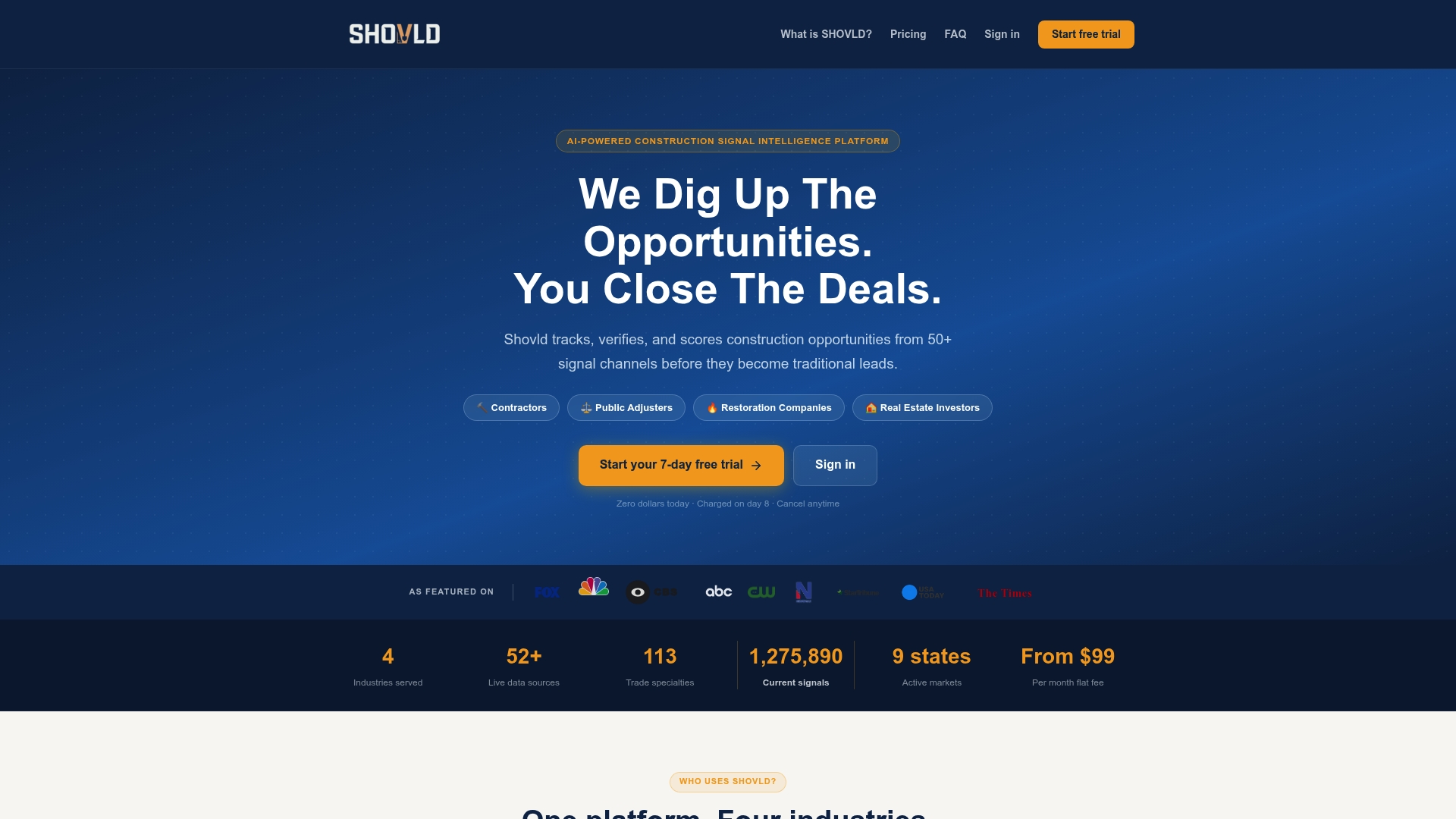
Trade and market filters mean a roofing contractor in Phoenix sees different leads than a restoration company in Miami. Automated outreach templates in multiple languages, real-time notifications, and built-in CRM pipeline management mean the gap between signal and contact shrinks from days to hours. Every lead type covered in this article, from pre-foreclosure notices to municipal RFPs, flows through a single verified feed rather than a dozen disconnected portals.
See which Shovld plan fits your market and trade, or visit getshovld.com to start a free trial and see live signals in your area today.
Where to start building your signal collection program
Priority public sources to set up first:
County building department portals (permits and permit applications)
County recorder of deeds (ownership transfers, liens, lis pendens)
County assessor/treasurer (tax delinquency, assessed values)
Municipal planning commission agendas (zoning and land-use filings)
State insurance department databases and FEMA disaster declarations
Local code enforcement and 311 open-data portals
Public procurement portals (state and municipal RFPs)
Private and supplementary sources:
Industry reports and developer press releases
Design-award announcements and lender financing notices (per construction data sourcing research)
Estimating and BIM data for enriching scope estimates once a lead is qualified
30/60/90-day pilot plan:
Days 1–30: Choose two to three target markets. Select five signal types from the catalog above. Set up free public portal monitoring and log every record in a spreadsheet or CRM.
Days 31–60: Verify and score the first 30 days of records using the checklist above. Run pilot outreach on the top 10 scored leads. Compare results against your existing CRM backlog.
Days 61–90: Scale the workflow. Integrate a structured feed or platform to replace manual monitoring. Measure bid-hit rate against the pilot cohort and adjust signal weighting based on what converted.
For teams that want to skip the manual setup phase entirely, Shovld’s signal intelligence platform delivers a turnkey version of this program with AI scoring, deduplication, and CRM integration already built in.