
How AI Finds Contractor Opportunities in 2026
AI contractor opportunity discovery is the process of continuously scanning public data sources, normalizing raw records, and scoring each signal to produce qualified leads contractors can act on immediately. Platforms like Shovld, Sweetspot, and AskBaily have formalized this process, pulling from building permit filings, government procurement databases, and municipal records to surface opportunities before competitors even know they exist. Understanding how AI finds contractor opportunities means understanding a full pipeline: from raw data ingestion to enriched, verified contacts ready for outreach. This guide breaks that pipeline down, step by step.
How AI finds contractor opportunities from raw public data
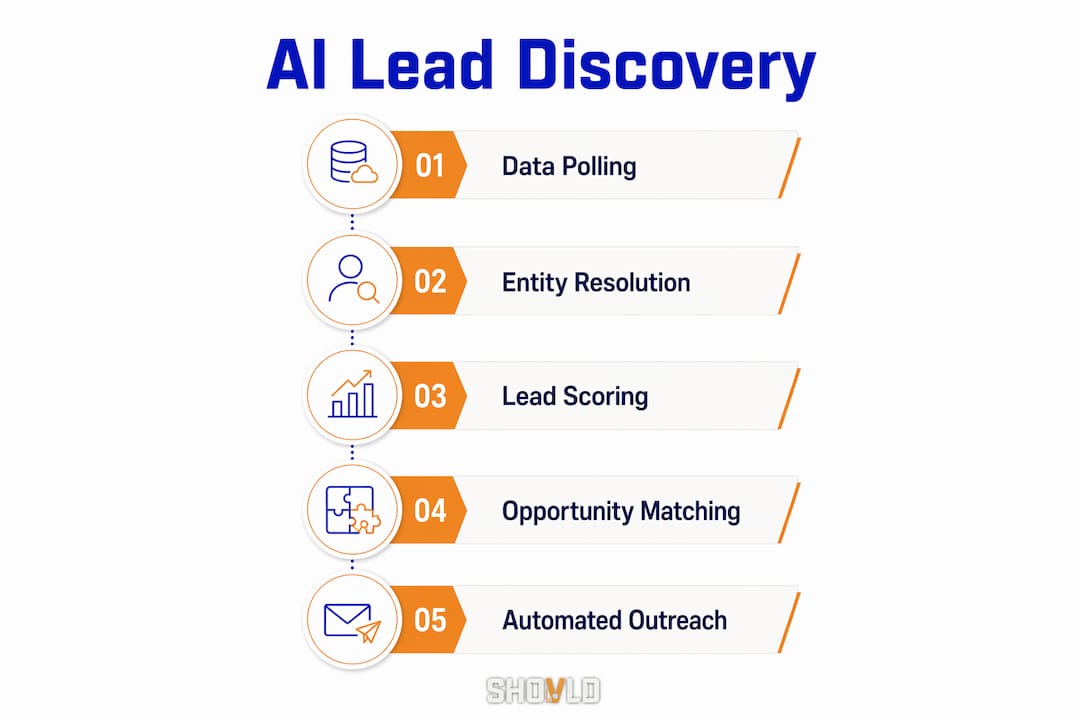
The foundation of AI contractor opportunity discovery is continuous polling. AI systems query open-data portals and government APIs around the clock, pulling structured permit records that include issue dates, estimated project values, permit types, and owner details. APIs like Socrata deliver normalized JSON permit data that AI pipelines can ingest without manual formatting. That consistency is what makes automated processing possible at scale.
Once data arrives, the pipeline runs through four distinct stages:
Normalization. Raw records from dozens of jurisdictions arrive in inconsistent formats. AI maps every field to a standard schema so that a permit from Dallas and one from Denver are processed identically.
Deduplication. Permit numbers and contract IDs serve as unique keys. The system discards duplicate records before any scoring begins, preventing the same lead from appearing twice in a contractor’s queue.
Qualification. Rule-based filters and reasoning models evaluate each record against parameters like project type, estimated value, and jurisdiction. LLM models flag ambiguous cases for human review rather than forcing a bad classification.
Contact enrichment. Once a lead qualifies, the system resolves owner and applicant entities by cross-referencing business registrations, licensing databases, and online profiles to produce verified contact information.
Entity resolution is where most pipelines slow down. Matching inconsistent owner names across sources often takes more processing time than the initial scrape. Best practice separates qualification from enrichment and caches verified identities to avoid redundant lookups on the same property owner.
Pro Tip: Set your AI pipeline to flag permits with estimated values above your minimum project threshold before enrichment runs. Enriching low-value leads wastes API calls and inflates costs.
Lead accuracy is not a nice-to-have. Sending outreach to misclassified leads burns your reputation with property owners and wastes your team’s time. Reliable lead qualification is what separates a productive AI pipeline from an expensive noise machine.

Does semantic search change how AI identifies contractors’ best leads?
Keyword-only searches miss too much. A contractor searching for roofing work might query “roof replacement,” but the permit or RFP could describe the same scope as “exterior envelope restoration” or “membrane system renewal.” Traditional keyword filters return nothing. Semantic search returns the right lead.
AI systems built for government contracting opportunity discovery use query expansion to automatically include acronyms, synonyms, and related terms. A search for “cybersecurity” expands to include “information assurance” and “network defense” without the user configuring anything. The same logic applies to construction: “HVAC retrofit” captures “mechanical system upgrade” and “climate control modernization.”
The more significant capability is document reading. AI does not just scan metadata fields. It reads attached RFPs, scopes of work, and specification documents to understand what the project actually requires. That means a lead scored on document content is far more accurate than one scored on a title field alone.
“Searching by meaning and reading opportunity documents directly distinguishes AI opportunity discovery from traditional keyword-only approaches, catching leads others miss.” — Sweetspot AI GovCon Workflow Guide
Cross-database aggregation multiplies the benefit. Platforms pull from SAM.gov, FPDS, USASpending, and state and local procurement portals simultaneously. A single query surfaces opportunities across all sources, ranked by fit score relative to the contractor’s capabilities and past work history.
The practical result is faster go/no-go decisions. Explainable AI scoring tells a contractor not just whether to pursue an opportunity, but why it scored the way it did. That transparency builds trust in the system and reduces the time teams spend second-guessing recommendations.
Why timing is the real competitive advantage in AI lead discovery
Speed is the variable most contractors underestimate. By the time a lead appears in a mainstream aggregator, the outreach window is often closed. Property owners who filed a permit three weeks ago have already heard from two or three contractors. You are not competing on quality at that point. You are competing on price.
Contractors who monitor permits directly contact property owners the same day a permit issues. Competitors relying on aggregators find the same lead weeks later. That gap is the difference between a warm conversation and a cold call to someone who has already signed a contract.
The speed advantage compounds at the decision stage too. AI-driven scoring enables go/no-go decisions up to 60 times faster than manual review. A solicitation that would take a team 30 minutes to evaluate manually gets scored in seconds. That frees up business development capacity for outreach rather than screening.
This is the core of the construction industry timing problem. Most contractors enter opportunities after the market has already reacted. AI monitoring flips that dynamic by surfacing signals at the source, before aggregators, before competitors, and before the property owner has made a decision.
Pro Tip: Connect your AI lead alerts directly to your CRM and set automated outreach sequences to trigger within hours of a permit issuance. Tools like bid pipeline software can help you manage simultaneous opportunities without losing track of follow-up timing.
Monitoring source data before leads appear in common databases is the essential discipline. First-mover advantage closes rapidly once a lead surfaces in shared feeds. The contractors winning the most work are not the ones with the best pitch. They are the ones who show up first.
How AI matches contractor qualifications to the right opportunities
Most lead platforms sell the same lead to five contractors simultaneously. You win by being cheaper or faster, not by being the best fit. AI-driven matching works differently. It gates opportunities by qualification before a lead ever reaches your queue.
The matching process starts with structured intake. Instead of a generic lead form, AI conducts a structured scope interview that captures the variables that actually determine whether a contractor can do the work. AskBaily’s methodology collects zoning overlays, ADU legality, energy code compliance requirements, and permit feasibility constraints before any matching occurs. That specificity eliminates the ambiguity that causes mismatched leads.
Regulatory verification runs at match time, not at intake. The system checks active license status and insurance validity against regulator APIs in real time. A contractor whose license has lapsed does not receive leads requiring that license class. That gate protects both the contractor and the property owner.
The difference between AI matching and traditional platforms is significant:
FactorTraditional Lead PlatformsAI-Driven MatchingLead distributionSame lead sold to multiple contractorsMatched to qualified contractors onlyRegulatory checkNone at point of saleLicense and insurance verified at match timeScope accuracyGeneric category selectionStructured intake capturing zoning, permits, complianceLead qualityVariable, often lowGated by pass/fail regulatory signals
Gate automation with strict pass/fail signals on license class, insurance validity, and permit feasibility outperforms fuzzy matching by preventing outreach to leads you cannot legally or practically serve. That precision is what makes AI-driven matching worth the investment compared to traditional lead generation alternatives.
The result is a shorter list of higher-quality leads. You spend less time disqualifying bad fits and more time closing work that actually matches your capabilities.
Key takeaways
AI finds contractor opportunities by converting scattered public records into verified, scored, and enriched leads that contractors can act on before competitors even see them.
PointDetailsContinuous data pollingAI monitors permit portals and procurement databases around the clock, not just during business hours.Semantic search expands reachAI reads documents and expands queries to capture leads described with variant or technical language.Timing determines win ratesSame-day outreach after permit issuance outperforms aggregator-dependent approaches by weeks.Qualification gates protect qualityPass/fail checks on license, insurance, and permit feasibility prevent wasted outreach on unqualified leads.Explainable scoring speeds decisionsAI scores that show their reasoning reduce manual screening time and improve bid accuracy.
What i’ve learned watching contractors use AI signal data
By Avi
The contractors who get the most out of AI opportunity discovery are not the ones chasing the most leads. They are the ones who trust the qualification layer and act fast on a shorter list. That sounds obvious, but most teams I have seen default to pulling every lead the system surfaces and then manually re-screening them. That defeats the purpose entirely.
The real value of a well-built AI pipeline is not volume. It is converting messy public records into contacts you can actually call with confidence. When the system has already verified the license class, confirmed the permit is active, and resolved the owner’s contact information, your outreach is a business conversation, not a cold guess.
The pitfall I see most often is poor outreach practice after a good lead surfaces. The AI does the hard work of finding and qualifying the opportunity. Then a contractor sends a generic email three days later and wonders why the conversion rate is low. The timing advantage evaporates fast. If you are not reaching out within hours of a signal, someone else is.
Explainable scoring matters more than most contractors realize. When a system tells you a lead scored 82 out of 100 and shows you exactly which factors drove that score, you can make a real decision. When it just says “high priority,” you are back to guessing. Demand transparency from any AI tool you evaluate.
The future of this space is not more leads. It is better signal quality and faster verification. The platforms that invest in regulatory data accuracy and real-time license checking will pull ahead of those that just aggregate more sources.
— Avi
See how Shovld surfaces opportunities before the market does
Shovld is a construction signal intelligence platform built for contractors, real estate investors, and restoration professionals who want to act before the competition reacts. The platform aggregates permit data, code violations, distressed-property indicators, and municipal records across multiple U.S. markets, then scores and verifies each signal into a qualified lead with enriched contact information.
You get early visibility into properties that need work before they show up anywhere else. Shovld’s qualification layer checks regulatory fit and timing so your team focuses on leads worth pursuing. Explore Shovld’s pricing plans to find the right tier for your market coverage, or visit What Is Shovld? to see exactly how the platform processes public signals into contractor-ready opportunities.
FAQ
What public data sources does AI use to find contractor leads?
AI systems pull from building permit portals, government procurement databases like SAM.gov and FPDS, municipal code violation records, and open-data APIs. These sources provide structured signals including permit type, estimated value, issue date, and owner details.
How much faster does AI qualify contractor opportunities than manual review?
AI-driven scoring delivers go/no-go decisions up to 60 times faster than manual evaluation. A solicitation that takes 30 minutes to screen manually is scored in seconds.
Why does timing matter so much in AI contractor lead discovery?
Contractors who monitor permits directly contact property owners the same day a permit issues. Aggregator-dependent competitors often find the same lead three or more weeks later, well after the owner has engaged another contractor.
How does AI match leads to the right contractor?
AI uses structured intake to capture regulatory variables like zoning, license class, and permit feasibility, then verifies active license and insurance status against regulator APIs at match time before delivering a lead.
Is ai-driven lead discovery better than traditional lead platforms?
AI matching gates leads by qualification before delivery, while traditional platforms sell the same lead to multiple contractors simultaneously. The result is higher lead quality and less price-based competition.