
How AI Aggregates Investment Property Signals
AI signal aggregation in real estate investing is defined as the automated process of collecting, enriching, reconciling, and scoring property data streams through a governed multi-agent pipeline to produce actionable investment recommendations. Platforms like SZL Holdings’ terra, Kolena, and Realmo’s Rey assistant have moved this process well beyond spreadsheet analysis. Understanding how AI aggregates investment property signals gives you a structural edge: you act on synthesized intelligence while competitors are still manually pulling comps and chasing rent rolls.
How AI aggregates investment property signals: the core pipeline
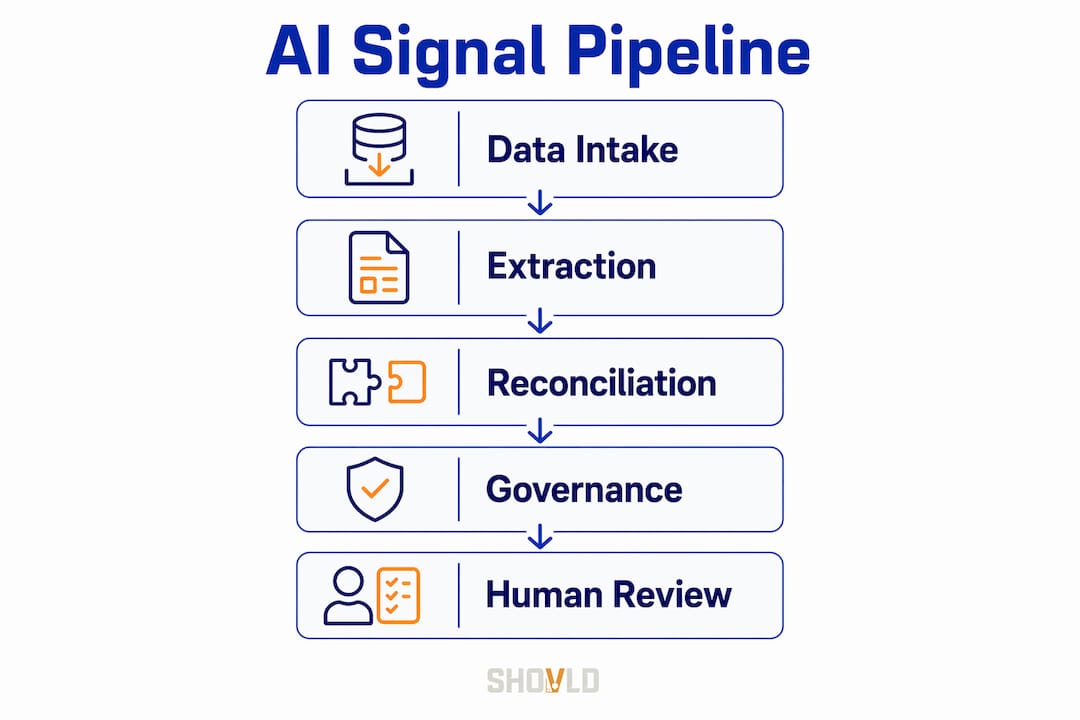
The process follows a structured sequence, not a single algorithm. Each stage feeds the next, and skipping one degrades the output quality of everything downstream.
Deal intake. The pipeline begins when a property record, offering memorandum, or public data trigger enters the system. Structured fields like address, asset class, and asking price are parsed and normalized immediately.
Document ingestion and data extraction. Lease agreements, rent rolls, inspection reports, and title documents are ingested. Specialized agents extract tenant names, rent amounts, deposit values, and lease expiration dates with page-level citations attached to every field.
Data enrichment. Extracted fields are cross-referenced against market databases, municipal permit records, and comparable sales feeds. This is where raw document data becomes contextualized signal data.
Multi-agent reconciliation. Separate agents compare extracted values against each other and against external benchmarks. The cre-acquisition-orchestrator model illustrates this well: a master orchestrator manages five phase orchestrators overseeing 21 specialist agents and four ingestion agents, each handling valuation, income analysis, neighborhood intelligence, and investment upside in parallel.
Composite scoring. Agents generate buy, hold, or pass signals with supporting rationale. Parallel AI agents covering valuation and income produce composite property scores that reflect weighted signal inputs rather than a single data point.
Recommendation generation. The pipeline compiles findings into a structured investment committee memo or scoring report. No recommendation executes without passing through a human approval gate.
Receipt emission. A cryptographic audit trail records every input, agent decision, and human confirmation. This receipt is the governance layer that makes the entire output defensible.
Pro Tip: When evaluating any AI investment tool, ask specifically whether it separates extraction from reconciliation logic. Tools that blend both steps into one black-box output cannot produce audit-ready reports.
How AI extracts and reconciles lease and rent-roll data
Lease and rent-roll data is where most manual underwriting breaks down. A 200-unit multifamily deal can involve 200 separate lease documents with inconsistent formatting, handwritten amendments, and conflicting rent schedules. AI handles this at scale, but the architecture matters.
Multi-agent extraction captures structured fields from each document independently, attaching page-level citations so every figure is traceable to its source. The critical design principle is keeping extraction separate from reconciliation. Splitting extraction from reconciliation rules allows clear traceability of changes rather than producing black-box scores. This means an auditor or investor can see exactly which page of which lease produced a flagged discrepancy.
The reconciliation stage applies deterministic, rule-based checks rather than probabilistic AI inference. Kolena’s lease audit workflow runs 40 configured checks comparing deposits, rents, and dates across lease sets, producing detailed auditable reports in minutes. That speed matters: what previously required a week of paralegal time now surfaces discrepancies before a letter of intent is signed.
Key fields captured in a well-structured lease extraction workflow include:
Tenant legal name and guarantor information
Base rent, escalation schedules, and concession periods
Security deposit amounts and conditions for return
Lease commencement and expiration dates
Renewal options and termination clauses
Pro Tip: Require cent-level reconciliation output from any AI lease audit tool. If the system only flags percentage-level variances, it will miss the small discrepancies that compound into material misrepresentations at closing.
Workflow stageWhat it producesDocument ingestionRaw field extraction with page citationsDeterministic reconciliationFlagged variances with rule referencesAudit report generationStructured, defensible output for due diligence
How comps APIs feed automated valuation models
Real estate comps APIs are the data supply chain for machine learning valuation models. Without structured, consistent comparable data, every downstream calculation from DSCR to cap rate estimation rests on inconsistent inputs.

A comps API delivers recent sales data, rental pricing benchmarks, property characteristics, and market indicators through automated queries. Mashvisor’s comps API returns property details, pricing benchmarks, and market indicators that support DSCR and valuation calculations programmatically. The practical implication: an underwriting model can refresh its comparable set every time a new sale closes in the target submarket, rather than relying on a broker’s manually pulled comp sheet from three weeks ago.
This matters most in fast-moving markets where stale comps produce systematically wrong valuations. An AI system pulling live comps data catches a 12% rent growth trend in a submarket before it shows up in a broker’s quarterly report.
Data sourceUpdate frequencyUse in underwritingManual broker compsWeekly to monthlyCap rate, ARV estimationComps API (automated)Near real-timeDSCR, valuation model inputsRevenue intelligence platformsContinuousOccupancy forecasting, rent trend signals
Pro Tip: When building or evaluating an AI underwriting model, confirm that the comps API normalizes for property characteristics like square footage and condition. Raw price-per-unit comparisons without normalization produce misleading signals in heterogeneous markets.
Revenue intelligence platforms go further by linking operational KPIs to targets for forward-looking insights. Leasing velocity and occupancy trends become predictive signals rather than lagging indicators. That shift from backward-looking to forward-looking data is where AI in real estate investing creates its clearest competitive advantage.
What governance mechanisms make AI signal aggregation trustworthy
Governance is not a feature. It is the precondition for using AI outputs in regulated investment decisions. Without it, you have a fast tool that produces indefensible recommendations.
The terra platform from SZL Holdings demonstrates what serious governance architecture looks like in practice. The system enforces a covenant policy with Λ-axis governance scoring and cryptographic proof-chains, and no AI recommendation executes without human confirmation. That design choice is deliberate: it preserves human accountability while capturing AI speed and scale.
The critical governance components in a trustworthy signal aggregation platform are:
Policy-driven scoring. Every signal weight and scoring threshold is defined by explicit policy rules, not learned implicitly by a model that cannot explain its outputs.
Cryptographic audit trails. Each input, agent decision, and human approval is recorded in an immutable chain. Decision trails with cryptographic proof trace each input to final outputs, making the entire process defensible in due diligence or litigation.
Entity resolution. Consistent identification of properties, tenants, and counterparties across documents prevents the same entity from appearing as two different signals. Ambiguous matches route to manual review rather than forcing a probabilistic guess.
Human approval gates. Final investment decisions based on AI aggregation outputs must remain under human accountability due to regulatory and quality concerns. Gates are not optional in compliant workflows.
“The value of AI in underwriting is not that it replaces judgment. It is that it surfaces every relevant signal so human judgment operates on complete information rather than a subset of it.”
The governance layer also protects against a specific failure mode: signal aggregation errors caused by ambiguous entity matching. When the same property appears under two slightly different addresses across data sources, a system without entity resolution treats them as two separate signals and double-counts the data.
How AI discovery assistants accelerate early-stage deal sourcing
Before any pipeline runs, an investor needs to find the right deal. AI-powered discovery assistants address the front end of signal aggregation by interpreting investor intent and matching it against large property databases in real time.
Realmo’s Rey assistant interprets user asset type, geography, price, and investment thesis to return matched listings using a rich property and intelligence database covering over a million active commercial real estate listings. The practical shift is significant: instead of filtering a database by fixed criteria, an investor describes a thesis conversationally and the system returns properties that match the underlying logic.
Early-stage signal aggregation through an AI assistant typically synthesizes:
Asset type and submarket positioning relative to demand trends
Valuation signals including asking price versus estimated market value
Financial indicators such as in-place NOI, occupancy rate, and lease expiration schedule
Location intelligence covering transit access, demographic trends, and competitive supply
Distressed indicators including deferred maintenance flags, permit history, and code violations
This front-end synthesis compresses the deal identification phase from days to minutes. An investor running a value-add multifamily strategy in secondary markets can surface 40 qualified candidates in the time it previously took to review five offering memorandums. The pre-market property opportunities that AI surfaces at this stage are the ones that never make it to crowded listing platforms.
Key takeaways
AI signal aggregation produces reliable investment intelligence only when extraction, reconciliation, governance, and human oversight operate as a connected system rather than isolated tools.
PointDetailsStructured pipeline is non-negotiableDeal intake, enrichment, multi-agent scoring, and human approval must all be present for outputs to be defensible.Separate extraction from reconciliationBlending both steps into one process produces black-box outputs that cannot support audit-quality due diligence.Comps APIs replace stale manual dataAutomated comparable feeds keep valuation models current and eliminate the lag that produces systematic pricing errors.Governance is the trust layerCryptographic audit trails and human approval gates are what separate a fast tool from a trustworthy one.Early discovery compresses deal timelinesAI intent-matching assistants surface qualified deals before they reach crowded listing platforms.
Why the governance question is the one most investors skip
I have watched investors adopt AI underwriting tools with genuine enthusiasm and then quietly abandon them six months later. The reason is almost always the same: the tool produced outputs they could not explain to a lender, a partner, or themselves.
The platforms that stick are the ones built around auditability from the start. When a multi-agent system mirrors real-world underwriting with specialized agents handling discrete tasks, each step produces a traceable output. That traceability is what lets you defend a buy decision when a deal goes sideways.
The other pattern I see consistently: investors treat AI discovery and AI underwriting as the same problem. They are not. Discovery is about finding deals before the market does. Underwriting is about validating them with precision. Conflating the two leads to either over-relying on a scoring tool that was never designed for due diligence, or dismissing a discovery tool because it does not produce investment committee-ready memos.
The investors getting the most from AI right now are the ones who have mapped their workflow and identified exactly where AI adds speed without sacrificing accountability. They use AI for undervalued property identification at the front end and governance-enforced scoring at the back end. The middle, where judgment lives, stays human.
— Avi
See how Shovld puts signal intelligence to work
Shovld is built for investors who want to act before the market reacts. The platform tracks permits, code violations, HOA pressure, distressed-property indicators, and deferred maintenance patterns across U.S. markets, transforming scattered public records into verified, scored opportunities.

Where most tools surface deals after they are already crowded, Shovld’s AI aggregates construction and municipal signals at the earliest stage, giving you a timing advantage that manual research cannot replicate. Whether you are evaluating a single market or running a multi-market acquisition strategy, Shovld’s signal intelligence plans are structured to match your deal volume and workflow. Learn more about how Shovld works and see which plan fits your pipeline.
FAQ
What does AI signal aggregation mean in real estate?
AI signal aggregation in real estate is the automated process of collecting property data from multiple sources, reconciling discrepancies, and scoring the combined output to produce investment recommendations. The process typically involves specialized agents handling lease extraction, market comparables, and financial modeling in parallel.
How many agents are involved in a CRE AI underwriting pipeline?
Advanced systems like the cre-acquisition-orchestrator use a master orchestrator managing five phase orchestrators and 21 specialist agents to replicate a full acquisition workflow. The number of agents scales with deal complexity and the range of data sources being synthesized.
Why do AI lease audits need deterministic reconciliation rules?
Deterministic rules produce audit-ready outputs by flagging specific variances with clear references to the rule that triggered the flag. Probabilistic AI inference alone cannot explain why a discrepancy was flagged, which makes the output indefensible in due diligence.
Can AI replace human judgment in investment decisions?
AI accelerates and structures the analysis, but final investment decisions must remain under human accountability due to regulatory requirements and quality standards. Governance-enforced platforms build human approval gates directly into the workflow to prevent overreliance on automated outputs.
What is the role of a comps API in automated property investment signals?
A comps API delivers structured comparable sales and rental data through automated queries, feeding valuation and DSCR models with current market benchmarks. This replaces manually pulled comp sheets and keeps underwriting models accurate as market conditions shift.