
Property Age in Rehab Cost Estimation: Budget Smarter
Property age should increase your baseline rehab estimate by a noticeable percentage depending on the decade built, plus dedicated line items for every major system that has exceeded its service life. For homes in the prime remodel window, REsimpli recommends a contingency buffer on top of your scoped costs, listed as its own line item. Push to the high end of that band when permit history is thin or the property shows deferred maintenance across multiple systems. For pre-1970 properties, practitioners add a separate structural and hazardous-material surcharge per square foot on top of the percentage contingency.
The role of property age in rehab cost estimation goes beyond a single multiplier. Age predicts which systems are statistically overdue, which hazardous materials are likely present, and how much scope can expand once walls open. The core rules:
Under 20 years: 0–5% contingency; cosmetic scope rarely hides structural surprises.
20–30 years: 5–10%; HVAC and water heater replacement probability rises sharply.
30–50 years: 10–20%; the prime remodel window where system failures cluster.
50+ years: 15–30% plus per-square-foot hazmat surcharge; lead, asbestos, and galvanized plumbing are probable.
Pro Tip: The single highest-return record check before any offer is the roof permit history. If a 30+ year home has no roofing permit on file, budget a full replacement ($6,000–$15,000) as a certain cost, not a contingency.
Table of Contents
How do you quantify age risk with contingency bands and sample calculations?
What inspection and public-record checks reduce the most unknowns?
Using age and public records to pre-screen and score opportunities
What does a reproducible age-adjusted estimating workflow look like?
Mitigation strategies and negotiation tactics for age-driven risk
Age-driven rehabs reward the team that sees the signal first
Shovld turns age signals into scored, ready-to-bid opportunities
How does property age drive system-by-system rehab costs?
Age does not degrade a house evenly. It clusters failures around predictable service-life thresholds, which is exactly what makes it a usable screening filter.
Four Seasons Home Improvement’s analysis of 681,000+ permits found that major-remodel permits spike between years 25 and 40. Homes aged 31–40 generate major-remodel permits at 4.4× the rate of homes under 10 years old. That clustering is not random — it maps directly to the service lives of the systems installed when the house was built.
SystemTypical Service LifeAge Threshold for Replacement BudgetReplacement Cost RangeRoof (asphalt shingle)20–30 years25+ years without permit$6,000–$15,000HVAC15–20 years20+ years$5,000–$12,000Water heater10–15 years15+ years—Electrical panel30–40 yearsPre-1980 or no upgrade permit—Plumbing (galvanized)40–70 yearsPre-1970Full repipe variesWindows20–30 years30+ years, original frames—
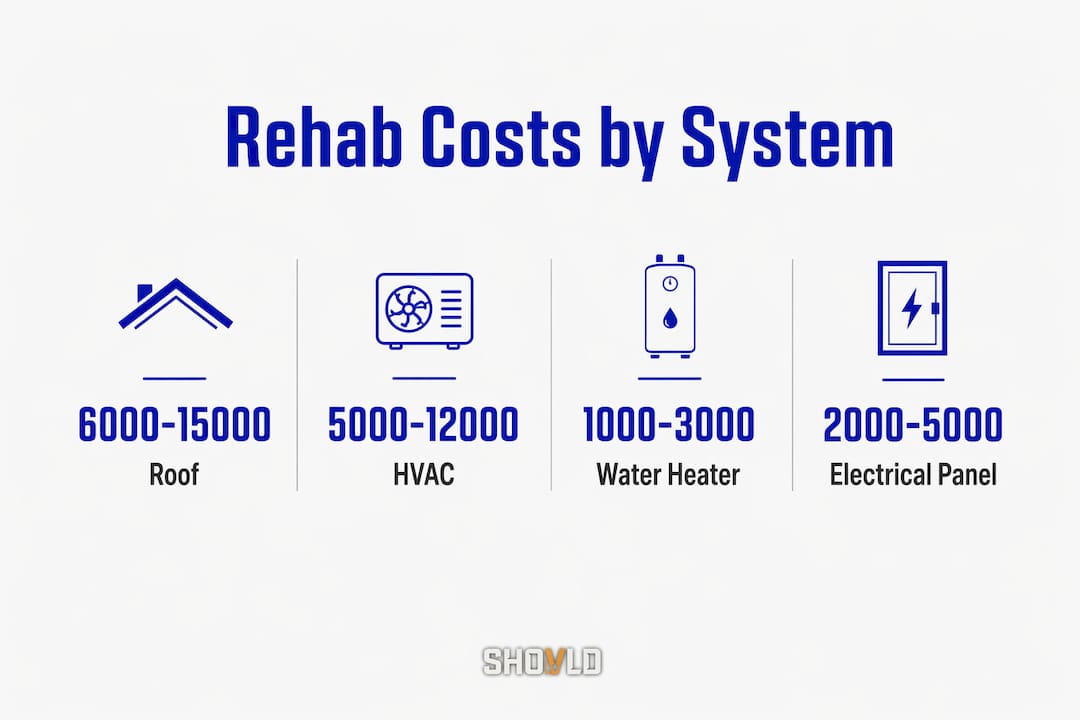
Roof ($6,000–$15,000), HVAC ($5,000–$12,000), water heater ($1,000–$3,000), electrical panel ($2,000–$5,000) — ranges sourced from Deal Run’s system-cost guidance.
Beyond service life, age introduces hazardous materials that trigger mandatory remediation costs. Properties built before 1978 may contain lead paint; pre-1985 construction often includes asbestos in flooring, insulation, or drywall compound; pre-1990 homes may have polybutylene plumbing, which is prone to failure; and pre-1970 properties frequently combine galvanized plumbing with outdated knob-and-tube or aluminum wiring. These are not cosmetic issues. Each one can convert a moderate rehab into a structural work project with mandatory testing, abatement, and re-inspection costs.
Deferred maintenance compounds the problem. When one system fails past its service life without replacement, adjacent systems often absorb the stress. A leaking roof damages insulation, framing, and drywall. A failing water heater corrodes supply lines. The scope that looked cosmetic on the surface becomes structural once the walls open.
Pro Tip: Dated finishes — original single-pane windows, popcorn ceilings, builder-grade hollow-core doors — are reliable visual cues that no major system has been touched. Check what makes a house look dated to calibrate how much deferred work the finishes signal.
How do you quantify age risk with contingency bands and sample calculations?
Contingency is not a cushion you hide in markup. According to REsimpli, the most common estimating error is ignoring age-related compounding risks, and the fix is a dedicated contingency line item, not a padded labor rate.

Age-based contingency bands:
Property AgeCondition/Permit HistoryContingency BandUnder 20 yearsGood condition, permits current0–5%20–30 yearsMixed condition, some deferred5–10%30–50 yearsDeferred maintenance, thin permit history10–20%50+ yearsPre-1970 hazmat risk, no major permits15–30% + $5–$15/SF surcharge
Worked sample calculation (1,400 SF, 1978-built duplex):
Baseline cosmetic rehab (kitchens, baths, flooring): $42,000
Roof replacement (no permit since 1990, age 36 years): $10,000
HVAC replacement (original unit, age 28 years): $8,000
Electrical panel upgrade (pre-1980 panel): $3,500
Lead paint testing and remediation allowance: $2,500
Age-band contingency (15% of $42,000 baseline): $6,300
Total estimated budget: $72,300
Without the age-driven line items, the same estimator using only the cosmetic scope would have quoted $42,000. Remote estimates that rely on proxy data without sufficient contingency can substantially understate final costs.
Pro Tip: Show contingency as a separate labeled line on every client estimate. Hidden markup erodes trust when scope expands; a named contingency line sets expectations and protects your margin.
What inspection and public-record checks reduce the most unknowns?
A focused 15–30 minute walk-through, combined with three specific record pulls, eliminates the largest sources of estimate error before you commit to a number.
Field checklist (on-site):
Ceiling stains or soft spots: indicate active or past roof/plumbing leaks.
Water heater age tag: if over 12 years, budget replacement.
Electrical panel: look for Federal Pacific or Zinsco panels, double-tapped breakers, or aluminum wiring.
Visible plumbing material: gray polybutylene pipe or galvanized steel are automatic line items.
Window style: original single-pane wood frames signal no major system updates.
Knob-and-tube wiring signs: visible in attic or basement, common pre-1950.
Records checklist:
Pull the full permit history from the municipal building department.
Check for open code violations through the city or county records portal.
Review tax-assessment records for anomalies (sudden value drops often follow insurance claims or structural findings).
Search for previous major-renovation permits (roof, HVAC, electrical) to confirm or rule out replacement.
Request HOA filings if applicable — deferred common-area maintenance often signals deferred unit maintenance.
Combining visual cues with permit history lets you calculate effective age rather than relying on the built year alone. A 1985 home with a 2019 roof permit, a 2021 HVAC permit, and updated windows has an effective age closer to 10 years for those systems. A 1995 home with no permits since 1997 may carry the risk profile of a 1970s property. Permit history predicts condition more reliably than the year on the tax record.
Pro Tip: Pull the roof permit history first. It is the single document that most reliably predicts whether a property is a cosmetic job or a structural rehab.
Using age and public records to pre-screen and score opportunities
Consider a 1988-built duplex with no roofing permit on record since 1995, an original HVAC unit, and two recent municipal code complaints for exterior deterioration. Chronologically, the property is 38 years old — squarely inside the prime remodel window where system failures cluster. The scoring logic is straightforward:
Roof age: over 30 years, no permit. Replacement certain. Add a significant cost allowance.
HVAC age: late 30s in years. Replacement certain. Add a substantial cost allowance.
Code complaints: active violations accelerate negotiating leverage and urgency.
Contingency band: 15–20% on baseline cosmetic scope.
Acting before the roof fails matters financially. Deferred replacements typically cost notably more than planned work due to emergency scheduling, collateral damage, and accelerated labor costs. A contractor or investor who identifies this property before the roof fails can negotiate from a position of knowledge, not crisis.
Tracking these signals manually across dozens of markets is where most teams lose the timing advantage. Shovld aggregates permit recency, code violations, tax-assessment anomalies, and distressed-property indicators into a single scored feed, so you see which properties are entering the prime remodel window before the competition does.
Shovld’s AI urgency scoring weights permit recency, violation history, and property age together, then surfaces the highest-probability opportunities first. That means fewer cold leads and more bids on properties where the scope is predictable and the negotiating window is open. Teams using permit data for investment decisions consistently find that early visibility converts to better margin, not just more volume.
Pro Tip: Weight code violations and missing major-system permits equally. Either one alone is a yellow flag; both together on a 30+ year property is a high-urgency signal worth acting on this week, not next month.
What does a reproducible age-adjusted estimating workflow look like?
Remote filter: Pull built year, permit history, and any code violations before visiting. Flag properties with age over 25 and no major-system permits in the last 15 years.
Focused site check: Use the field checklist above. Spend time in the attic, basement, and mechanical room — not just the kitchen and baths.
Conditional allowance lines: Add dedicated line items for each system at or past service life. Do not fold these into a general contingency.
Testing and phased scope: For pre-1978 properties, include a lead paint test allowance. For pre-1985, include asbestos screening. Phase structural or hazmat work before cosmetic finishes.
Final bid with explicit contingencies: Show the age-band contingency as a labeled percentage line. Clients who see the reasoning accept higher contingencies more readily than clients who see a single inflated number.
Sample age-adjusted estimate table (1,400 SF, 1978-built):
Line ItemAmountCosmetic scope (kitchens, baths, flooring)$42,000Roof replacement$10,000HVAC replacement$8,000Electrical panel upgrade$3,500Lead/asbestos testing allowance$2,500Age-band contingency (15%)$6,300Total$72,300
Pro Tip: Present phased scopes as a decision tree: “If testing confirms asbestos, Phase 2 adds $X.” Clients who understand the conditional logic rarely push back on contingency lines.
Mitigation strategies and negotiation tactics for age-driven risk
Age-driven unknowns do not have to land entirely on your margin. Several tactics shift or cap the exposure before you sign a contract.
Conditional offers: Write inspection contingencies tied to specific system findings (roof condition, panel type, plumbing material). A failed inspection on a flagged system becomes a price reduction, not a surprise cost.
Escrowed allowances: For systems that are likely but not confirmed to need replacement, negotiate a repair escrow held at closing. Both parties agree on the trigger and the cap.
Contractor-led testing: Order asbestos, lead, and sewer camera inspections before finalizing scope. The cost is $300–$800 total and eliminates the largest sources of estimate error.
Roof-first sequencing: On 30+ year properties, complete the roof before any interior cosmetic work. A leaking roof during a kitchen remodel doubles your labor cost.
Capped contingency offers: Instead of a fixed low bid that leaves you exposed, offer a capped contingency structure. You absorb costs up to the cap; the seller or buyer credits anything above it. This preserves the deal while protecting your margin.
When the math on a pre-1960 property shows replacement costs exceeding 60–70% of rebuild value, the rebuild vs. remodel question becomes real. Renovation financing options, including renovation-inclusive mortgages, can shift the financial calculus for buyers who want to preserve the structure. For contractors, knowing that option exists gives you a stronger conversation when a client’s budget does not match the scope reality.
Pro Tip: The negotiation tactic that preserves margin without killing deals most often is the repair credit, not the price reduction. A $10,000 credit at closing costs the seller less psychologically than a $10,000 price cut, and it gives you the cash to do the work correctly.
Key Takeaways
Property age is the most reliable early-stage predictor of hidden rehab scope, and the contractors and investors who build age into their estimates from the first screening call consistently protect more margin than those who discover scope after the contract is signed.
PointDetailsAge-band contingencyAdd 10–20% for 30–50 year properties; push to 15–30% plus a $5–$15/SF surcharge for pre-1970 homes.System service-life thresholdsRoof, HVAC, and electrical panel age are the three highest-cost replacement triggers; budget them as certain costs when permits are absent.Permit history beats built yearEffective age from permit records predicts condition more reliably than the tax-record year; missing major-system permits are a high-risk flag.Deferred work costs morePlanned replacements cost roughly 40% less than emergency work; acting inside the prime remodel window (years 25–40) preserves negotiating leverage.Shovld for early-stage scoringShovld aggregates permit recency, code violations, and age signals into AI-scored opportunities, so teams identify prime remodel window properties before they become emergencies.
Age-driven rehabs reward the team that sees the signal first
The contractors and investors who consistently win on older properties are not the ones with the lowest bids. They are the ones who read the age signals accurately before anyone else does, price the real scope, and negotiate from knowledge. The prime remodel window is predictable. The system failures are predictable. The only variable is whether you see the opportunity before it becomes a crisis bid.
Working with public-record signals across multiple markets makes one thing clear: the gap between a well-priced age-driven rehab and an emergency gut job is almost always a timing problem, not a knowledge problem. The data exists. The question is whether you are pulling it before or after the roof caves in.
Shovld turns age signals into scored, ready-to-bid opportunities
Most teams spend hours manually cross-referencing permit records, code violations, and property age data across county portals. Shovld does that work automatically, across 50+ data sources, and scores each opportunity by urgency so your team focuses on the properties most likely to convert into profitable bids.

Shovld’s permit aggregation flags properties with missing major-system permits. Its code-violation tracking surfaces active complaints on aging properties. AI urgency scoring weights age, permit recency, and distress signals together into a single ranked feed. Automated outreach templates let you contact property owners before the competition even knows the opportunity exists. The result is a faster lead-to-bid cycle, fewer emergency rehabs that blow your margin, and a pipeline built on predictable, age-driven scope rather than guesswork.
See which plan fits your market and trade at Shovld’s pricing page and start your free trial today.
Useful sources and further reading
REsimpli: How to Estimate Rehab Costs — source for the 10–20% contingency recommendation and age-related compounding risk guidance.
Four Seasons Home Improvement: Prime Remodel Window — permit-backed analysis of 681,000+ properties; source for the 31–40 year clustering data and the 40% deferred-work premium.
Deal Run: Estimate Repairs Without Seeing the Property — system replacement cost ranges, remote-estimate understatement risk (20–40%), and effective-age methodology.
Deal Run: Rehab Cost Per Square Foot — source for the $5–$15/SF pre-1970 structural and hazmat surcharge.
Deal Run: Property Age Red Flags — pre-1978 lead, pre-1985 asbestos, pre-1990 polybutylene, and pre-1970 galvanized plumbing thresholds.
Shovld: Why Permit History Predicts Property Condition — deeper reading on integrating permit pulls with age-based screening.
Shovld: How Permit Data Reveals Investment Opportunity — how permit aggregation uncovers early-stage rehab opportunities at scale.
Shovld: How Distressed Properties Create Remodel Jobs — how older, distressed properties generate predictable remodel pipelines.