
Build a Deal Pipeline From Public Records in 2026
The most reliable way to build a deal pipeline from public records is to extract verified filing events, score them against your ideal customer profile, and route the highest-intent matches into a warm outreach workflow before your competitors even know the opportunity exists. This is not list-buying. It is systematic signal intelligence.
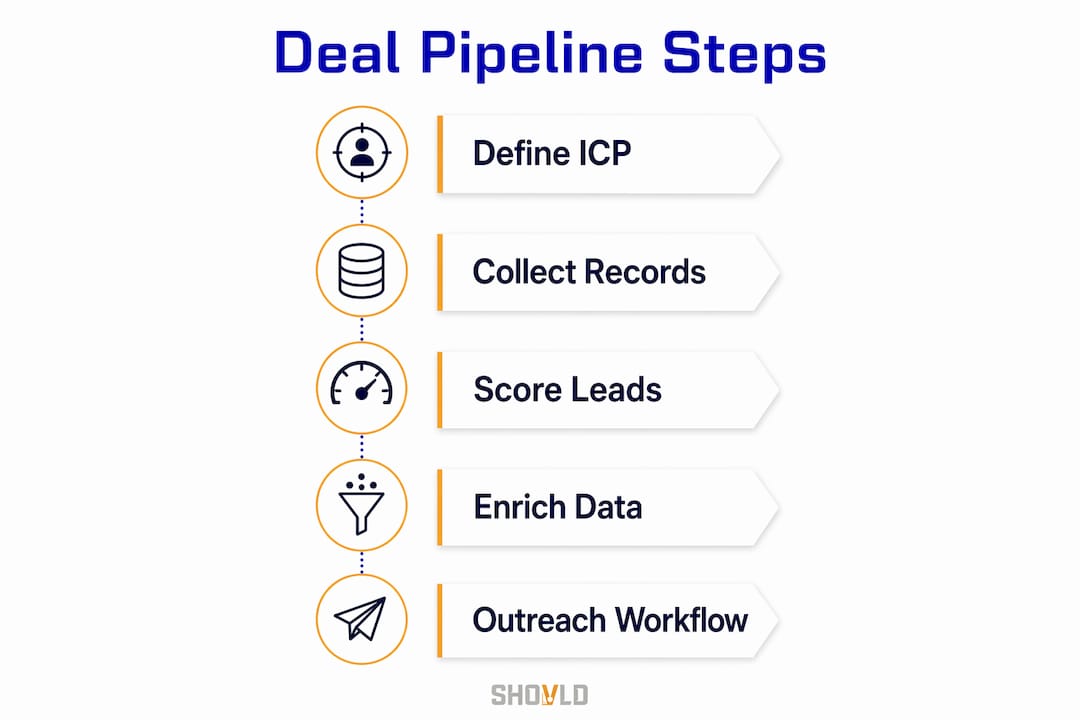
Here is the core method in five steps:
Define your ICP parameters by translating your target customer into queryable variables: geography, entity type, industry code, property type, or permit category.
Connect to official government sources including Secretary of State filings, county permit databases, property tax records, and court filing portals.
Monitor filing events as intent signals rather than running one-time exports. New permits, tax delinquencies, and director appointments all have a short window of relevance.
Apply AI scoring to rank leads by fit and timing simultaneously, not just by whether they match your ICP on paper.
Route top matches into warm introduction workflows. Registry-sourced prospects introduced through a double opt-in mechanism typically reach 40–50% reply rates, compared to roughly 2% for cold outreach to scraped or purchased lists.
Which public records actually produce pipeline-ready leads?
Not every government database is equally useful. The sources that consistently surface actionable opportunities share one trait: they are legally mandated to be accurate and time-stamped, giving them a structural advantage over third-party commercial lists.
Secretary of State business filings capture new formations, director appointments, and annual returns. New business filings represent companies at their most receptive moment: they need vendors and have not yet locked in relationships with anyone.
County permit databases reveal upcoming construction activity before a project goes to bid. Restoration companies, roofing contractors, and remodeling firms all benefit from knowing which properties just pulled a permit. Platforms like MiamiPermitAI combine multiple public data sources to sharpen lead qualification from permit feeds.
Property tax records and mortgage filings identify ownership status, equity position, and financial pressure. Tax delinquency is one of the clearest early warning signals available in any public dataset.
Court records covering liens, probate, and bankruptcy mark properties or businesses in financial transition. These filings are public in most U.S. jurisdictions and updated continuously.
Official government records outperform scraped commercial lists because accuracy is a legal requirement, not a vendor promise.
Pro Tip: Start with one record type, get the full pipeline working end to end, then add sources. Trying to ingest everything at once produces noise before it produces leads.
How to read distress signals and deal indicators in public data
Raw records do not tell you who to call. The signal comes from knowing which data points indicate urgency, and how to weight them against each other.
Common distress signals used to score leads include:
Tax delinquency duration and severity. An owner two years behind on property taxes is in a fundamentally different position than one who missed a single payment.
Code violation frequency. Multiple unresolved violations within a short window suggest deferred maintenance and an owner who may be ready to exit or needs remediation help fast.
Liens and probate filings. A mechanics lien filed by a contractor, or a probate case opened after an ownership transfer, both signal a property in transition. Wholesalers and public adjusters watch these closely.
New regulatory authorizations and director appointments. High-intent filing events include new FCA or SEC authorizations, C-suite appointments, and first annual returns. Each signals organizational momentum and a company actively building its vendor stack.
Ownership changes and equity estimation. Scoring frameworks weight distress signals against ownership duration and estimated equity to separate motivated sellers from owners who simply have a problem they plan to fix.
A property with multiple overlapping signals, say a tax delinquency plus two code violations plus a recently filed lien, scores far higher than any single trigger alone. That stacking logic is what separates a scored pipeline from a raw data export.
How AI scoring turns raw filings into a prioritized prospect list
Without a scoring layer, public records are noise. With one, filing events become ranked, actionable prospect lists with decision-maker paths attached.

AI scoring works by cross-referencing every filing event against your ICP, firmographic data, and behavioral signals simultaneously. A company that just received a new regulatory authorization and matches your target industry and geography scores higher than a perfect ICP match whose last relevant filing was 18 months ago. Timing weight is built into the model, not added as an afterthought.
The scale advantage is real. Manual registry prospecting limits a single analyst to hundreds of records per week. An AI layer processes millions of records across multiple registries continuously, scoring every match in real time. That gap does not close with more headcount.
AI also pulls in signals beyond the filing itself: technographic data, funding events, and permit history all enrich the prospect profile. The output is not a data dump. It is a ranked list of warm, verified opportunities ready for outreach.
Pro Tip: Combine AI scoring with a warm introduction workflow rather than cold email. The data advantage evaporates the moment you send a generic cold message to a verified lead.
Building a proprietary intelligence layer that compounds over time
A one-time query against a public database is a tactic. A persistent intelligence layer that tracks signals over time is a competitive asset. Tracking public record signals continuously exposes trends invisible from static snapshots, including which neighborhoods are heating up, which property types are cycling into distress, and which filing categories precede the deals your team actually closes.
Building that layer requires a few deliberate choices:
Aggregate diverse sources into a unified platform. County permit portals, Secretary of State databases, court filing systems, and property tax records each use different formats. Normalization happens at ingestion, not downstream.
Use event-based triggers instead of static exports. Automated ongoing data ingestion from APIs and respectful web scraping of public record portals forms the backbone of any system that stays current.
Enrich raw records with contact data and firmographics before scoring. Government registries give you structure and verification. They do not give you a phone number or a LinkedIn profile.
Feed outcome data back into the scoring model. Leads that converted, deals that closed, and outreach that went cold all teach the model which signal combinations actually predict revenue.
Integrate with your CRM so high-scoring leads route automatically to the right team member, with all relevant context attached. No spreadsheet handoffs, no leads falling through the cracks.
Shovld is built around exactly this architecture. The platform tracks permits, code violations, HOA pressure, distressed property signals, and municipal records across multiple U.S. markets, then scores and surfaces the opportunities most relevant to your business before the market catches up. For contractors and restoration companies looking to understand how permit data fits into this picture, Shovld’s breakdown of permit-driven opportunity signals is worth reading alongside the raw data work.
Key Takeaways
Public records, scored with AI against a precise ICP and tracked continuously, produce a deal pipeline that compounds in quality and speed over time.
PointDetailsStart with ICP parametersTranslate your ideal customer into queryable variables before touching any database.Prioritize official sourcesLegally mandated government records are more accurate than any third-party scraped list.Stack distress signalsLeads with multiple overlapping signals score highest and convert most reliably.Score for fit and timingA perfect ICP match with a stale filing scores lower than a timely, near-perfect match.Warm outreach convertsRegistry-sourced prospects introduced through double opt-in reach 40–50% reply rates versus 2% for cold email.
The real edge is not the data. It is what you do with it first.
Most contractors and investors know public records exist. County websites are public. Court filings are searchable. Permit databases are online. The data is not the secret.
The edge is in the layer on top: the scoring logic, the event triggers, the enrichment pipeline, and the outreach timing. Teams that treat filing events as static filters lose to teams that treat them as time-sensitive signals. A new director appointment or a fresh code violation has a window of relevance measured in days, not months. Miss that window and you are just another cold call.
What also gets underestimated is the feedback loop. Every lead your team dispositions, whether it converted, stalled, or went cold, is training data for the next scoring cycle. Platforms that close that loop get sharper over time. Platforms that do not are just running the same query on a bigger dataset.
The professionals winning with public record intelligence in 2026 are not the ones with the most data access. They are the ones who built a system that tells them who to call, why, and when, before anyone else on the block figured it out.

Shovld tracks permits, code violations, distress indicators, and municipal records across U.S. markets, then scores and delivers the opportunities that match your business before the competition sees them. See which Shovld plan fits your pipeline goals.