
HOA Violations Signal Motivated Sellers: 2026 Guide
HOA violations are defined as formal notices issued by a homeowners association for breaches of community rules, and they are one of the most reliable signals of a motivated seller in residential real estate. When violations go unresolved, they create financial pressure, block the closing process, and force sellers to act fast. Understanding how HOA violations signal motivated sellers gives buyers and investors a measurable edge before a property ever hits the open market. Key tools in this process include estoppel certificates, resale certificates, and HOA account histories, each of which reveals what a standard title search will not.
How HOA violations signal motivated sellers at closing
The closing process is where HOA violations do their most visible damage. Before a lender funds a loan or a title company issues insurance, they require a clean estoppel certificate from the HOA. An estoppel certificate is a legally binding document that confirms the current status of dues, fines, and open violations on a property. Unresolved violations and pending fines can block estoppel issuance entirely, halting lender funding and title insurance until the seller resolves them.
In Florida, HOA associations have 10 business days to deliver estoppel information. Delays in that window can force forfeited fees and create real urgency for sellers who are already under contract. A seller who cannot produce a clean estoppel certificate faces a binary choice: fix the violations before closing or negotiate with the buyer to absorb the cost. Neither option is comfortable, and that discomfort is exactly what creates negotiating room for buyers.
Title companies and lenders depend entirely on HOA documentation because violations often do not appear in standard county title searches. A buyer who skips the estoppel request is flying blind. A buyer who requests it and finds open violations has just found leverage.

Pro Tip: Always request the full HOA account history, not just the estoppel certificate summary. Pre-ledger or pending violations not yet finalized can still block certification and signal a seller under pressure.
The key insight here is that seller motivation stems from the transactional bottleneck violations create, not just the financial cost of the fines themselves. A seller who wants to close on time will move quickly to resolve or negotiate. That urgency is your opportunity.
What types of HOA violations most strongly indicate seller motivation?
Not all violations carry the same weight as motivation signals. A single warning for an overgrown lawn is noise. A pattern of violations is a signal. Buyers and investors should learn to read the difference quickly.
The strongest indicators of a motivated seller include:
Multiple simultaneous violations. Three or more open violations at once suggest the owner has stopped engaging with the HOA entirely. That disengagement often reflects broader financial or personal stress.
Aged violations. Violations open for six months or longer indicate the seller has not resolved issues despite repeated notices. Six or more months open and three or more simultaneous violations are the standard heuristics used to identify distressed sellers in both HOA and municipal code contexts.
Unapproved exterior changes. Unpermitted additions, fence installations, or paint colors that violate HOA rules are common overlooked issues. These unapproved changes often require costly remediation before a clean estoppel can be issued.
Unpaid fines with accruing interest. Fines that have compounded over time signal a seller who either cannot or will not pay. That financial constraint translates directly into negotiating flexibility on price.
Violations in new developments or condo communities. HOAs in newer communities tend to enforce rules more aggressively. A violation in this context carries more transactional weight than one in a loosely managed older community.
The comparison to municipal code violations is instructive. Municipal fines can range from $50 to $250 per day, with liens exceeding $40,000 over several years. HOA fines follow a similar escalation pattern. The longer a violation sits unresolved, the more financial pressure accumulates on the seller.
Pro Tip: Cross-reference HOA violation records with tax delinquency data. A seller carrying both signals is under compounding pressure and far more likely to negotiate on price and terms. Shovld tracks both signals simultaneously across multiple U.S. markets.
How can buyers and investors leverage HOA violations in negotiations?
Knowledge of open violations is only useful if you act on it strategically. The goal is not to exploit a distressed seller unfairly. The goal is to price risk accurately and structure a deal that works for both parties.
Verifying violations before you negotiate
Start with documentation. Request the following before making any offer:
The current estoppel certificate or a formal HOA account statement
A full violation history for the property, not just open items
The HOA’s governing documents, including fine schedules and cure timelines
Contact information for the HOA management company for direct verification
Any pending litigation or special assessments affecting the community
Buyers and lenders rely on HOA account histories and estoppel certificates because violations are internal HOA records, invisible to standard title searches. If the seller cannot or will not provide this documentation, that refusal is itself a signal.
Structuring the negotiation
Once violations are confirmed, you have three practical levers. First, request a price reduction equal to the estimated cost of resolving all open violations plus a buffer for any fines that accrue before closing. Second, require the seller to cure all violations before closing as a contract contingency. Third, negotiate a credit at closing that allows you to resolve violations yourself after taking ownership.
Sellers with open violations often accept speed or certainty over top dollar because the estoppel requirement forces their hand. A clean, fast offer from a prepared buyer is worth more to a pressured seller than a higher offer from a buyer who may walk when violations surface during due diligence.
The risk of accepting a property with unresolved violations is real. If you close without a clean estoppel, you inherit the violations and the fines. Mitigate this by making estoppel certification a hard closing condition in your purchase contract, not a soft request.
Pro Tip: If you are working with a real estate agent, ask them to contact the HOA management company directly before submitting an offer. Management companies will often confirm violation status informally, giving you negotiating intelligence before the formal estoppel process begins.
HOA violations vs. other motivated seller signals: how do they compare?
HOA violations are one signal in a broader set of distress indicators. Understanding where they rank relative to other signals helps you prioritize your research time.
Signal TypeTiming VisibilityFinancial ImpactNegotiation InfluenceTransaction Blocker?HOA violationsInternal records onlyModerate to highHighYes, via estoppelTax delinquencyPublic recordsHighVery highYes, via lienProbate recordsPublic recordsVariableHighSometimesMunicipal code violationsPublic recordsHighHighSometimesDeferred maintenancePhysical inspectionVariableModerateNo
HOA violations occupy a unique position in this table. They are the only signal that directly blocks the closing mechanism through the estoppel certification requirement. Tax delinquency creates liens that must be cleared, but the process is more standardized. Strongest motivated seller signals emerge when HOA violations are cross-checked against lender and finance closing requirements, because that combination reveals exactly how much pressure the seller is under.
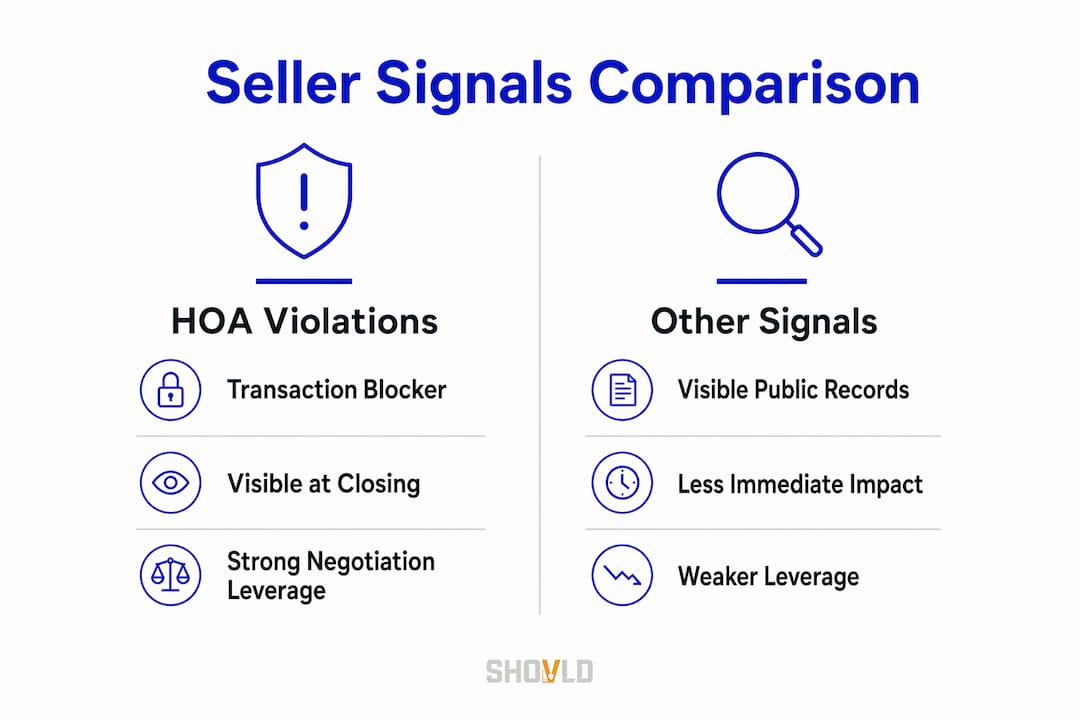
Probate records and tax delinquency are visible in public records, which means more investors are already watching them. HOA violations are largely invisible until you request the right documents. That information asymmetry is the real advantage for buyers who know where to look. For a deeper look at how tax delinquency compounds seller pressure, the combination with HOA violations creates some of the most motivated sellers in any market.
Condo communities and new subdivisions deserve special attention. HOA enforcement in these settings is typically more aggressive and more consistent, which means violations there carry a higher probability of creating genuine seller urgency compared to a loosely managed older neighborhood.
Key takeaways
HOA violations are the most direct transaction-blocking signal in real estate, and sellers carrying unresolved violations are measurably more likely to negotiate on price, terms, or both.
PointDetailsEstoppel certificates are the keyUnresolved violations block estoppel issuance, halting lender funding and title insurance at closing.Violation age and count matterSix or more months open and three or more simultaneous violations are the strongest motivation heuristics.Violations are invisible in title searchesBuyers must request HOA account histories and estoppel certificates directly; standard searches miss them.Sellers prioritize speed over priceSellers with open violations often accept lower offers to secure a fast, certain close.Cross-signal research multiplies leverageCombining HOA violations with tax delinquency or probate data identifies the most motivated sellers.
What i’ve learned watching HOA violations derail closings
I have watched deals fall apart in the final week because a seller assumed their HOA violations were minor and would not affect closing. They were wrong every time. The estoppel process does not grade violations by severity. An unapproved fence and a $50,000 unpaid fine carry the same blocking power when the title company needs a clean certificate.
What surprises most buyers is how invisible this pressure is from the outside. A property can look pristine and list at full market value while carrying three open violations and $8,000 in accrued fines that will surface only when the estoppel comes back. The seller often does not fully understand their own exposure until that document arrives.
The sellers I have seen move fastest are not always the ones in the worst financial shape. They are the ones who have been fighting with their HOA for years and are simply exhausted. That emotional fatigue translates into real flexibility. They want the problem gone more than they want the last dollar of equity.
The trend worth watching in 2026 is HOA enforcement escalation in Sun Belt markets, particularly South Florida and parts of Texas and Arizona. Communities built in the 2000s are aging, reserve funds are strained, and boards are enforcing rules more aggressively to protect property values. That enforcement pressure is creating a new wave of motivated sellers who did not expect to be in this position. Buyers who track HOA pressure in South Florida and similar markets right now are finding opportunities that the broader market has not priced in yet.
— Avi
How Shovld helps you find these signals before the market does
HOA violation data is scattered across management companies, county records, and internal HOA systems. Pulling it together manually is slow, and slow means you miss the window before a property lists publicly.

Shovld aggregates HOA pressure signals, code violations, permit activity, and distressed-property indicators across multiple U.S. markets into a single scored feed. Instead of chasing individual records, you see which properties are accumulating the signals that predict motivated sellers. Shovld’s platform is built for real estate investors, agents, and contractors who want to act before the crowd does. Explore Shovld’s signal intelligence plans to see how the platform fits your market strategy, or visit what Shovld does for a full breakdown of its tracking capabilities.
FAQ
What is an HOA estoppel certificate?
An HOA estoppel certificate is a legally binding document that confirms the current status of dues, fines, and open violations on a property. Lenders and title companies require it before funding or insuring a transaction.
Do HOA violations show up in a standard title search?
No. HOA violations are internal records and do not appear in standard county title searches. Buyers must request estoppel certificates or detailed HOA account statements to uncover them.
How many violations indicate a truly motivated seller?
Three or more simultaneous open violations, or any violation open for six or more months, are the standard heuristics for identifying a motivated seller. Violation age and multiplicity both increase the probability that a seller will negotiate.
Can a buyer negotiate based on open HOA violations?
Yes. Open violations give buyers leverage to request price reductions, seller-paid cure costs, or closing credits. The seller’s need for a clean estoppel certificate creates a hard deadline that strengthens the buyer’s position.
Are HOA violations more useful than other distress signals?
HOA violations are unique because they directly block the closing mechanism through estoppel certification. Other signals like tax delinquency or probate records are more visible in public records, which means more competition. HOA violations offer information asymmetry to buyers who know how to find them.