
How to Use Public Records for Leads That Convert
Public records are government-held documents that any professional can access to identify real business opportunities before competitors do. Contractors, real estate investors, public adjusters, and restoration companies that use public records for leads consistently find prospects at the earliest stage of need, before those prospects ever post a job or list a property. The governing frameworks for access include the Freedom of Information Act (FOIA), state open records laws, and federal court systems like PACER. This article explains which records matter most, how to access them efficiently, and how to convert raw data into a predictable pipeline.
What public records work best for lead generation?
Public records lead generation starts with knowing which document types carry the strongest signals. Not all government data is equally useful. The records below consistently produce the highest-quality prospects across construction, real estate, and professional services.
Building permits: Filed before any project starts, permits reveal property owners who have already committed to spending money. A permit for a roof replacement or structural repair is a direct signal of contractor need.
Business license filings: New business registrations at the Secretary of State level identify entrepreneurs who need services ranging from commercial insurance to office buildout.
Property records and deed transfers: Recent sales, liens, and ownership changes signal buyers, sellers, and distressed owners who may need professional help.
Court records via PACER: Federal civil filings, bankruptcies, and judgments identify businesses and individuals under financial pressure, which creates demand for legal, financial, and restoration services.
Code violations and municipal citations: Properties cited for code violations are statistically more likely to need contractor work, remediation, or investor attention.
Corporate filings: Annual reports, registered agent changes, and dissolution filings reveal companies in transition, which creates openings for vendors and service providers.
Government registry data is more accurate than third-party scraped lead databases because legal filings carry penalties for false information. That accuracy advantage is the core reason professionals prioritize public sources over purchased lists.
How to access public records efficiently

Access methods vary by record type and jurisdiction. Federal records fall under FOIA, which carries a 20-business-day response window, with state variations such as New York’s 5-day acknowledgment requirement and California’s 10-day allowance. State and county records follow their own open records statutes, which differ significantly.
For federal court records, PACER charges $0.10 per page with a $3 cap per document, and fees are waived if quarterly charges fall under $30. That makes PACER one of the most cost-effective sources for legal and financial signal data.
Narrow, specific FOIA requests produce faster responses and better results. Agencies struggle with vague or broad queries. Before filing, check existing FOIA libraries, which many federal agencies maintain publicly, to avoid requesting data that is already available.
Pro Tip: Search your county recorder’s website and your state’s Secretary of State portal before filing any formal records request. Most property deeds, business filings, and permit records are available online at no cost.
How do you turn raw public data into usable leads?
Raw public records are signal sources, not finished lead lists. Public records require human or AI enrichment to become sales-ready. The gap between a permit filing and a qualified prospect is where most professionals lose time. A structured workflow closes that gap.
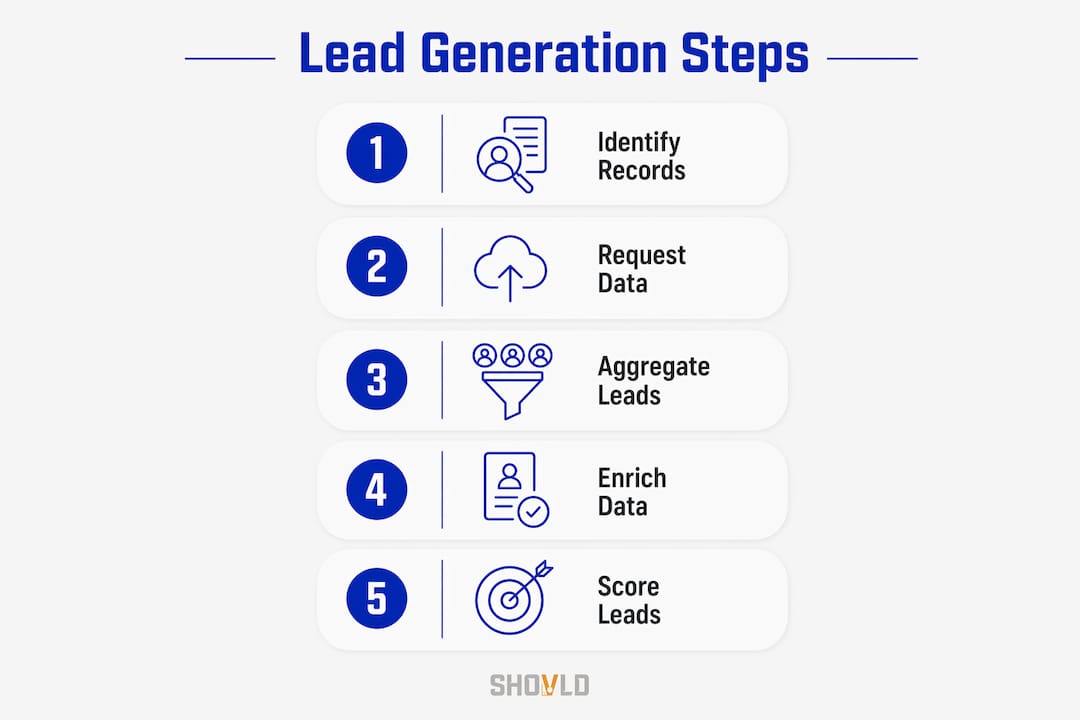
The four-step enrichment workflow
Retrieve the raw record. Pull the target data from the relevant portal, whether that is a county permit database, a Secretary of State filing system, or PACER. Export or copy the key fields: owner name, property address, filing date, and record type.
Enrich with contact and firmographic data. AI enrichment tools append verified emails, LinkedIn profiles, phone numbers, and employee counts to raw records. Clay is one widely used platform for this step. The output is a record that now includes both the signal and the contact details needed to act on it.
Review and qualify manually. Not every permit or filing represents a real opportunity. A human review step filters out duplicate records, out-of-territory properties, and signals that do not match your service profile. This step protects your outreach quality.
Prepare and sequence outreach. Organize qualified leads by signal type and timing. A permit filed three days ago is a warmer prospect than one filed six months ago. Sequence outreach to prioritize recency.
Experienced prospectors treat public records as signal layers on top of base lists from LinkedIn or Google, customizing outreach timing and messaging based on the specific signal type. A bankruptcy filing calls for a different message than a new building permit.
Automating data monitoring through aggregation tools or APIs is more efficient than manual lookup. Most government portals are designed for single queries, not bulk data pulls. Automation handles the volume problem and flags new filings as they appear.
Pro Tip: Set up automated alerts for permit filings and Secretary of State registrations in your target markets. Shovld tracks these signals across multiple U.S. markets and scores them so you act on the strongest opportunities first. Learn how AI finds contractor opportunities before the market reacts.
What are the biggest mistakes when using public records for leads?
Public records prospecting fails most often because of process errors, not data quality. The mistakes below account for the majority of wasted time and poor results.
Assuming all records are digitized. Significant public records remain in paper format and require in-person visits or mailed requests. County courthouses, older permit archives, and some municipal records still require physical access. Plan for this before building a workflow that depends entirely on online retrieval.
Treating records as ready-to-use lead lists. A permit filing contains an address and an owner name. It does not contain a phone number, an email, or a decision-maker title. Skipping the enrichment step produces outreach that cannot reach anyone.
Filing vague FOIA requests. Broad requests slow down response times and often result in denials or heavily redacted documents. Specificity is the single most controllable variable in FOIA success.
Ignoring record age. A code violation filed 18 months ago may already be resolved. Recency filters are not optional. They are the difference between a live lead and a dead one.
Overlooking jurisdiction differences. A workflow that works in Texas may not work in Massachusetts. State open records laws, fee structures, and portal designs vary widely. Build jurisdiction-specific processes.
“Public records give you the signal. Your workflow determines whether that signal becomes revenue.”
The professionals who build predictable pipelines from public data are not working harder than their competitors. They are working earlier. They see the permit before the project goes to bid. They see the violation before the property lists. That timing advantage is the entire value of the method.
What compliance rules apply to public records prospecting?
Extracting leads from public databases is legal, but the way you use that data carries real obligations. Compliance is not a secondary concern. It protects your reputation and your business.
Respect privacy exemptions. Not all government-held data is public. Medical records, juvenile court files, certain law enforcement records, and sealed court documents are exempt from disclosure. Accessing exempt records through unauthorized means is a federal offense.
Verify before you contact. Contacting someone based on inaccurate or outdated data wastes your time and damages your credibility. Verification through enrichment tools or direct confirmation is a required step, not an optional one.
Follow CAN-SPAM and TCPA rules. Email and phone outreach based on public records must comply with federal anti-spam and telemarketing statutes. Consent requirements, opt-out mechanisms, and do-not-call list checks apply regardless of how you sourced the contact.
Avoid harassment patterns. Contacting the same prospect repeatedly based on a single public record signal crosses from prospecting into harassment. Build cadence limits into your outreach sequences.
Document your sources. Maintaining a record of where each lead originated protects you in the event of a compliance dispute. A public record due diligence checklist is a practical tool for keeping this documentation consistent.
Compliance with state and federal transparency statutes is not just a legal requirement. It is a competitive advantage. Professionals who operate cleanly build reputations that generate referrals. Those who cut corners burn through markets.
Key Takeaways
Public records are the most accurate and legally accessible source of early-stage lead signals available to professionals, but they require structured enrichment workflows and compliance practices to produce results.
PointDetailsStart with high-signal record typesPermits, code violations, and corporate filings consistently produce the strongest early-stage leads.Enrich every raw recordAppend contact data and firmographics before outreach; raw records alone cannot be acted on.Automate monitoring for volumeAPIs and aggregation tools handle bulk filings far more efficiently than manual portal searches.File narrow FOIA requestsSpecific, detailed requests produce faster responses and fewer redactions than broad queries.Comply before you contactVerify data accuracy and follow CAN-SPAM, TCPA, and state privacy rules on every outreach sequence.
Why I think most professionals are leaving this opportunity on the table
Most professionals I talk to have heard of public records. Very few have built a real workflow around them. The common objection is that the data is too raw, too scattered, or too hard to access at scale. That objection was valid five years ago. It is not valid now.
The combination of AI enrichment and automated monitoring has changed the math entirely. What used to take a researcher two days now takes a well-configured workflow two hours. The professionals who figure this out first in any given market gain a timing advantage that is genuinely hard to replicate. They are not competing for the same crowded opportunities. They are finding needs before those needs become visible to anyone else.
The real mistake is treating public records as a research tool rather than a prospecting engine. The data is not the product. The workflow is the product. Build the workflow, automate the monitoring, enrich the signals, and you have a pipeline that generates opportunities continuously. That is a fundamentally different position than waiting for referrals or bidding on posted jobs. I have seen contractors and investors completely change their business model once they internalize this. The records were always there. The method just needed to catch up.
For real estate investors specifically, AI-aggregated property signals from permits and deed transfers represent one of the clearest early-warning systems available in any market.
— Avi
Shovld turns public record signals into scored opportunities
Shovld is built for professionals who want to act before the market reacts. The platform tracks permits, code violations, HOA pressure, distressed-property indicators, and municipal records across multiple U.S. markets, then scores each signal so you know which opportunities to prioritize.

Manual public records research produces signals. Shovld produces a ranked pipeline. The platform appends enrichment data automatically, filters by territory, and surfaces the strongest opportunities first. Contractors, restoration companies, real estate investors, and public adjusters use Shovld to find work before it is posted anywhere. Review the Shovld pricing plans to find the tier that fits your market and volume.
FAQ
What are public records used for in lead generation?
Public records serve as signal sources that identify businesses and property owners at the moment of need. Permits, code violations, corporate filings, and court records all indicate specific circumstances that create demand for professional services.
How do I access public records for prospecting?
Federal records are available through FOIA requests and PACER. State and county records are accessible through open records portals, Secretary of State websites, and county recorder offices. Most property and business filing data is available online at no cost.
Are public records accurate enough to use for outreach?
Government registry data is more reliable than third-party scraped databases because legal filings carry penalties for false information. Accuracy improves further when raw records are verified through AI enrichment before outreach.
Do I need to comply with privacy laws when using public records?
Yes. CAN-SPAM, TCPA, and state privacy statutes apply to all outreach regardless of how you sourced the contact. Exempt records such as medical files and sealed court documents cannot be accessed or used for prospecting.
How does Shovld help with public records lead generation?
Shovld monitors public record signals across multiple U.S. markets, scores each opportunity, and delivers a ranked pipeline to contractors, investors, and restoration professionals. The platform replaces manual research with automated, enriched signal intelligence.