
Expired Listings and Off-Market Strategy: 2026 Guide
Expired listings are properties whose listing agreements ended without a sale, and they represent the highest-value entry point in any off-market real estate strategy. Unlike cold leads from portals, these sellers have already signaled motivation by listing once. They know the market, they’ve experienced failure, and they’re ready for a different approach. The role of expired listings in off-market strategy is not a niche tactic. It’s a repeatable acquisition channel that outperforms traditional lead sources when executed with the right timing, compliance awareness, and outreach framework.
Why do listings expire and what opportunities does this create?
Listings expire when a seller’s agreement with their agent ends before a buyer is found. The agreement has a fixed term, and when that term closes without a signed contract, the listing status changes to “expired” in the MLS. That moment is your window.
The most common causes of expiration fall into five categories:
Overpricing: The seller’s price expectation exceeded what the market would bear.
Poor marketing: Limited photography, weak listing copy, or minimal digital exposure reduced buyer interest.
Access issues: Restrictive showing schedules or tenant-occupied properties reduced foot traffic.
Agent communication gaps: Sellers felt uninformed and disengaged from the process.
Market timing: The property hit the market during a slow seasonal period.
Understanding which factor caused the expiration is the foundation of a strong off-market offer. A seller who failed because of pricing needs a different conversation than one who failed because of poor marketing. Diagnosing the cause lets you frame a solution rather than just another pitch.
Pro Tip: Before contacting any expired seller, verify the listing status in the MLS. A withdrawn listing still has an active contract. Contacting that seller directly can violate your state’s agency rules. Expired and withdrawn statuses are legally distinct, and confusing them is one of the fastest ways to create a compliance problem.
Sellers with expired listings have already gone through the emotional process of listing their home. They’ve had showings, received feedback, and watched their listing sit. That experience creates a specific kind of motivation. They’re not curious about selling. They’re committed to it. That distinction matters enormously when you’re building an off-market pipeline.
How do expired listings outperform traditional leads?
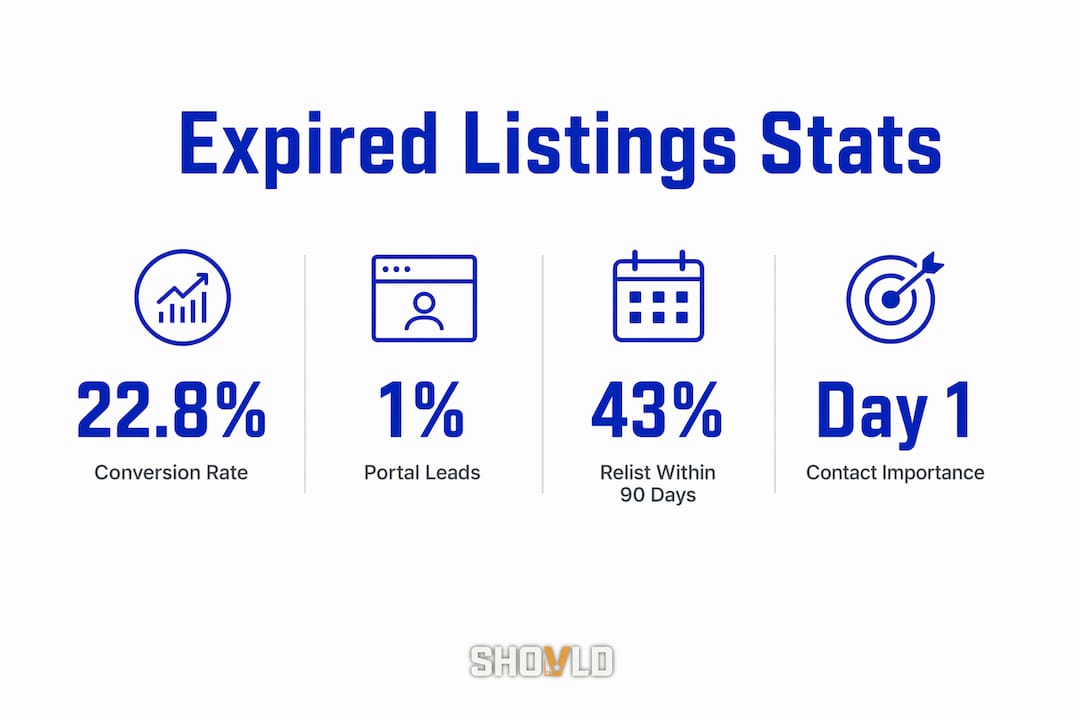
The conversion gap between expired listings and portal leads is not marginal. Expired listings convert at about 22.8%, based on REDX and Ylopo analysis of 2.7 million leads. Portal leads convert near 1% annually. That is a structural difference, not a cyclical one.
Lead TypeConversion RateSeller Motivation LevelTypical Outreach WindowExpired listings~22.8%High (proven intent)Day 1 to 90 days post-expirationPortal buyer leads~1%VariableOngoingCold direct mailSub-1%UnknownOngoingReferral leadsVariesModerate to highImmediate
The reason expired listings convert so much higher is structural. These leads represent pre-qualified seller intent, not passive interest. The seller has already made the decision to sell. Your job is to solve the problem that stopped them the first time.
“Expired listings differ from portal leads not just in conversion rate but in the entire economic structure of the engagement. The seller is already in motion. You’re not creating demand. You’re meeting it.” — LabCoat Agents, 2026
Timing is the other critical variable. Around 43% of expired listings relist within 90 days, with the average relist window sitting at 45 days. That means your outreach cadence cannot be passive. Agents and investors who wait a week to follow up are often contacting sellers who have already signed with someone else.
The practical implication is clear. Day 1 contact is not optional. It’s the standard. Sellers who don’t respond immediately are not disqualified. A CRM-based follow-up sequence extending to 90 days captures the sellers who need time to process before they’re ready to engage. The agents who win these listings are the ones who stay in contact without being aggressive.
What compliance rules apply to expired listing outreach?
Off-market outreach is not a compliance-free zone. Agents and investors who treat expired listings as an unregulated channel create serious legal exposure for themselves.
The core compliance requirements for expired listing outreach include:
Explicit seller consent: Any off-market marketing of a property requires documented authorization from the seller. You cannot market a property you don’t represent without written permission.
Fair Housing compliance: Off-market listing marketing requires adherence to Fair Housing rules to prevent discriminatory targeting of buyers or selective exposure based on protected class characteristics.
MLS rules on limited exposure: The coming soon status in MLS is a seller-authorized, regulated approach to limited exposure marketing. It is not a workaround for standard MLS rules. Local MLS boards set specific timelines and showing restrictions that must be followed.
Documentation: Every communication with an expired seller should be logged. If a dispute arises about representation or solicitation, your records are your defense.
The distinction between expired and withdrawn listings is not just procedural. Withdrawn listings still carry active listing contracts, meaning the seller is still legally represented by another agent. Contacting them directly without authorization can trigger ethics complaints and state licensing board investigations.
Compliance is not a barrier to off-market strategy. It’s the structure that makes the strategy sustainable. Agents who document consent, verify listing status, and follow MLS rules build a repeatable process. Those who skip these steps build a liability.
How to integrate expired listings into your off-market strategy
A practical expired listings strategy has three phases: research, outreach, and follow-up. Each phase has specific actions that determine whether you win the listing or lose it to someone faster.
Phase 1: Research before you call
Verify the listing status in your MLS. Confirm the listing is expired, not withdrawn or active with a new agent.
Pull market comps for the property. Understand what the market would actually bear and where the prior listing was priced relative to that.
Review the prior listing for marketing quality. Check photo count, listing description, days on market, and price history.
Identify the likely failure cause. Pricing, marketing, or access? Your diagnosis shapes your entire conversation.
Phase 2: Day-1 outreach
Contact the seller on the first day the listing expires. Phone calls outperform letters on day 1. Your opening is not a pitch. It’s a question. Ask the seller what they felt went wrong. Let them tell you. Empathetic outreach that diagnoses listing failure without criticizing the prior agent builds trust faster than any script.
Frame your off-market offer around fixing the specific problem they experienced. If pricing was the issue, show them a realistic comp analysis. If marketing was the issue, show them what a full-exposure campaign looks like. Offer framing built around solving the prior failure outperforms generic pitches and lowball offers every time.

Pro Tip: Never criticize the seller’s prior agent by name. It reads as unprofessional and puts the seller on the defensive. Instead, say something like: “It sounds like the approach didn’t match what the market needed at that time. Here’s what I’d do differently.” That framing positions you as a problem-solver, not a critic.
Phase 3: Sustained CRM follow-up
Most expired sellers don’t sign with the first agent who calls. They evaluate options. Effective follow-up requires a CRM-based contact cadence that runs for up to 90 days. That means scheduled calls, emails, and text touchpoints spaced across the full relist window.
Platforms like Shovld help agents and investors track distressed-property signals and public-record data across multiple markets, giving you early visibility into properties before they even hit the expired status. That kind of pre-market property intelligence turns a reactive expired listing search into a proactive acquisition pipeline.
Key Takeaways
Expired listings convert at roughly 22.8% compared to portal leads near 1%, making them the highest-ROI lead source available for off-market acquisition when outreach is timely, compliant, and tailored to the seller’s prior failure.
PointDetailsExpired listings are pre-qualified leadsSellers have already committed to selling, making them far more responsive than cold or portal leads.Timing is the deciding factorAround 43% of expired listings relist within 90 days, so day-1 contact and a 90-day CRM cadence are non-negotiable.Compliance protects your pipelineVerify expired vs. withdrawn status before outreach and document all seller consent to avoid licensing and Fair Housing violations.Diagnose before you pitchIdentifying the cause of listing failure (pricing, marketing, access) lets you frame a targeted solution instead of a generic offer.Technology extends your reachSignal intelligence tools like Shovld surface distressed-property indicators early, giving you a head start before listings formally expire.
Why expired listings reward preparation more than persistence
I’ve watched agents burn through expired listing lists by calling fast and saying nothing useful. The speed is right. The preparation is wrong. The sellers who respond best are the ones who feel heard in the first 60 seconds of a call. That only happens when you’ve already reviewed their listing, pulled their comps, and formed a clear opinion about what went wrong.
The off-market angle adds another layer. Off-market deals trade a smaller buyer pool for privacy and seller control. Not every expired seller wants that. Some want maximum exposure the second time around. The mistake is assuming every expired listing is an off-market opportunity. The better approach is to ask the seller what they actually want from the next attempt, then position your offer around that answer.
The compliance piece is where I see the most avoidable mistakes in 2026. Agents who confuse withdrawn listings with expired ones, or who market properties without documented consent, are not cutting corners. They’re building a liability that will catch up with them. The agents who treat compliance as a competitive advantage, not a burden, are the ones building durable pipelines.
The trend I’m watching closely is the convergence of signal intelligence and expired listing prospecting. Tools that track permit activity, code violations, and deferred maintenance patterns give you visibility into properties that are likely to expire before they actually do. That’s not a prediction. That’s a timing advantage. The agents and investors who act on early signals rather than waiting for the MLS to update are the ones who will own this channel in the next few years.
— Avi
How Shovld helps you act before the listing expires
Expired listings are a strong off-market channel. The agents and investors who win them consistently are the ones who combine fast outreach with early intelligence.

Shovld is an AI-powered signal intelligence platform that tracks permits, code violations, HOA pressure, distressed-property indicators, and municipal records across multiple U.S. markets. It surfaces verified, scored opportunities before they become crowded. For agents and investors building an off-market acquisition pipeline, Shovld gives you the early visibility that turns reactive prospecting into a predictable process. Review the Shovld pricing plans to find the option that fits your market and deal volume.
FAQ
What is the role of expired listings in off-market strategy?
Expired listings serve as pre-qualified, motivated seller leads whose listing agreements ended without a sale. They form a core off-market acquisition channel because the seller has already demonstrated intent to sell and is open to new approaches.
How do I find expired listings?
Expired listings are accessible through MLS access, which agents have directly, and through prospecting platforms like REDX that aggregate expired listing data daily. Always verify the status is expired and not withdrawn before making contact.
Why do expired listings convert so much better than portal leads?
Expired listings convert at about 22.8% compared to roughly 1% for portal leads because the seller has already committed to selling. Portal leads are often early-stage browsers with no firm intent.
What is the difference between an expired and a withdrawn listing?
An expired listing has a fully ended listing agreement, making the seller free to work with any agent or investor. A withdrawn listing still carries an active contract, meaning direct outreach without authorization can violate agency rules.
How long should I follow up with an expired seller?
A follow-up cadence of up to 90 days is the standard best practice. Since roughly 43% of expired listings relist within that window, sustained CRM-driven contact captures sellers who need time before they’re ready to commit to a new approach.