
How Foreclosure Activity Drives Contractor Work in 2026
Foreclosure activity is the single most reliable catalyst for contractor work in distressed property markets. When filings rise, so does the volume of cleanouts, repairs, and full renovations that banks, servicers, and investors need completed before resale. U.S. foreclosure filings reached a six-year high in early 2026, with completed foreclosures up 45% year over year and average foreclosure timelines shrinking by 14%. That compression matters. Faster timelines mean properties move from filing to rehab-ready faster, and contractors who understand how foreclosure activity drives contractor work are positioned to capture that volume before the crowd arrives.
How foreclosure activity drives contractor work today
The 2026 foreclosure environment is not a sudden spike. It is a sustained wave building across multiple regions, and it is creating a predictable pipeline of renovation and restoration work for contractors who know where to look.
Foreclosure filings rose 32% year over year in january 2026 alone. That volume translates directly into REO inventory, which is bank-owned property that must be inspected, repaired, and prepared for resale. Every REO property is a potential project.
The Foreclosure Index hit 52.4 in june 2026, a 46.4% year-over-year increase. That number reflects how much faster distressed properties are cycling through the system. Shorter timelines reduce the window for contractors to get in front of servicers, which makes early identification critical.
RegionForeclosure Pressure LevelPrimary Work TypeSouth (FL, TX, GA)Very HighFull rehab, cleanout, roof repairMidwest (OH, IL, MI)HighDeferred maintenance, interior renovationWest (CA, AZ, NV)Moderate to HighCosmetic rehab, code complianceNortheast (NY, NJ, PA)ModerateStructural repair, winterization
Pro Tip: Track REO inventory listings in your target market weekly. When bank-owned listings cluster in a zip code, that area is entering peak contractor demand. Shovld monitors distressed-property signals across public records so you can spot these clusters before they show up on general listing platforms.
Why economic pressures are amplifying foreclosure-driven renovation demand
Tariffs on imported building materials are reshaping the economics of both new construction and renovation. Tariffs raised new construction costs by $9,200 to $17,500 per home in 2026. That cost increase pushes buyers and investors toward existing homes, including foreclosed properties, rather than new builds.
The ripple effect is direct. When new construction becomes too expensive, demand shifts to renovation work on existing stock. Foreclosed homes, which already sell at a discount, become the most financially viable option for investors who need to control acquisition costs. That investor demand creates contractor work.
Rising property taxes, insurance premiums, and escrow costs are also pushing more homeowners into foreclosure. These are not mortgage-rate problems alone. They are cost-of-ownership problems that affect a broad range of property types and price points.
The economic drivers linking foreclosure rates to contractor demand include:
Tariff-driven cost increases making new construction unaffordable and redirecting investment to existing homes
Rising insurance and tax burdens accelerating foreclosure filings among overleveraged owners
Slowed new construction concentrating renovation demand on existing and distressed properties
Compressed foreclosure timelines increasing the pace at which REO properties enter the rehab pipeline
Investor acquisition activity at foreclosure auctions creating immediate demand for repair and renovation crews
Pro Tip: When new construction slows in a market, watch for a corresponding increase in permit activity on existing homes. That permit surge signals renovation demand. Shovld tracks permit data across U.S. markets in real time.
What types of work foreclosed properties generate and how to find them
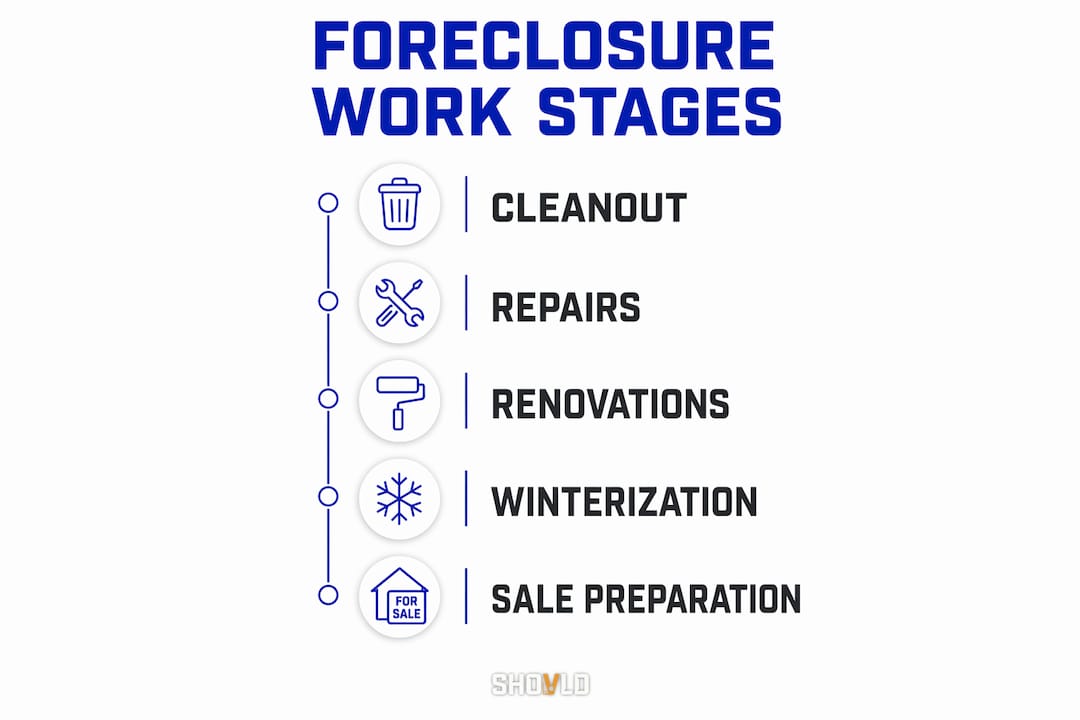
Foreclosed properties generate work across a wide range of trades and project types. The sequence is predictable. Cleanout comes first, then inspection, then repair, then cosmetic renovation for resale.
Cleanout phases are critical but often under-budgeted, leading to delayed inspections and higher holding costs. Debris removal must happen before any trade can conduct accurate measurements or assessments. Contractors who specialize in cleanout work have a reliable entry point into the foreclosure pipeline because they are always first in the door.
After cleanout, work orders typically include roof assessment, HVAC inspection, plumbing repair, electrical updates, and full interior renovation depending on the property’s condition and the investor’s exit strategy. The flow of work orders through servicers runs through national vendors and subcontractors before reaching field technicians. Margins get extracted at each layer. Contractors who access work higher in that chain earn significantly more per project.
Here is how to access foreclosure-driven work pipelines before they get crowded:
Register directly with mortgage servicers. Major servicers maintain approved vendor lists. Getting on those lists puts you ahead of the subcontractor layers.
Monitor pre-foreclosure filings. Properties in default are 90 to 180 days from REO status. That window is your lead time. Identifying pre-foreclosure properties early gives you time to build relationships before the work order is issued.
Build relationships with REO agents. Real estate agents who specialize in bank-owned properties control access to a steady stream of renovation projects.
Track code violations and deferred maintenance signals. Properties accumulating violations are often heading toward foreclosure. Shovld surfaces these signals from public records before they become common knowledge.
Attend foreclosure auctions. Investors who buy at auction need contractors immediately. Being present at auctions puts you in front of buyers at the exact moment they need your services.
Work TypeTypical TimingPayment ReliabilityCleanout and debris removalImmediately post-REOModerate (servicer-dependent)Structural and safety repairsPre-listingHigh (investor-funded)Cosmetic renovation for resalePre-listingHigh (investor-funded)Winterization and preservationSeasonal, ongoingModerate (servicer-dependent)Full rehab for rental conversionPost-acquisitionHigh (direct investor contract)
What legal and operational risks come with foreclosure work
Foreclosure work carries real legal exposure that contractors must understand before signing any agreement. The most dangerous misconception is that a construction lien guarantees payment. It does not.
A construction lien recorded after a bank’s mortgage is often worthless in foreclosure. When a bank forecloses, it wipes out junior liens. If your lien was recorded after the mortgage, you may receive nothing. Understanding mortgage priority and your state’s relation-back laws is not optional. It is the difference between getting paid and absorbing a total loss.
In Florida, lien deadlines require claims to be recorded within 90 days and lawsuits filed within one year. Every state has its own timeline. Missing a deadline extinguishes your rights entirely. 70% of general contractors experienced work stoppages in 2023 due to payment disputes. That statistic reflects how common payment failure is in this space.
Best practices for managing foreclosure-related contracts and payments:
Verify mortgage priority before starting work. Pull title records to confirm whether any existing mortgage predates your lien rights.
Get written authorization to enter. Institutional foreclosure processes shift liability to field technicians. Written entry authorization protects you legally.
Require a deposit or partial payment upfront. Servicer workflows are slow. A deposit protects your cash flow while work is in progress.
Document everything on site. Photos, timestamps, and written condition reports create a paper trail that supports payment disputes.
Know your state’s lien recording deadlines. Calendar them immediately when a project starts. Missing them costs you your only legal recourse.
Pro Tip: Before accepting a work order through a national vendor, calculate your net payment after all layers take their cut. If the margin does not cover your labor and materials with room for risk, decline the job and pursue direct servicer relationships instead.
How regional foreclosure trends shape contractor work volume
Foreclosure pressure is not uniform across the country. The South leads the nation in foreclosure filings, with Florida markets like Tampa Bay consistently ranking among the highest in the U.S. That concentration creates intense contractor demand in specific metro areas, but it also means competition is fierce.
New construction thrives in high-foreclosure areas like Tampa Bay because builders can undercut resale prices and offer financing incentives. This creates a two-tiered market. Contractors who work on foreclosed properties compete against new builds for buyer attention, which pushes investors to renovate more aggressively to remain competitive on price and condition.
The Midwest presents a different dynamic. Midwestern mortgage markets reflect a prolonged plateau in construction activity and sustained high foreclosure levels. This is a grind market, not a spike market. Work volume is steady but not explosive. Contractors in Ohio, Illinois, and Michigan benefit from consistent deferred-maintenance and interior renovation demand rather than large-scale rehab projects.
The Northeast moves slowly due to longer judicial foreclosure timelines. Properties take longer to reach REO status, which means the pipeline is smaller but more predictable. Contractors who build servicer relationships early in the Northeast face less competition because fewer contractors are willing to wait out the longer timeline.
Practical guidance by region:
South: Prioritize speed and volume. Build servicer relationships and cleanout capacity to handle high turnover.
Midwest: Focus on deferred maintenance and interior renovation. Long-term servicer contracts provide steady income in grind markets.
West: Target code compliance and cosmetic rehab. Investor activity is high and renovation budgets tend to be larger.
Northeast: Build relationships early and be patient. The slower pipeline rewards contractors who are already approved when properties finally reach REO status.
Key takeaways
Foreclosure activity drives contractor work by creating a predictable pipeline of cleanout, repair, and renovation projects that flows from filing through REO status to resale-ready condition.
PointDetailsForeclosure filings are at a six-year highCompleted foreclosures rose 45% year over year in 2026, expanding the REO pipeline significantly.Economic pressures amplify demandTariff-driven cost increases of up to $17,500 per new home are redirecting investment to foreclosed properties.Cleanout is the entry pointDebris removal must happen before any trade can inspect or measure, making cleanout contractors first in the door.Lien priority determines paymentA lien recorded after a bank’s mortgage is often wiped out in foreclosure, making title research non-negotiable.Regional strategy mattersSouthern markets offer high volume, Midwestern markets offer steady grind work, and the Northeast rewards early relationships.
What I’ve learned about timing in foreclosure markets
The contractors who struggle in foreclosure markets are not the ones who lack skills. They are the ones who show up late. By the time a property appears on a general listing platform as REO, three or four contractors have already submitted bids. You are playing in a commoditized market at that point, competing on price alone.
The contractors who build real pipelines from foreclosure activity do one thing differently. They get in front of the signal before it becomes public. That means tracking pre-foreclosure filings, code violations, and deferred maintenance patterns rather than waiting for a work order to land in your inbox. The timing problem in construction is not a skills gap. It is an information gap.
Economic cycles will keep producing foreclosure waves. The 2026 surge is not the last one. Contractors who build systems for early identification now will have a structural advantage in every future cycle. That means investing in data, building servicer relationships before you need them, and understanding the legal landscape well enough to protect your margins.
The contractors I have seen grow through downturns are not lucky. They are early. They treat public records as a prospecting tool, not a confirmation of what everyone already knows.
— Avi
Shovld gives contractors early visibility into foreclosure-driven work
Shovld is an AI-powered signal intelligence platform built for contractors, restoration companies, and real estate investors who want to act before the market reacts.

Shovld tracks permits, code violations, distressed-property indicators, HOA pressure, and municipal records across multiple U.S. markets. It transforms that scattered public data into verified, scored opportunities so you can identify undervalued properties needing work before they hit the REO pipeline. When foreclosure filings are rising at a six-year high, the contractors who win are the ones with early visibility. Review Shovld’s signal intelligence plans and see which markets you should be watching right now.
FAQ
How does foreclosure activity create contractor work?
Foreclosure activity creates contractor work by generating REO properties that require cleanout, repair, and renovation before resale. Every completed foreclosure is a potential project for contractors who are positioned in the servicer pipeline.
What types of work are most common on foreclosed properties?
The most common work types are debris cleanout, structural and safety repairs, cosmetic renovation, and winterization. Cleanout is always first and is critical because no other trade can begin until the property is cleared.
Are construction liens reliable protection on foreclosure projects?
A construction lien recorded after a bank’s mortgage is often wiped out when the bank forecloses. Contractors must verify mortgage priority and know their state’s lien recording deadlines before starting any foreclosure-related project.
Which U.S. regions have the most foreclosure-driven contractor work in 2026?
Southern states, particularly Florida, lead the nation in foreclosure filings and REO volume. The Midwest offers steady deferred-maintenance work, while the West and Northeast present different opportunity profiles based on local market conditions and foreclosure timelines.
How can contractors find foreclosure work before it gets competitive?
Contractors find foreclosure work early by monitoring pre-foreclosure filings, registering directly with mortgage servicers, building relationships with REO agents, and tracking public-record signals like code violations and deferred maintenance. Shovld automates this signal tracking across multiple U.S. markets.