Opening Section
The Problem in Motion
A restoration contractor in Austin spends $3,000/month on lead generation platforms. She converts 15% of inquiries, which means she's paying roughly $200 per job that actually closes. But here's what kills the profit: by the time a homeowner posts on Google Ads or Angi, they've already called three other contractors. The negotiation starts with price, not quality. She's competing against 47 other restoration companies trying to win the same $8,000 roof claim.
Meanwhile, a contractor 30 miles away knows about the same property three weeks earlier. He's already walked it, given the estimate, and scheduled the work. The property owner never needed to post online. The price negotiation never happened.
Why Lead Generation Stopped Working
Contractors think the problem is "lead quality" or "conversion rates." They're wrong. The real problem is timing and commoditization. Lead generation platforms were revolutionary in 2012. In 2026, they're crowded marketplaces where everyone pays for the same inventory.
Here's what changed: Every lead on Google Ads, Angi, Thumbtack, Yelp, or any aggregator is simultaneously visible to dozens of competitors. The homeowner doesn't choose the contractor with the best work—they choose the one who called back in 20 minutes and offered the lowest price. Lead generation has turned jobs into auctions.
The contractors winning aren't smarter negotiators. They identified the opportunity before the auction started.
What You'll Learn
By the end of this article, you'll understand why signal intelligence is replacing lead generation as the contractor's competitive advantage. You'll see the specific patterns that identify opportunities weeks before they hit public platforms, the framework that separates winners from the crowded middle, and how to move first when it matters most.
Table of Contents
Why Lead Generation Is Broken (And How It Got That Way)
The Signal Intelligence Framework: Five Elements That Change Everything
How Early Signals Work in Practice: Real Contractor Wins
The Pattern Recognition That Separates Winners
Common Mistakes Contractors Make When Transitioning Away
FAQ: Questions Contractors Actually Ask
Why Lead Generation Is Broken (And How It Got That Way)
The Commoditization Problem
Lead generation platforms solved a real problem in the 2010s: homeowners had no way to contact contractors, and contractors had no way to reach homeowners. Angi and Thumbtack created marketplaces. Google surfaced contractors for local searches. Yelp aggregated reviews. This was genuine innovation.
By 2025, it became a commoditization trap.
A homeowner with a roof leak posts on three platforms simultaneously. They get 12-15 responses within an hour. The contractor with the lowest price and fastest response wins—not the best contractor. Contractors now bid against each other like Uber drivers fighting for surge pricing.
The math doesn't work anymore. A contractor needs a 30%+ conversion rate on lead generation inquiries just to break even on platform costs. Most are hitting 10-15%. The rest is margin erosion.
What Contractors Are Missing
The average contractor looks at this problem and concludes: "I need a better lead source" or "I need to get better at converting leads."
They're solving the wrong problem.
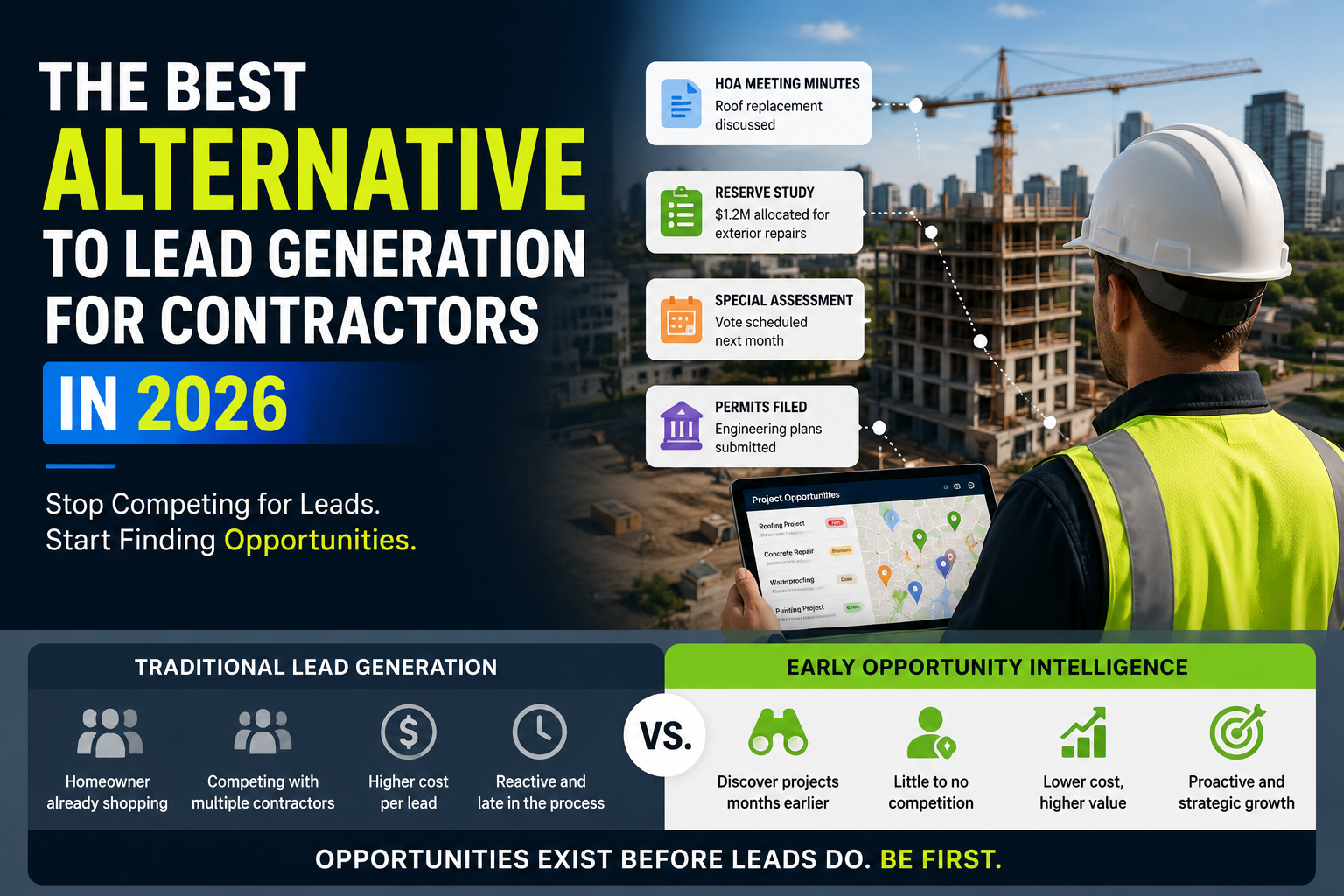
The real insight: Most opportunities never hit public lead generation platforms. They exist in the signal phase—before homeowners know they need to post online. A water stain appears on a ceiling. A permit gets filed for electrical work. An insurance claim gets processed. These signals exist in public records, industry databases, and market patterns weeks before the homeowner calls anyone.
Contractors who identify and move on these signals don't compete in the "respond fastest to an Angi inquiry" game. They're already writing the estimate.
The Signal Intelligence Framework: Five Elements That Change Everything
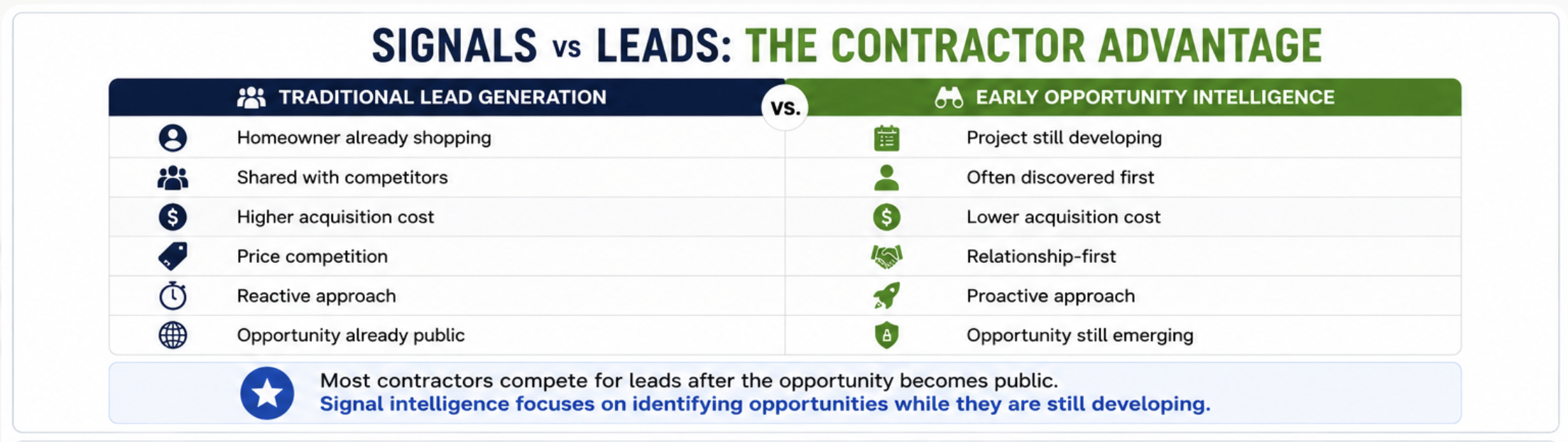
Signal intelligence is a fundamentally different approach to identifying contractor opportunities. It's not better lead conversion or smarter negotiation. It's identifying opportunities in the phase before they become public leads.
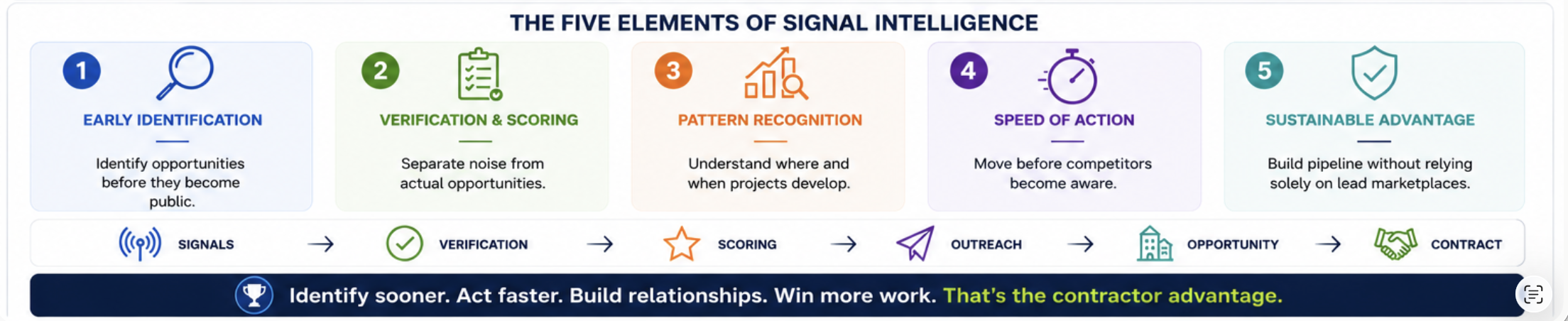
Here are the five elements that define it.
Element 1: Early Identification (The Timing Advantage)
A distressed property signal exists 3-6 weeks before it hits a lead generation platform. This might be an insurance claim, a permit filing, a property tax issue, or a code enforcement action. These signals are public information, but most contractors never look for them.
When you identify the property in week 1, you have 3 weeks to make contact before the homeowner posts online. You're the first call. You're not competing. You're the option they already said yes to.
Element 2: Verified and Scored (Not Every Signal Is Opportunity)
Not every signal indicates a contractor opportunity. A property tax assessment increase might be renovation, might be tax reassessment, might be unrelated. A permit might be for electrical work (not your specialty) or a deck you can't quote.
Signal intelligence systems verify whether signals align with actual contractor opportunities. They score signals by likelihood, recency, and property characteristics. A water claim on a 40-year-old roof in a heavy rain market is a higher-probability signal than a minor assessment increase.
This eliminates the waste of chasing cold signals that won't convert.
Element 3: Market Pattern Recognition (Seasonal and Geographic)
Contractor work isn't random. It follows patterns: water damage spikes after storms, permit activity concentrates in spring, specific neighborhoods have older properties more prone to roofing failures. When you understand your market's patterns, you can predict where signals will concentrate.
A contractor in Florida knows hurricane season drives roof claims. A Massachusetts contractor knows spring thaw creates foundation issues. A contractor in wildfire regions knows when insurance claims spike. Pattern recognition lets you focus where signals are highest-probability.
Element 4: Moving First (The Execution Advantage)
When you identify a signal, you have a narrow window to move before the homeowner calls three other contractors. This means calling directly, sending a mailer, or reaching out within 24-48 hours of signal identification.
Most contractors wait for the homeowner to post a job. You're calling before they know they need to post.
Element 5: Sustainable Competitive Advantage (Not Dependent on Auctions)
Lead generation creates a treadmill: You pay for leads, convert at declining rates, lower your price to compete, margins shrink, you need more leads to sustain the business. Signal intelligence breaks this cycle.
When you move on opportunities before they become public, you don't compete on price. You're the option they already chose. You control the negotiation. Your margins remain intact. Your cost per conversion doesn't spike as more competitors join the platform.
How Early Signals Work in Practice: Real Contractor Wins
Example 1: The Phoenix Restoration Contractor
A Phoenix restoration company identified a pattern in their market: neighborhoods with older homes experiencing water damage usually filed insurance claims within 14 days of the triggering event (burst pipe, roof failure, flooding). The company began tracking new insurance claims in their service area weekly.
In January, they identified 8 water damage claims filed across three neighborhoods. They called within 24 hours of claim filing. They booked 7 jobs. Total time to identify, contact, and book: 72 hours.
A contractor using lead generation platforms would wait for homeowners to post, then respond to 12+ competitors bidding on the same leads. This contractor had already signed contracts before the homeowner posted anything.
The difference in profit margin: The signal intelligence contractor negotiated from strength. The lead generation contractor negotiated from desperation.
Example 2: The Texas Roofing Company
A Texas roofing contractor noticed that severe hail events in their region created 3-6 week delays before contractors could physically complete repairs. The supply chain was broken, scheduling was saturated. Properties sat waiting for service.
The contractor began identifying hail damage claims (public event, public claims data, public property records) the day they were filed. Instead of competing 8 weeks later when the backlog cleared, they called within 48 hours when the property owner was still in shock about the damage.
By moving early, they didn't fight the scheduling crunch. They became the contractor the property owner chose first.
Example 3: The Specialty Contractor (Foundation)
A foundation contractor in Cincinnati realized that properties with foundation issues almost always had preceding signals: recent water claims, specific property ages, geographic concentration in flood plains. They created a targeting list of 400 high-probability properties based on public data.
They reached out to these properties proactively with an inspection offer. They converted 12% of outreach into jobs. A typical lead generation platform was converting at 8% for this contractor. The difference: They were moving on properties identified through patterns, not competing in auctions.
The Pattern Recognition That Separates Winners
Contractors winning through signal intelligence don't have magic. They've identified 3-4 patterns in their market that predict contractor opportunities.
Here's how to find yours:

Step 1: Identify Your Most Profitable Jobs
Look back at the last 20 jobs you completed. What did they have in common? Specific neighborhoods? Specific property ages? Specific claim types? These commonalities reveal patterns.
Step 2: Find the Data That Predicts Those Patterns
Once you know what your ideal jobs look like, find the public data that predicts them.
Insurance claims → Public claim filings
Permit work → Local permit databases
Distressed properties → Tax records, code enforcement, HOA actions
Storm damage → Weather events + property location
Foundation issues → Soil surveys, geological data, flood history
Step 3: Set Up Monitoring
You don't need AI. You need consistency. Check permit databases weekly. Monitor claim filings. Track weather events in your area. Identify properties that match your pattern. Call them.
Step 4: Move Fast
The window between signal identification and lead generation posting is 2-4 weeks. Use it. Call within 48 hours of identification.
Common Mistakes Contractors Make When Transitioning Away
Mistake 1: Thinking You Can Ignore Lead Generation Entirely
You probably shouldn't. Lead generation still works—it's just no longer your primary strategy. Use it as a secondary channel while you scale signal intelligence. You'll still get some inquiries; convert what comes in. But don't build your business on it.
The contractors winning are using signal intelligence as 70% of their pipeline and lead generation as 30%. They're not abandoning platforms. They're reducing dependence.
Mistake 2: Being Inconsistent With Outreach
Signal identification is only valuable if you act on it immediately. Contractors often identify signals, add properties to a "call later" list, and then never call. The window closes. The homeowner posts online. The opportunity becomes a lead generation auction.
The discipline that matters: Identify signals Tuesday, call Wednesday. Not "call when you have time."
Mistake 3: Not Tracking Which Signals Actually Convert
Not all patterns work equally. A contractor might identify 50 properties monthly based on permit activity, but only 10% convert to conversations. But maybe insurance claims convert at 35%. You need to track which signal types actually work in your market.
Without tracking, you're wasting time on low-probability signals and missing high-probability ones.
Mistake 4: Scaling Too Fast Without Infrastructure
Signal identification at 10 properties/month is manageable. At 100/month, you need a system. If you're manually tracking permit filings and calling everyone, you'll collapse when you hit scale. Build a simple system early (spreadsheet, basic CRM, or monitoring tool) so you can scale without burning out.
Mistake 5: Thinking This Is a Quick Fix
Some contractors think signal intelligence is a magic answer to lead generation cost. It's not a quick fix—it's a sustainable strategy that compounds. Week 1, you move on 8 signals and book 2 jobs. Month 4, you've refined patterns, increased volume, and book 8 jobs/month from signals. It takes 60-90 days to see real traction.
FAQ
Q: How do I find insurance claims and permit data in my area?
Most states and counties publish permit records publicly (usually through county assessor or building department websites). Insurance claim data is trickier—some states require insurance companies to file claim summaries publicly (check your state's insurance commissioner office). Property tax records, code enforcement actions, and HOA violations are public in most jurisdictions. Your county assessor's office can point you to the right databases. Some contractors hire a data service to monitor this; most start by checking permit and tax record sites weekly.
Q: How many signals do I need to identify to get one actual job?
This depends on signal quality, your area, and your follow-up speed. A contractor tracking high-quality signals (insurance claims on older properties matching their specialty) might convert 20-40% of identified signals to conversations, and 50-60% of conversations to jobs. A contractor tracking lower-quality signals (all permit filings regardless of type) might convert 5-10% to conversations. Start tracking your conversion rate for each signal type and optimize from there.
Q: Can I do this without hiring someone?
Yes, at the start. One contractor can monitor 50-100 signals monthly by spending 30 minutes twice a week checking public databases and making calls. As you scale to 300+ signals monthly, you'll need to hire someone or use a monitoring service. Most contractors start solo, then hire part-time help once they're confident the strategy works.
Q: What if I'm in a small town where there aren't many signals?
You'll have lower signal volume, which means you need higher conversion rate. The advantage is less competition—while three contractors are fighting over lead generation, you're the only one reaching out to signal-identified properties. In small markets, signal intelligence often has an even bigger advantage because everyone else is on the same lead generation platforms.
Q: How is this different from "cold calling"?
Cold calling is contacting random property owners hoping they need work. Signal intelligence is contacting properties where a triggering event (permit, claim, tax issue) indicates they likely need work. The conversion difference is massive: cold calling might convert 2-3%, signal intelligence converts 20-40%. You're reaching people who actually have a reason to need your service, not hoping they do.
Q: What if someone else in my area figures this out?
They will. But not immediately. When they do, the advantage shifts from "be the only one doing this" to "be the best at doing this." You'll have established relationships, reputation, process. They'll be starting. You'll win on speed and execution. Plus, the market is large enough that two contractors using signal intelligence in the same area can both book more jobs than they would fighting on lead generation.
Q: Can I use this with lead generation or do I have to choose?
Use both. Signal intelligence should be your primary strategy, but lead generation still works. You'll identify signals Monday through Friday, call on those properties, book jobs. Leads will still come through platforms. Convert them. The optimal strategy is 70-75% signal intelligence, 25-30% lead generation.
The Contractors Winning in 2026
The contractors thriving right now aren't using a different lead generation platform. They identified that the lead generation model itself is broken and built their business on something better.
They move on signals when homeowners are still researching. They don't compete in auctions. They control the conversation because they're the option the property owner already chose.
This isn't complicated. It's not AI. It's pattern recognition, consistency, and speed. Any contractor can do it. Most won't because it requires discipline and doesn't feel like the "quick fix" that lead generation promises.
The ones who commit to it win.