The Problem Nobody Wants to Talk About
The email lands at 6 AM on a Tuesday. "Emergency board meeting called for Thursday. Roof engineering report just came back. We need $2.3M. Your assessment is due by Friday."
This isn't a fictional scenario. It's the Tuesday morning reality for hundreds of property managers, real estate investors, and board members across South Florida's HOA community. And it's happening at a scale that would shock anyone not knee-deep in the restoration and property investment world.
South Florida's Homeowners Associations face a perfect storm: aging infrastructure, relentless salt air corrosion, hurricane damage that compounds annually, and approval bottlenecks that turn a $50K repair into a six-month saga. Meanwhile, restoration contractors and savvy real estate investors are sitting on a goldmine of opportunities—if only they knew where the problems were before they became emergencies.
South Florida HOA Repair Problems: The Three Pain Points
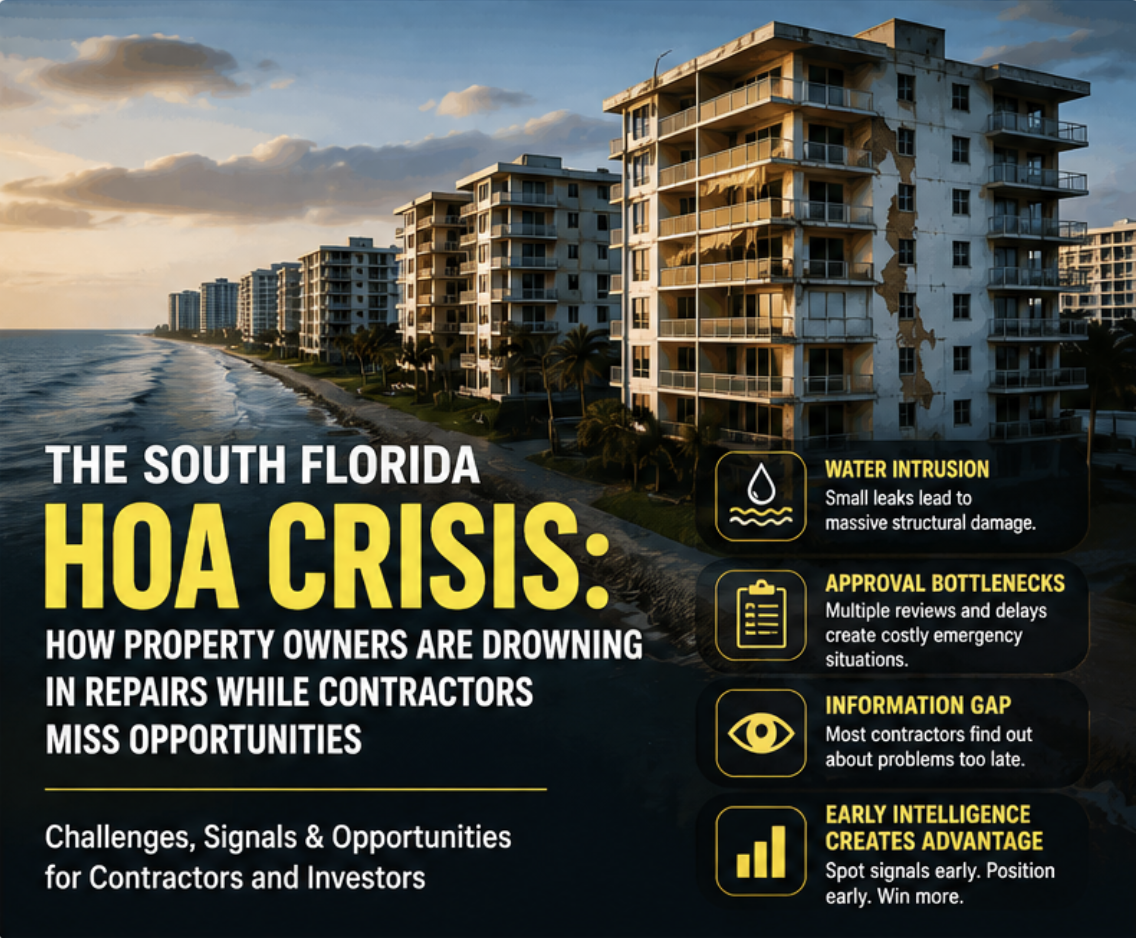
1. Water Intrusion Problems in South Florida Buildings: The Cascading Repair Problem
Jennifer Martinez manages a 200-unit oceanfront building in Boca Raton. She's been in HOA management for 12 years. Here's what she told us:
"We found water intrusion in Unit 401 three weeks ago. Looked like a simple roof leak. But once the engineer got in there, we found mold in the walls, structural damage behind the concrete, and failing sealant across the entire southeast-facing facade. What was supposed to be a $20K repair is now a $340K project—and we can't even get board approval because nobody wants to vote yes on that number without three more opinions."
This is textbook South Florida HOA math. Salt air eats through caulking and sealant. One small opening becomes a vector for moisture. That moisture finds its way into structural cavities. By the time it's discovered, you're not fixing a leak—you're remediating mold, replacing framing, and dealing with structural integrity that requires engineer sign-offs and special assessment approval.
The restoration contractors who thrive in this market aren't the ones who wait for emergency calls. They're the ones who know about problems before they hit the inspection reports. Early identification means planned budgets instead of emergency assessments. It means competitive bidding instead of desperation pricing. It means actually controlling the scope instead of watching it expand weekly.
2. HOA Special Assessments in South Florida: The Approval Bottleneck and Budget Crisis
Here's the hidden cost of HOA governance: bureaucracy.
A real estate investor, David Chen, acquired a 150-unit building in Miami Beach last year. He inherited a board that approves projects on a 30-day cycle. He found evidence of plumbing issues in the building infrastructure during a reserve study. Here's what he experienced:
"I identified the problem in March. Board meeting in April. Voted to get bids in May. Three contractors submitted proposals in June. Board wanted more time to review. We reconvened in July. Turns out two board members wanted their own contractor's opinion. In August, we finally approved. By September, one of the problematic water lines had burst and damaged two units. That burst created $85K in additional damage that could have been prevented if we'd moved two months earlier. The board met every month. We still took seven months to approve a fix."
This isn't mismanagement. This is standard HOA governance. Boards have fiduciary duties. They need multiple bids. They need reserve studies. They need special meeting approvals for certain spending thresholds. All of that is responsible—but it creates windows where deterioration accelerates.
The smarter investors and contractors know one thing: the approval process is non-negotiable, but knowing about the problem early compresses that timeline dramatically. Instead of discovering an issue in Month 5 of a 7-month approval cycle, you discover it in Month 1. You're positioned to bid competitively. You're not scrambling. You're strategic.
3. How Contractors Find HOA Repair Opportunities: The Information Gap
Here's what nobody talks about in the restoration industry: most contractors don't know about a property's problems until the problems become someone else's emergency.
Maria Rodriguez runs a mid-sized restoration company in Fort Lauderdale. She waits for phone calls. Her business is reactive. When a pipe bursts or a roof fails and the board finally approves emergency repairs, Maria gets the call—along with five other contractors. By then, the scope is determined. The timeline is determined. The budget is locked. She's one of six bids.
But there's another layer. The best contractors could be reaching out earlier. They could be proposing pre-emptive assessments. They could be positioning themselves as trusted advisors instead of emergency responders. The problem is information. They don't know which buildings have aging infrastructure. They don't know which HOAs are vulnerable. They don't know where moisture is creeping into concrete. They don't know about unpermitted repairs. They don't know about deferred maintenance sitting in reserve studies.
This is where intelligence becomes currency.
HOA Infrastructure Risk for Investors and Restoration Contractors
For Real Estate Investors: If you own or are evaluating HOA properties in South Florida, infrastructure risk is your single largest variable cost. A building with known, manageable infrastructure issues is a different investment than one with deferred problems hiding in structural cavities. Early visibility into what's actually wrong—before you acquire it or inherit it—changes your acquisition strategy, your pricing model, and your exit timeline.
For Restoration Contractors: You're not competing on price alone. You're competing on position. The contractor who can tell a property manager about emerging problems is infinitely more valuable than the contractor who shows up after the emergency call. You're moving from reactive service provider to strategic partner. That's a different margin structure.
The Path Forward: Moving Earlier Than Your Competitors
The contractors and investors winning in South Florida's HOA market share one characteristic: they have intelligence before problems become emergencies.
They know about HOA special assessments before they're announced. They understand reserve studies that flag aging infrastructure. They're aware of permit records showing unpermitted modifications that create liability. They see patterns in maintenance requests. They understand building science well enough to connect salt-air corrosion to structural vulnerability.
This intelligence advantage compounds. When you know a building is vulnerable to water intrusion—that its facade sealant is aging, that its structural envelope is deteriorating—you can position your services strategically. You can offer diagnostic work that leads to planned repairs. You can build relationships with property managers based on foresight instead of crisis.
[If you're curious about how property intelligence works in practice, check out what Shovld does to understand how contractors and investors access construction signals before they become public opportunities.]
When you're evaluating whether to acquire an HOA building, you can identify infrastructure risk before the inspection uncovers it. You can price accordingly. You can decide whether the repair burden fits your investment thesis.
The winner in South Florida's HOA market isn't the company that responds fastest to emergencies. It's the company that sees problems early.
And seeing those problems early requires moving beyond traditional reactive channels. It requires access to signal data—HOA meeting minutes, permit records, contractor bids, assessment history, maintenance patterns—the breadcrumbs that indicate building health before structural engineers are required.
What Should You Be Watching?
If you're a real estate investor or restoration contractor operating in South Florida, the HOAs that matter are the ones showing early signals:
Buildings with aging reserves (reserve studies showing 10+ year-old infrastructure)
Salt-air exposure (oceanfront and near-oceanfront properties)
Unpermitted modifications (visible from permit records; liability indicator)
Inconsistent maintenance patterns (board transitions, budget cuts, deferred work)
Recent engineering assessments (somebody already identified a problem; others are coming)
Special assessment history (pattern of large unexpected costs)
These signals exist in public records. They exist in HOA communications. They exist in building documentation. The question isn't whether the information is available. The question is whether you have the tools to see it before everyone else does.
The Competitive Advantage in 2026
The HOA market in South Florida is competitive. But it's not equally competitive. The information advantage is real. The contractors with early visibility to property condition—who know about infrastructure risk before special assessments are called—are winning business and margins that reactive competitors can't touch.
The real estate investors who can identify buildings with manageable infrastructure issues (versus catastrophic ones) are pricing deals more accurately and executing exits on their timeline, not the board's.
Both groups share something: they moved earlier than their competitors because they saw the signals first.
How Construction Signal Intelligence Helps You Move Earlier
Moving earlier than competitors requires visibility. You need to see what's actually happening inside buildings—not after emergencies, but while problems are still manageable.
For real estate investors: Early visibility to building condition changes your investment thesis entirely. You can price risk accurately. You can time acquisitions around repair cycles. You can identify undervalued buildings where infrastructure problems are known and manageable rather than hidden and catastrophic.
For restoration contractors: Early visibility transforms your business model. You're not competing on price with five other emergency responders. You're the advisor who can tell property managers what's coming. You're building relationships based on foresight. That's a completely different margin structure.
The intelligence layer matters more than you think.
[Learn more about how Shovld helps contractors and investors see construction signals before they become emergencies.] Or explore our guide to construction signal intelligence for more on how to identify building risk before others do.
FAQ: South Florida HOA Challenges and Opportunities
Q: What are the most common HOA infrastructure problems in South Florida? A: The big three are salt-air corrosion of exterior elements (sealants, metal framing, cladding), water intrusion through aging envelope systems, and structural damage from hurricane impacts compounded by deferred maintenance. Plumbing failures are also common in older buildings.
Q: How long does it typically take to get HOA approval for major repairs? A: The formal process takes 60-90 days minimum, but in practice, from problem identification to approved project is 4-8 months in many South Florida HOAs. This varies based on assessment thresholds and board structure. Early identification can compress this timeline by several months.
Q: Where can restoration contractors find HOA leads? A: Reserve studies, permit records, HOA meeting minutes, and historical assessment data are all public. Shovld surfaces these signals to help contractors and investors move earlier.
Q: What's the cost difference between planned versus emergency repairs in South Florida HOAs? A: Emergency repairs can substantially exceed planned repair costs due to compressed timelines, limited contractor availability, emergency mobilization fees, and expanding scope. A project that could have been executed methodically becomes expensive when rushed.
Q: How do I evaluate infrastructure risk when acquiring an HOA property? A: Start with reserve studies (identify what they flagged as aging). Review permit history (unpermitted work suggests deferred compliance). Analyze assessment history (patterns indicate vulnerability). Check building science: salt-air exposure is a primary indicator. Finally, understand what's actually failing by talking to property managers about maintenance calls.
Q: What's the timeline for water intrusion damage to become structural damage? A: In South Florida's climate, water intrusion can escalate into structural deterioration surprisingly quickly if left unresolved. Salt air accelerates corrosion. Moisture in structural cavities doesn't just cause rot—it corrodes rebar and weakens concrete. This is why early detection matters so much.
Q: How does knowing about a problem early change your contractor positioning? A: You move from price-based competition to value-based positioning. You can offer diagnostic services, reserve planning input, and strategic phasing. You become an advisor, not just a service provider.
The Bottom Line
South Florida's HOA challenges are real. They're also predictable. The buildings facing infrastructure crises aren't mysterious—they're buildings showing identifiable signals: aging infrastructure, salt-air exposure, maintenance patterns, permit history, and assessment trends.
The contractors thriving in this market aren't the fastest responders to emergencies. They're the ones who see the signals before emergencies happen. They move earlier. They position strategically. They win.
The same applies to real estate investors. The ones making smart acquisition decisions aren't the ones surprised by special assessments. They're the ones who understood the building's actual infrastructure risk before they made an offer.
The competitive advantage in South Florida's HOA market is visibility. The question is whether you have it.