The scenarios and contractor profiles in this article are representative examples based on common construction and
contracting industry experiences. They illustrate real patterns and dynamics observed across residential, commercial, and
restoration markets.
The Core Problem Nobody Addresses
A homeowner wakes up to water stains on their ceiling. They Google "water damage repair near me."
Fourteen contractors appear in search results. They call three. They pick the cheapest. Your margin
on that call—if you even get it—is already destroyed.
This scene repeats thousands of times every single day across the construction industry. And it
represents a fundamental timing problem that most contractors don't even recognize they have.
By the time a property owner searches for a contractor, they're not looking for options anymore.
They're looking for whoever can show up fastest. The problem has matured. The damage has
spread. The urgency has set in. Competitors have already been contacted. The market has
commoditized what should be a strategic opportunity into a price-driven emergency call.
The construction industry doesn't have a marketing problem. It has a timing problem.
Most contractors don't enter an opportunity at the right time. They enter when someone else's
emergency becomes visible—after the damage, after the desperation, after the competitive field has
already crowded around the same fire. By then, you're not selling expertise. You're selling speed and
availability. Margins collapse. Relationships feel transactional. The contract goes to the low bidder.
Meanwhile, the contractors and service companies winning right now—the ones with predictable
revenue, strong margins, and loyal clients—entered those opportunities months or years before the
problem became an emergency.
The Reactive Contractor Model: Why Most Construction Businesses Stay
Stuck
Here's what typical contractor operations look like:
Phone rings. Homeowner has a problem. Contractor shows up. Contractor solves it.
Contractor gets paid.That's the reactive model. It works. It generates revenue. But it has a fatal flaw: you have zero
control over timing.
Tom Henderson owns a mid-sized general contracting firm in the Southeast. He's been in business
for 15 years. He told us this:
I spend about $800 a month on Google Ads. I'm competing against nine other contractors for the
same search terms. When a lead comes in, I'm already the fifth person they've called. They've got
a budget in their head, and we've all got maybe 15 minutes to undercut each other on price. My
best clients don't come from Google. They come from referrals—and those referrals only happen
because I've done good work for someone. But that good work is reactive. I'm always fixing
something that's already broken. I'm never getting ahead of the problem.
This is the trap that most contractors never escape.
They spend money on ads, SEO, and lead generation tools trying to be first among the people
already searching for solutions. But they're not entering the market earlier. They're just trying to win a
crowd of competitors who all showed up too late.
The real problem isn't visibility. It's timing.
Why The Lead Generation Industry Became Overcrowded
The lead generation space exploded because someone figured out a simple formula: Capture
people actively searching for contractors, and sell access to that traffic.
Google Ads, Facebook Ads, Angi, Thumbtack, HomeAdvisor, JustAnswer—they all follow the same
playbook. They monetize desperation.
A homeowner has a water leak. They search "emergency plumber." Ten ads appear. Each contractor
paid $15-40 per click. The homeowner calls whoever answers fastest. The contractor who won the
lead didn't win because they're better. They won because they had the fastest response time and
lowest price.
Sarah Chen runs a kitchen remodeling business in California. She describes the economics this way:
I used to spend $3,000 a month on Google Ads. For that money, I was getting maybe 8-10 leads.
Conversion rate was about 20%, so I'd close 1-2 projects. Revenue per project was maybe
$15,000. The math worked, but barely. Every month felt like I was fighting for scraps against fifty
other remodelers. Then I realized something: the people searching for kitchen remodeling aren't
the ones with the best budgets. They're the people whose kitchens failed them—broken cabinets,
leaking pipes, failed appliances. By the time they're searching, their problem is urgent and they've
got budget anxiety. They want cheap and fast, not good and strategic.The lead generation platforms didn't break the construction industry. They just monetized what was
already broken about it: the absence of early visibility.
When you don't know about a property problem until someone gets desperate enough to search for it,
you're playing in a commoditized market. Thirty contractors are competing for the same desperate
homeowner. The one with the most aggressive pricing and fastest response time wins. Everyone else
loses. Margins evaporate.
Why Timing Matters More Than Ad Spend
Here's a heretical idea in construction marketing: Spending more money on ads doesn't solve the
timing problem. It just makes you more visible to the people who are already too late.
The contractors winning right now—the ones with 8-12 month pipelines, predictable revenue, and
margins that actually cover their overhead—aren't winning because they found a better Facebook
audience or figured out SEO. They're winning because they entered the opportunity earlier.
They knew about the roof problem before the emergency call. They understood the plumbing issue
before the burst pipe. They identified the structural concern before the engineering inspection forced
the issue.
This isn't magic. It's visibility into building condition and property risk before catastrophe strikes.
Contractor A pays for ads, gets leads from desperate homeowners, competes on price, closes 30%
of conversations, achieves 18% net margins.
Contractor B knows about emerging property problems weeks or months before the crisis hits. They
reach out to property managers and owners proactively. They position themselves as advisors, not
emergency responders. They close 65% of conversations. They achieve 35% net margins.
Who spent more on marketing? Contractor A. Who has better business? Contractor B.
The difference isn't ad strategy. It's timing.
The Signal Intelligence Advantage: Moving Earlier Than Desperation
The construction industry runs on desperation. A roof fails. A pipe bursts. Mold appears. A foundation
cracks. Then someone calls a contractor.
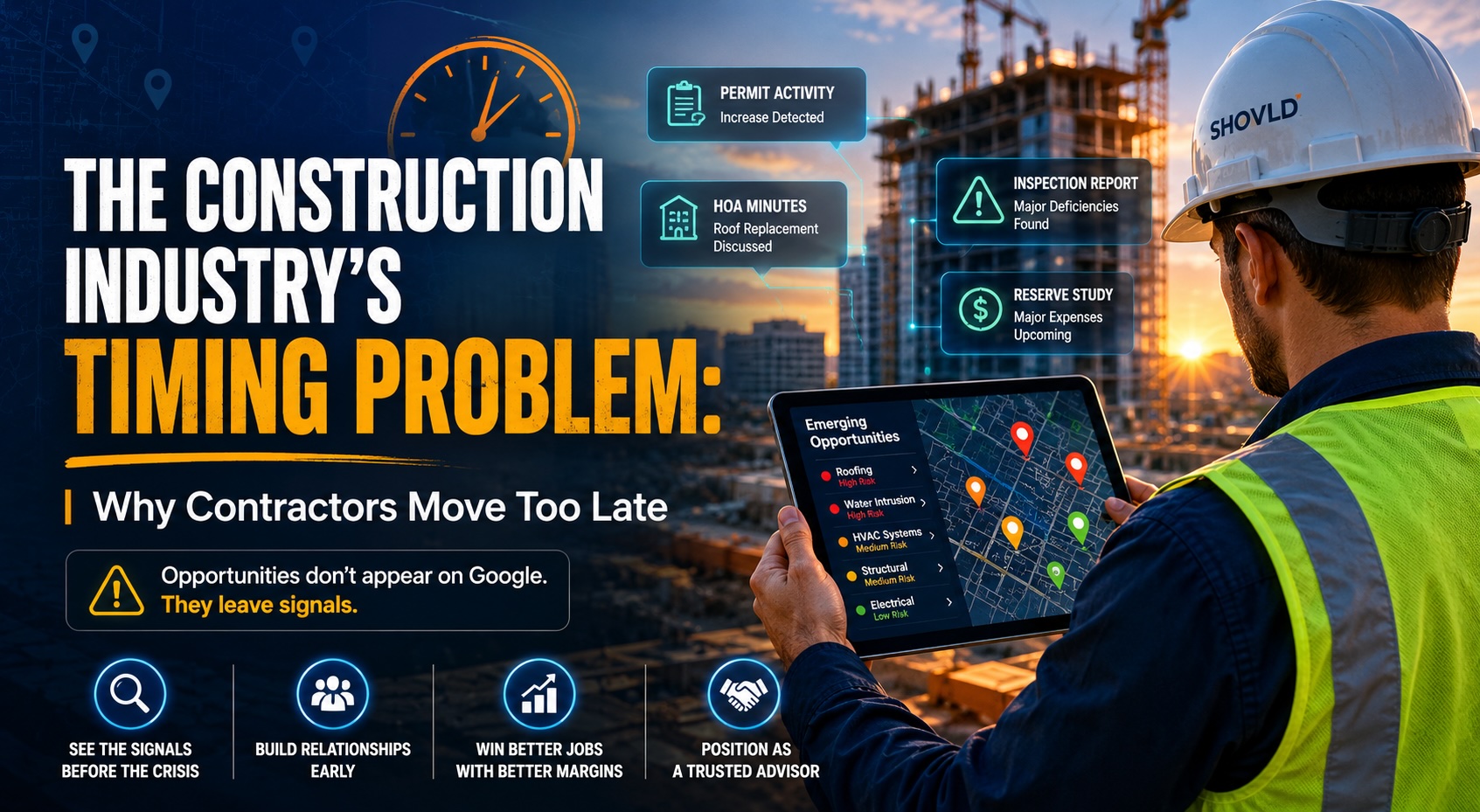
But buildings don't fail overnight. They show signals. Months or years of visible indicators exist before
the emergency:Permit records showing aging infrastructure
Maintenance request patterns suggesting deterioration
Reserve studies flagging aging systems
HOA meeting minutes discussing deferred maintenance
Assessment history showing budget stress
Inspection reports identifying vulnerability
These signals are public. They're accessible. They're visible months before the property owner
becomes desperate enough to call a contractor.
The contractors and companies moving earlier than competitors aren't finding them through ads.
They're seeing them in signal data.
Mike Rodriguez runs a commercial restoration company in Miami. His shift happened when he
started monitoring permit records and inspection reports in his target markets.
We used to respond to emergency water damage calls. Typical project: $15,000, thin margins,
one-off relationship. Now we're seeing a pattern in permit records—large commercial buildings
with aging HVAC systems failing in Q3. We reach out in May. By September, when the system
typically fails, we've already done diagnostic work, priced the fix, and built trust. The project is
$80,000 instead of $15,000. The margin is real. We're not competing on price. We're the advisor
who told them the problem was coming.
This is what timing advantage looks like. And it doesn't require better ads. It requires earlier visibility.
What Separates Contractors Who Win From Those Who Don't
The contractors with strong margins, loyal clients, and predictable pipelines share one thing: they
have visibility into property problems before they become emergencies.
They're not chasing Google leads. They're not bidding against seventeen competitors. They're not
selling on price.
They're positioned as trusted advisors because they saw something coming that the property owner
didn't expect.
For that to work, you need three things:
1. Early visibility — Knowing about a property problem weeks or months before the crisis hits
2. Strategic positioning — Being the person who can tell a property manager "this is developing into
something bigger"
3. Relationship value — Being perceived as an advisor who helps with planning, not just an
emergency responderMost contractors never get past #1. They don't have access to property signal data. So they wait for
desperation instead.
The ones who do have that access move earlier. They control the timing. They own the relationship.
They own the margin.
The Path Forward: Seeing Signals Before Your Competitors Do
The competitive landscape in construction isn't about who has the best website or the most
aggressive ad budget. It's about who sees problems before they become visible to everyone else.
Buildings in your market show identifiable signals right now. Old permit history. Deferred maintenance
patterns. Reserve studies flagging aging infrastructure. HOA special assessment trends.
Maintenance request escalations. These signals exist in public records. They exist in building
documentation. They exist in permit databases and inspection reports.
The question isn't whether the signals are available. The question is whether you have the tools to
see them before everyone else does.
If you want to understand how property signal intelligence works in practice, explore what Shovld
does at getshovld.com to see how contractors access construction signals before they become
visible emergencies.
When you can see that a commercial building's HVAC system is aging, its maintenance patterns are
escalating, and its reserve study flagged mechanical systems—you can reach out before the
breakdown. You're not responding to desperation. You're offering foresight. That's a completely
different position.
When you can identify that a residential property has aging plumbing, unpermitted modifications that
create liability, and moisture issues emerging in inspection reports—you can offer diagnostic work
that leads to planned repairs. You're an advisor. You're building relationships based on value, not
crisis response.
The contractor who sees problems early doesn't compete on price. They compete on visibility.
What Should You Be Monitoring?
If you're a contractor or service company operating in a specific market, the properties worth your
attention are the ones showing signal patterns:
Aging infrastructure indicators (permit records showing 15+ year-old systems)
Maintenance escalation patterns (increasing service calls, budget concerns)
Recent inspections or assessments (somebody already identified a problem; others are coming)Deferred maintenance history (visible from permit records and property documentation)
HOA special assessment trends (pattern of large unexpected costs)
Permit activity changes (sudden increase in repair permits suggests emerging issues)
Reserve study flags (commercial and multi-family properties with aging infrastructure noted)
These signals exist in public records. They exist in building systems data. They exist in inspection
reports. The question isn't whether the information is available. The question is whether you have
access to it before your competitors do.FAQ: Construction Timing and Opportunity Discovery
Q: If I'm already getting work through Google Ads, why should I care about early signals?
A: Google Ads puts you in a bidding war with nineteen other contractors for the same desperate
homeowner. Signal intelligence puts you in a conversation with one property owner who isn't yet
desperate—and you're the only one in that conversation. The economics are completely different.
Q: How far in advance can I see construction problems in signal data?
A: It varies, but typically you can see emerging issues 4-12 weeks before they become crisis-level.
Reserve studies flag aging infrastructure months in advance. Permit records show deferred maintenance
patterns. Inspection reports identify vulnerability long before failure. The earlier you see it, the better your
position.
Q: Isn't cold outreach to property managers going to feel pushy?
A: Only if you're selling something. If you're offering intelligence—"Your building's plumbing system shows
signs of aging based on permit history; this is emerging into a problem"—you're being valuable, not pushy.
You're an advisor sharing foresight.
Q: How do I get access to property signals and signal data?
A: Signals exist in public records: permit databases, inspection reports, HOA meeting minutes, reserve
studies, assessment history, property documentation. The challenge is aggregating and monitoring them
across a market. That's where tools like Shovld come in—surfacing construction signals before they
become public emergencies.
Q: If I reach out early with signal intelligence, won't the property owner just call someone
cheaper later?
A: Possibly. But you've positioned yourself as the advisor who saw the problem coming. That's a different
relationship than the emergency responder they call after the crisis hits. You're competing on value and
foresight, not price. The relationship sticks.
Q: Does this strategy work for all types of construction businesses?
A: Signal intelligence works best for businesses that benefit from early visibility: contractors (plumbing,
HVAC, electrical, roofing, foundation), restoration companies, commercial maintenance, property
management advisory services, and real estate investment analysis. If your business benefits from
knowing about building problems before owners get desperate, signal intelligence gives you a competitive
advantage.
Q: How much should I spend on signal intelligence tools compared to ads?A: That depends on your business. But consider this: if you're spending $2,000/month on ads and closing
1-2 projects, try spending $500/month on signal intelligence tools instead and see what happens to your
close rate when you're positioning as an advisor instead of a commoditized responder. The ROI typically
improves dramatically.
Q: Can a solo contractor use this approach, or is it only for larger companies?
A: A solo contractor might actually benefit more. You can't compete with larger companies on ad spend or
response speed. But you can absolutely compete on expertise and early positioning. If you reach out as
the expert who identified an emerging problem, you're more valuable than the large company responding
to an emergency. Scale matters less than timing.
The Bottom Line
The construction industry has a timing problem. Contractors spend enormous money competing for
leads from property owners who are already desperate. By then, the opportunity is commoditized.
Margins collapse. Price competition dominates. Relationships feel transactional.
The contractors winning right now—the ones with strong margins, loyal clients, and predictable
revenue—entered those opportunities earlier. They had visibility into building problems before they
became emergencies. They positioned themselves as advisors instead of emergency responders.
They moved before desperation set in.
The good news: The signals that indicate emerging construction problems are visible months
before the crisis hits. Permit records, inspection reports, maintenance patterns, reserve studies,
assessment history—they all exist in public data. The contractors who monitor this data move earlier.
They own the relationship. They own the margin.
The bad news: Most contractors will never do this. They'll keep paying for ads, competing on price
with seventeen other contractors, and wondering why their margins are so thin. They'll stay stuck in
the reactive model.
But if you're the contractor willing to move earlier—if you build visibility into signal data—you're no
longer competing in the same market as everyone else.
You're competing on timing.
And timing beats ad spend every single time.