
How Probate Records Signal Motivated Sellers
Probate records are public estate documents that directly expose seller motivation by revealing executor authority, estate debts, hearing deadlines, and heir urgency in real time. Real estate investors who understand how probate records signal motivated sellers gain access to a category of lead that combines legal pressure, emotional distance, and financial necessity in a single file. Unlike pre-foreclosure or tax delinquency lists, probate leads carry a unique blend of time-bound legal process and heirs who often have no personal attachment to the property. Platforms like Tracerfy and ProbateData have built entire data businesses around this signal, pulling case numbers, executor details, estate values, and hearing dates directly from county court filings.
How probate records signal motivated sellers through key data points
Probate records contain specific fields that function as urgency indicators. Not every open probate case represents a motivated seller, but certain combinations of data points create a profile that is hard to ignore.
The most telling signals include:
Executor authority level. In California, Full IAEA authority allows a sale to close in 15 to 20 days after Letters Testamentary are issued, with no court confirmation required. Limited authority forces a court hearing, extending the timeline significantly. An executor with full authority who has already listed the property is operating under far less friction, which translates directly to negotiating flexibility.
Upcoming hearing dates. A court date within 30 to 60 days creates deadline pressure. Executors and heirs who have not yet accepted an offer at that point often become more receptive to reasonable terms.
Estate debt relative to appraised value. When an estate carries outstanding mortgages, liens, or tax obligations that approach or exceed the property’s value, the executor has a financial incentive to close quickly. This is one of the clearest motivation signals in any probate file.
Out-of-state or absentee executor address. An executor managing an estate from another state is paying carrying costs, dealing with remote logistics, and often has no emotional connection to the property. ProbateData identifies executor location as a core data point for gauging urgency.
Case filing date recency. A case filed within the past 60 to 90 days represents a fresh motivation window. Heirs are still in the early stages of decision-making, and outreach at this stage lands before the property hits the open market.
Inventory and appraisal filings. Once a Probate Referee appraisal is on file, you know the legal pricing floor. In California limited authority sales, offers must meet 90% of that appraised value, which shapes your offer strategy before you ever pick up the phone.
When three or more of these signals stack in a single case, the lead quality increases substantially. A recently filed case with an out-of-state executor, estate debt, and a hearing date approaching is not just a motivated seller. It is a seller with a deadline.
Pro Tip: Sort your probate pull by filing date first, then filter for out-of-state executor addresses. This two-step filter alone removes the majority of low-urgency cases from your working list.

How to research probate records for real estate lead generation
Finding probate leads requires working through public record systems that most investors never bother to learn. That friction is the advantage.
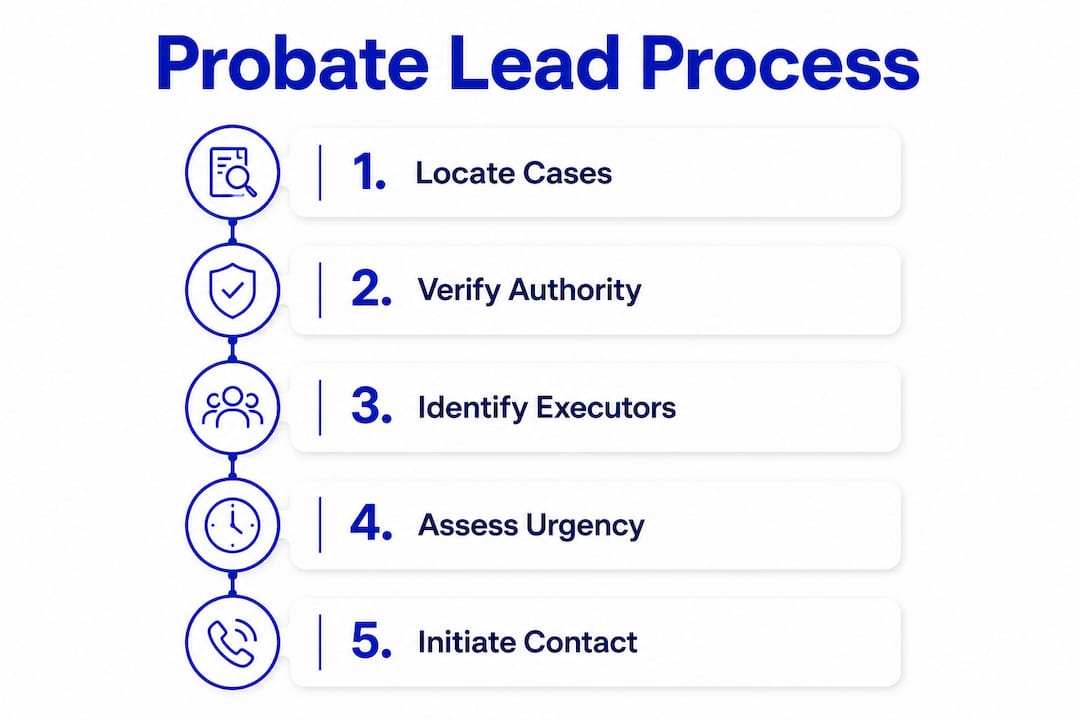
Follow this process to build a reliable probate lead pipeline:
Search county probate court records. Every county in the U.S. maintains a probate docket that is publicly accessible, either online or at the clerk’s office. Search by decedent name, case number, or filing date range. Many counties now offer online portals, though data quality and update frequency vary widely.
Use online probate databases. Services like Tracerfy pull on-demand probate data directly from county court records, giving you current estate activity rather than cached lists that may be months old. This distinction matters because a stale list means you are calling heirs who have already sold or are deep in escrow.
Cross-reference the county recorder and assessor. Once you have a case, check the county recorder for deed history and the assessor for ownership status. Properties still titled in the decedent’s name with no recent deed transfer are confirmed probate assets.
Recognize probate property indicators. Signs that a property is in probate include estate ownership on the deed, an executor mailing address that differs from the property address, no recent transfer recorded, and probate notices published in local legal newspapers.
Stack your list with additional distress signals. Combining probate leads with tax delinquency, vacancy indicators, absentee ownership, and code violations produces a significantly higher-quality working list. Each additional signal confirms that the seller’s motivation is not just legal but also financial and logistical.
Build outreach campaigns around the data. Direct mail, cold calling, and SMS campaigns each perform differently with probate leads. Direct mail to the executor’s address tends to outperform because it reaches the decision-maker directly rather than a property that may be vacant.
Pro Tip: Always order fresh, pull-on-demand probate data rather than purchasing cached lists. A list pulled today from live court records reflects actual estate activity. A list compiled three months ago may contain cases already closed, heirs who have moved on, or properties already under contract.
Here is how on-demand data compares to cached list purchases:
FactorOn-demand probate dataCached list purchaseData freshnessCurrent court filingsWeeks to months oldLead accuracyHighModerate to lowDuplicate riskLowHighCost per leadHigher upfrontLower upfrontConversion potentialSignificantly higherReduced by stale contacts
How probate signals compare to other motivated seller indicators
Probate motivation is distinct from every other distress category because it combines legal urgency with emotional detachment. Understanding where it sits relative to other signals helps you allocate outreach resources.
Pre-foreclosure sellers are motivated by fear of credit damage and loss of equity. Tax-delinquent owners are motivated by accumulating penalties and potential lien sales. Divorce-driven sellers are motivated by legal settlements and the need to divide assets. Probate sellers, by contrast, are often motivated by a combination of all three factors at once, plus the added layer that the property was never theirs to begin with. Heirs’ emotional detachment from inherited properties and their desire for quick liquidation produce a seller profile that is genuinely different from someone trying to save their own home.
The practical implication is that probate leads tend to carry more equity and less resistance to below-market offers than pre-foreclosure or divorce leads. The heir did not buy the property, did not build equity in it, and often has no interest in managing it. That psychology creates a negotiating environment that other distress categories rarely replicate.
Stacking multiple distress signals compounds this effect. A probate property that is also tax-delinquent and vacant is not just a motivated seller. It is a seller with three independent reasons to close fast.
Motivation categoryTypical seller behaviorLead qualityProbateEmotional distance, legal urgency, equity-richHighPre-foreclosureFear-driven, time-sensitive, equity variableHighTax delinquencyFinancial pressure, often absenteeModerate to highDivorceLegally compelled, emotionally chargedModerateVacancyPassive neglect, low engagementModerate
The pre-market property opportunity that probate creates is real, but it requires acting before the property is listed. Once an estate property hits the MLS, the motivation signal is still present, but the competitive advantage disappears.
How investors and buyers apply probate record insights to find motivated sellers
Knowing the signals is only half the work. Applying them inside a repeatable deal-sourcing system is what separates investors who close probate deals consistently from those who occasionally stumble into one.
Practical application starts with prioritization:
Sort leads by filing date and executor location first. Fresh cases with out-of-state executors represent the highest-urgency segment of any probate pull. Work this segment before anything else.
Structure offers around authority level. In California, court confirmation hearings involve overbid auctions with strict minimum increments. If you are working a limited authority case, price your initial offer knowing you may face competition at the confirmation hearing. Full authority cases allow faster, cleaner closings.
Verify executor authority before signing anything. Letters Testamentary or a Court Order are the documents that confirm the executor has legal standing to sell. Signing a purchase agreement with someone who lacks documented authority creates title issues that can collapse a deal at closing.
Integrate probate data into your CRM workflow. Tag each lead with the case filing date, authority level, hearing date, and executor location. Set follow-up reminders tied to court dates. An executor who ignored your first letter in month one may respond very differently in month three when a hearing is two weeks away.
Use exclusive data to reduce competition. Cached list purchases are often sold to multiple buyers simultaneously. On-demand pulls from live court records give you a window of exclusivity before the same data gets packaged and resold.
Pro Tip: Treat probate outreach as a relationship-building process, not a one-touch campaign. Heirs are often grieving and overwhelmed. A respectful, persistent follow-up sequence over 60 to 90 days consistently outperforms aggressive single-contact approaches.
The investors who build predictable pipelines from probate data are not doing anything exotic. They are pulling fresh data, stacking it with tax and vacancy signals, verifying authority before committing, and following up longer than their competition is willing to.
Key takeaways
Probate records are the most reliable public signal of motivated sellers because they combine legal deadlines, financial pressure, and emotional detachment in a single, searchable file.
PointDetailsExecutor authority determines urgencyFull IAEA authority enables faster closings; limited authority adds court confirmation delays.Signal stacking increases lead qualityCombining probate with tax delinquency, vacancy, and absentee data produces the highest-conversion leads.Fresh data outperforms cached listsOn-demand pulls from live court records reflect current estate activity and reduce wasted outreach.Verify authority before contractingLetters Testamentary or a Court Order must be confirmed to prevent deal collapse at closing.Probate motivation is structurally uniqueHeirs’ emotional distance and legal urgency create negotiating conditions other distress categories rarely match.
Why probate records are the signal most investors overlook
I have watched investors build entire acquisition businesses on pre-foreclosure lists while completely ignoring probate court filings sitting in the same county database. The reason is usually friction. Probate records require more steps to pull, more interpretation to score, and more patience to convert. That friction is exactly why the signal is worth pursuing.
The investors I have seen close the most probate deals share one habit: they treat executor authority as a non-negotiable due diligence item. Not a formality. Not something to check after the offer is signed. They verify Letters Testamentary before the first serious conversation. That single practice eliminates the deal failures that make other investors give up on probate entirely.
The other pattern I have noticed is that probate leads reward persistence in a way that other distress categories do not. A pre-foreclosure seller has a hard deadline forcing a decision. A probate heir may take six months to reach the same emotional readiness. Investors who build a 90-day follow-up sequence and stick to it consistently outperform those running single-touch campaigns. The deal that closes in month four was often contacted in month one.
The opportunity cost of ignoring probate in competitive markets is real. In markets where pre-foreclosure and tax delinquency lists are crowded around the same fire, probate records represent a less-competed, higher-equity segment that most investors have not bothered to learn. That gap closes over time, but right now it is still an edge worth building a system around.
— Avi
Find motivated sellers faster with Shovld

Shovld is a signal intelligence platform built for real estate investors and contractors who want to act before the market reacts. The platform aggregates probate indicators, code violations, permit activity, tax delinquency, vacancy signals, and HOA pressure across multiple U.S. markets, then scores and verifies each opportunity so you spend time on leads that are actually ready to move. Instead of pulling data from five separate sources and building your own stacking logic, Shovld delivers pre-scored, multi-signal opportunities in a single feed. Explore Shovld’s pricing plans to find the access tier that fits your market volume and deal flow goals.
FAQ
What makes probate records useful for finding motivated sellers?
Probate records expose executor authority, estate debts, hearing deadlines, and heir location, all of which signal urgency and willingness to sell below market. ProbateData identifies these data points as the core indicators of urgent sale potential in estate cases.
How do I find probate leads in my county?
Search your county’s probate court docket by decedent name or case number, either through the clerk’s online portal or in person. Services like Tracerfy also pull on-demand probate data directly from county records for faster, more current results.
What is list stacking in probate lead generation?
List stacking means combining probate status with additional distress signals such as tax delinquency, vacancy, or absentee ownership to identify sellers with multiple independent motivations. Stacking these signals significantly increases lead conversion rates compared to using any single data source alone.
Why does executor authority matter before making an offer?
An executor without documented authority cannot legally bind the estate to a sale agreement. Verifying Letters Testamentary or a Court Order before signing prevents title defects and deal collapse at closing.
How does probate motivation differ from pre-foreclosure motivation?
Probate sellers are motivated by legal deadlines and emotional detachment from inherited property, while pre-foreclosure sellers are driven by fear of credit damage and equity loss. Probate leads typically carry more equity and less resistance to negotiated pricing because heirs did not purchase the property themselves.