
How to Identify Absentee Owner Investment Targets
Absentee owner properties are defined as real estate where the owner’s mailing address differs from the property address in county tax records. These owners — landlords managing from a distance, out-of-state heirs, and investors who never occupied their assets — represent some of the most motivated sellers in any market. To identify absentee owner investment targets systematically, you need the right public records, a clean filtering workflow, and a strategy for stacking motivation signals that separates serious leads from noise. Tools like PropStream and PropertyRadar have made this process faster, but the underlying logic starts with a single data mismatch in a county assessor file.
How to identify absentee owner investment targets using public records
The foundation of any absentee owner strategy is the county tax assessor database. Every parcel record contains two address fields: the situs address (where the property sits) and the owner mailing address (where tax bills go). When those two fields don’t match, you have a confirmed absentee owner. That single comparison is the core public record indicator every serious investor should know.
Beyond the address mismatch, parcel records contain several other fields that sharpen your targeting. Owner name, property type, assessed value, ownership duration, and estimated equity all appear in most county databases. Ownership duration matters because a landlord who has held a property for 15 years has far more equity and potentially more fatigue than someone who bought two years ago.

Data freshness is the biggest challenge with county records. Assessor files update on irregular schedules, and mailing addresses go stale when owners move without notifying the county. Outdated mailing addresses are a real problem, and experienced investors supplement public records with skip tracing services to maintain contact accuracy. Platforms like PropStream and PropertyRadar aggregate and refresh this data continuously, which is why many investors pay for access rather than pulling raw county files manually.
The table below summarizes the key data fields and their strategic value:
Data fieldWhat it tells youSitus vs. mailing address mismatchConfirms absentee ownership statusOwnership durationSignals equity depth and potential seller fatigueProperty typeFilters for single-family, multifamily, or commercial targetsAssessed value and equity estimateIndicates deal potential and negotiating roomTax payment statusFlags delinquency as a motivation signal
How do you build an absentee owner list step by step?
Building a working list of absentee owner investment targets follows a clear sequence whether you go manual or automated. The manual route costs nothing but time. The automated route costs money but returns hours.
Manual workflow:
Go to your target county’s tax assessor or property appraiser website.
Search or download the full property roll for your target zip codes or neighborhoods.
Filter mailing address records that do not match the property address.
Apply your buy-box criteria: property type, minimum equity, ownership duration, and geographic boundaries.
Export the filtered list to a spreadsheet for deduplication and outreach preparation.
Automated workflow:
Platforms like PropStream, priced at around $97/month, include built-in absentee owner filters, skip tracing, and direct mail integrations. You set your criteria once and pull a refined list in minutes rather than hours. PropertyRadar offers similar functionality with stronger geographic visualization tools.
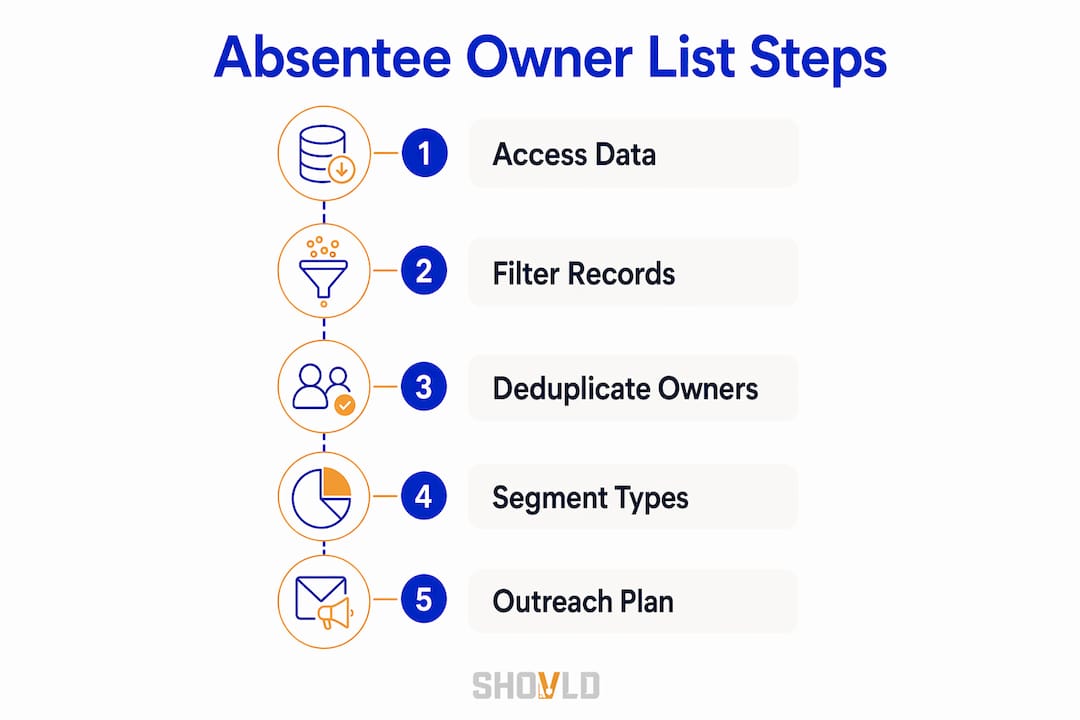
One step most investors skip is deduplication by owner rather than by parcel. Many absentee owners hold multiple properties, and targeting per owner rather than per address prevents you from sending five separate mailers to the same person about five different properties. Consolidating by owner lets you craft a single, more compelling message that references their full portfolio, which reads as far more professional and informed.
Pro Tip: Set your ownership duration filter to seven years or more. Owners who have held a property that long have typically accumulated significant equity and are statistically more likely to consider a sale than recent purchasers.
Once your list is clean and deduplicated, segment it by owner type before exporting. Out-of-state owners, local landlords, and inherited property owners each respond to different messaging. Treating them as one group wastes outreach budget and reduces response rates.
Why stacking motivation signals produces better leads
Absentee status alone is not enough to build a high-quality lead pipeline. An owner whose mailing address differs from the property address might be a sophisticated investor with no intention of selling for a decade. The real opportunity comes from stacking additional signals on top of absentee status to identify owners under real pressure.
The most effective motivation signals to layer include:
Out-of-state mailing address. Distance creates management friction. Owners who live more than 500 miles from their property face higher repair costs, tenant turnover challenges, and less visibility into property condition.
Tax delinquency. An owner who has missed property tax payments is facing escalating penalties and potential lien action. This is one of the strongest motivation indicators available in public records.
Vacant property status. A property sitting empty generates no rental income while still accumulating taxes, insurance, and maintenance costs. Vacancy data combined with absentee status creates a high-urgency profile.
Open code violations. Municipal code enforcement records are underutilized by most investors. Open code violations create escalating fines and compliance deadlines that pressure owners to resolve the situation quickly, often through a sale.
Long ownership duration with no recent permits. No permit activity over many years suggests deferred maintenance, which compounds the owner’s management burden.
The comparison below shows the difference in lead quality between single-signal and stacked-signal targeting:
Targeting approachLead qualityCompetition levelLikely responseAbsentee status onlyModerateHighLowAbsentee plus out-of-stateGoodModerateModerateAbsentee plus tax delinquentHighLowHigherAbsentee plus code violation plus vacancyVery highVery lowHighest
The logic is straightforward. Every signal you add narrows the pool and increases the probability that the owner is genuinely motivated. Fewer competitors are working these lists because pulling code violation data directly from municipal sources requires more effort than a standard PropStream export. That friction is your advantage.
What does effective outreach to absentee owners look like?
Direct mail remains the primary channel for reaching absentee owners, and the numbers support persistence. Well-targeted campaigns achieve response rates of 1 to 2.5%, which outperforms generic cold lists. That means for every 100 mailers sent to a properly filtered absentee owner list, one to three owners will respond. The math only works if your list is clean and your message is specific.
The most effective outreach practices for absentee owner investment strategies include:
Reference the property directly. Generic “we buy houses” postcards get ignored. A letter that mentions the specific address, the neighborhood, and a realistic offer range signals that you have done your homework.
Acknowledge the management burden. Absentee owners are not selling because they hate real estate. They are selling because managing a property from a distance is expensive and exhausting. Your message should reflect that understanding.
Use a multi-touch cadence. Send at least three to five contacts over 60 to 90 days before removing someone from your list. Many responses come on the third or fourth touch, not the first.
Time outreach strategically. Tax season (February through April) is when delinquent owners feel the most pressure. Code violation deadlines create urgency windows. Vacancy periods in winter months increase seller motivation in colder markets.
Follow up by phone when mail is returned. Returned mail is a signal to run skip tracing, not to remove the lead. The owner exists; you just need a current address or phone number.
Pro Tip: For owners with multiple properties on your list, send one letter that references all of their holdings in your target area. This approach positions you as a serious buyer rather than a mass mailer and generates significantly higher engagement.
Platforms like REmail and direct mail services integrated with PropStream allow you to automate multi-touch sequences triggered by list imports. This removes the manual scheduling burden and keeps your cadence consistent without requiring daily attention.
Key takeaways
Absentee owner investment targets are best identified by combining a mailing address mismatch in county tax records with stacked motivation signals like tax delinquency, vacancy, and code violations.
PointDetailsCore identification methodCompare owner mailing address to property address in county assessor records.Data quality mattersSupplement county records with skip tracing to manage outdated mailing addresses.Deduplicate by ownerTarget owners rather than parcels to avoid redundant outreach and improve message quality.Stack motivation signalsCombine absentee status with tax delinquency, vacancy, or code violations for higher-quality leads.Outreach persistence paysMulti-touch direct mail campaigns targeting absentee owners achieve 1 to 2.5% response rates.
The real edge is in the signals most investors ignore
I have watched investors build absentee owner lists the same way for years: pull a PropStream export, filter for out-of-state owners, send a postcard. It works at a basic level, but everyone in the market is doing the same thing. You are crowded around the same fire.
The investors who consistently close off-market deals are not working harder on outreach. They are working earlier on signal identification. Code violation data pulled directly from municipal sources, cross-referenced with absentee status and vacancy records, produces a list that almost no one else has. The effort to build that list is higher, but the competition for those leads is dramatically lower.
The other mistake I see constantly is treating a returned mailer as a dead lead. A returned letter means the county record is stale, not that the owner has vanished. Running skip tracing on returned mail has recovered some of the best leads I have worked with, because those owners are often the hardest to reach and therefore the least contacted by competitors.
Volume is not the goal. A list of 200 deeply stacked, verified absentee owner targets will outperform a list of 2,000 basic absentee records every time. Build fewer lists. Build better ones.
— Avi
How Shovld helps you find absentee owner properties faster

Shovld tracks permits, code violations, vacancy indicators, tax delinquency signals, and municipal records across multiple U.S. markets and surfaces them as scored, verified opportunities. For investors targeting absentee owner properties, this means you get a pre-stacked signal profile rather than a raw address list that still needs hours of cross-referencing. Shovld identifies early-stage opportunities before they become crowded, so you are contacting motivated owners before your competitors even know the lead exists. Review Shovld’s platform plans to see which tier fits your market coverage and outreach volume, or explore what Shovld does to understand how signal intelligence applies to your investment strategy.
FAQ
What defines an absentee owner property?
An absentee owner property is one where the owner’s mailing address differs from the property’s physical address in county tax assessor records. Common examples include out-of-state landlords, inherited properties, and investors who never occupied the asset.
How do I find absentee owner properties in my market?
Access your target county’s tax assessor database, download the property roll, and filter for records where the mailing address does not match the situs address. Platforms like PropStream automate this process with built-in absentee owner filters.
What signals should I stack with absentee status?
Tax delinquency, open code violations, and vacant property status are the three strongest signals to combine with absentee ownership. Each additional signal narrows the pool and increases the probability of a motivated seller.
What response rate should I expect from absentee owner mail campaigns?
Well-targeted absentee owner direct mail campaigns achieve response rates of 1 to 2.5%, which outperforms generic cold outreach. Consistent multi-touch cadences of three to five contacts significantly improve those results.
Why should I deduplicate my list by owner rather than by property?
Many absentee owners hold multiple properties, so deduplicating by parcel results in multiple separate mailers to the same person. Targeting per owner consolidates your outreach and allows for more informed, personalized messaging that references their full portfolio.