
Why Vacant Property Data Matters for Investors
Vacant property data is the earliest available signal of supply shift, seller motivation, and neighborhood transition in any real estate market. Investors who track vacancy at the data level, not just the listing level, consistently identify opportunities weeks or months before those properties appear on the MLS. With the U.S. retail vacancy rate hitting a historic low of 4.2% in 2025, the scarcest resource in commercial real estate is no longer capital. It is quality locations. Understanding why vacant property data matters for investors is no longer optional. It is the difference between acting on a deal and arriving after the crowd.
Why vacant property data matters for investors
Vacancy data, formally called property occupancy intelligence, captures the gap between a property’s physical state and its market activity. A property can be legally owned, tax-compliant, and completely invisible to the MLS while still broadcasting clear vacancy signals through USPS mail non-collection flags, utility consumption drops, and code enforcement citations. These signals are the raw material of off-market deal sourcing.
The financial stakes are direct. Each vacancy event costs a landlord 1.5 to 2 months of lost rent, which means identifying and acting on vacancy early protects both acquisition pricing and post-acquisition performance. For investors targeting distressed or transitional assets, vacancy data reduces the guesswork that typically inflates acquisition risk.

Prominent datasets used in the industry include USPS vacancy flags, utility consumption metrics, property tax delinquency records, and local vacant property registries. Each source captures a different dimension of vacancy, and combining them produces a far more accurate picture than any single feed alone. Investors who rely on one source are working with a partial map.
What types of vacant property data do investors rely on?
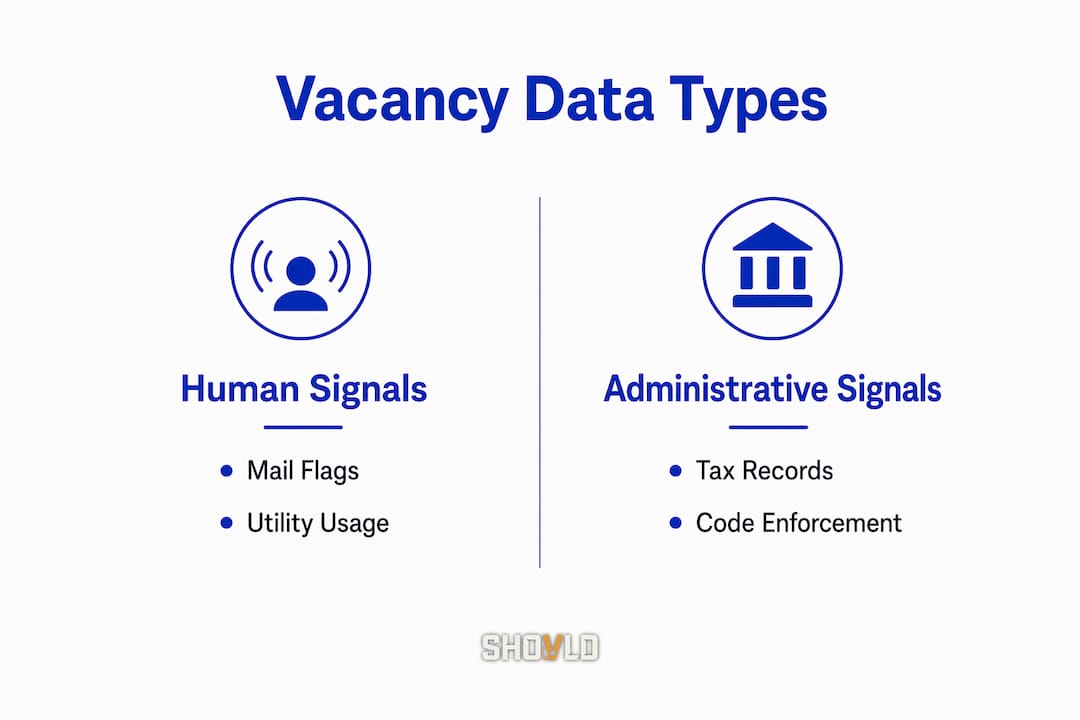
The industry draws from four primary categories of vacancy signal data, each with distinct strengths and update cycles.
USPS mail non-collection indicators represent a human-level signal. When mail accumulates without collection for 90 days or more, the USPS flags the address. This is one of the most reliable early indicators of residential vacancy because it reflects actual human behavior, not just administrative records.
Utility pulse monitoring tracks electricity and water consumption at the property level. Utility consumption drops sustained for three months can flag probable vacancy with high confidence. This signal is particularly powerful for commercial properties where consumption patterns are more predictable.
Shadow inventory and off-market datasets aggregate properties that are vacant but not listed, often sourced from foreclosure pipelines, probate records, and absentee owner databases. These are the hidden opportunities that most investors never see because they are not browsing the right data layer.
Local government records including tax delinquency, code enforcement citations, and vacant property registries provide a holistic view of why a property is vacant and what risks it carries. A property with three code violations and six months of tax delinquency tells a very different story than one with clean records and a recent utility shutoff.
Data TypeSourceSignal StrengthUpdate FrequencyBest ForUSPS mail flagsU.S. Postal ServiceHigh (residential)MonthlySingle-family, small multifamilyUtility monitoringUtility providersHigh (commercial)Monthly to quarterlyCommercial, industrialTax delinquencyCounty assessorMediumQuarterly to annualDistressed acquisitionsCode enforcementMunicipal recordsMedium to highVaries by cityNeighborhood risk scoringVacant property registriesLocal governmentMediumAnnualRegulatory compliance context
Pro Tip: Prioritize data providers that refresh their vacancy feeds in under 30 days. Data refresh frequency under 30 days significantly increases actionable accuracy, especially in fast-moving acquisition markets.
How does vacancy data reveal deals before listings appear?
Vacancy is an early indicator of market shifts, and acting on it offers a competitive advantage that runs weeks or months ahead of market visibility. This is the concept of invisible inventory: properties that are functionally available but not yet publicly listed, flagged only by the data signals they emit.
The speed advantage is concrete. When an investor contacts a motivated seller before that seller has engaged a broker, the negotiation dynamic shifts entirely. There is no competing offer, no bidding war, and no broker commission inflating the ask. The investor is the only person in the room.
Markets where off-market deal sourcing is most active, including Phoenix, Atlanta, and parts of the Midwest, consistently show that investors using vacancy signal data close at lower price-per-unit ratios than those sourcing exclusively from the MLS. The data advantage compounds over time because early outreach builds seller relationships that generate referrals to other off-market properties.
Explore pre-market property opportunities to understand how vacancy signals translate into specific acquisition strategies before a property ever hits public listings.
Here is how to use vacancy data for proactive deal sourcing:
Pull a vacancy signal report for your target zip codes using a platform that aggregates USPS flags, utility data, and tax records simultaneously.
Score each flagged property by signal strength, combining the number of active indicators with the duration of vacancy.
Cross-reference with ownership records to identify absentee owners, estate situations, or corporate holders who may be motivated to sell.
Initiate direct outreach via mail, phone, or door-knocking before the property enters any listing pipeline.
Track response rates and refine your outreach cadence based on which vacancy signal combinations produce the highest seller engagement.
Pro Tip: Properties flagged by three or more concurrent signals, such as USPS non-collection, utility shutoff, and a code violation, represent the highest-probability motivated seller situations. Prioritize these in your outreach queue.
Why do some vacant properties stay off-market permanently?
Not every vacant property is a distressed opportunity. Some represent rational hold decisions that investors misread as acquisition targets, and misreading them wastes time and capital.
The clearest example is the capital gains exit tax dynamic in high-appreciation markets. In cities like San Francisco, Los Angeles, and parts of New York, owners who purchased decades ago face capital gains tax bills that can exceed the annual cost of holding a vacant property. Selling triggers a tax event that wipes out a significant portion of the gain. Holding, even at the cost of carrying an empty building, is the mathematically superior choice for many long-term owners.
California’s Proposition 13 compounds this effect by capping property tax increases at 2% annually regardless of market appreciation. An owner who bought in 1985 may be paying property taxes on an assessed value of $200,000 for a property worth $2 million today. The carrying cost is negligible, and the exit cost is enormous. This is why vacancy does not always signal sell-readiness.
“Vacant and abandoned properties lower nearby home values and pose safety risks, affecting neighborhood dynamics and investor considerations.” Source: Results for America
The risks of vacancy are real regardless of the owner’s intent. Deferred maintenance accelerates in vacant structures. Squatters create liability. Neighboring properties lose value. Investors who acquire vacant properties must price in remediation costs that are often invisible until a physical inspection. A data-driven approach to vacancy must include a risk-scoring layer, not just an opportunity-scoring layer.
ScenarioAnnual Holding CostEstimated Exit TaxHold vs. Sell DecisionCA owner, 1985 purchase, Prop 13Low (capped assessment)Very high (decades of appreciation)HoldMidwest absentee owner, recent purchaseModerateLow to moderateLikely sellProbate estate, no mortgageLowModerateNegotiableCommercial owner, deferred maintenanceHigh (code violations)ModerateMotivated to sell
How to integrate vacancy data into smart investment strategies
Combining vacancy data with transaction velocity and price band analysis produces the most reliable market timing signals available to individual investors. Transaction velocity reveals active buying tiers even when market sentiment is negative, and pairing it with vacancy concentration maps shows exactly where supply is loosening before prices reflect that shift.
Multi-source data validation is non-negotiable for accuracy. A single USPS flag without corroborating utility data or tax records produces false leads. The most effective investors treat vacancy signals like a checklist: the more boxes checked, the higher the confidence level and the faster the outreach.
Collaboration with local brokers, property managers, and municipal agencies adds context that no dataset can fully capture. A property manager who covers 200 units in a target neighborhood knows which buildings are cycling tenants, which owners are frustrated, and which blocks are transitioning. That ground-level intelligence, layered on top of signal data, produces a picture no algorithm can replicate alone.
Aligning investment strategies with local government vacancy remediation programs also creates a structural advantage. Cities actively working to reduce vacancy often fast-track permits, offer tax incentives, and prioritize infrastructure investment in target zones. Investors who identify these zones early benefit from both the acquisition opportunity and the policy tailwind.
Here are the best practices and common pitfalls when incorporating vacancy data into investment workflows:
Do refresh your vacancy data at least monthly. Stale data produces dead leads and wastes outreach resources.
Do combine at least three signal types before committing outreach resources to a specific property.
Do track vacancy pattern types by asset class, since residential and commercial vacancy signals behave differently.
Don’t assume every vacant property is a motivated seller. Verify ownership intent before investing outreach time.
Don’t rely on public listings as a proxy for vacancy. By the time a property appears on the MLS, the early-mover advantage is gone.
Pro Tip: Build a simple scoring matrix that weights each vacancy signal by recency and severity. A utility shutoff from last month outweighs a USPS flag from eight months ago. Recency is the most underrated variable in vacancy scoring.
How does vacancy data compare to traditional market indicators?
Traditional market indicators, including MLS days-on-market, median price trends, and consumer sentiment surveys, describe what has already happened. Vacancy data describes what is about to happen. That distinction defines the entire value proposition.
Transaction velocity and vacancy signal data reveal supply and demand mismatches at the property level, not the market level. Sentiment surveys tell you how buyers feel about the market in aggregate. They do not tell you that a specific six-unit building in a specific zip code has been vacant for four months and has a delinquent tax bill. That specificity is where deals are made.
“Comparing price bands and days on market reveals active buying tiers even when market sentiment is negative, aiding negotiation.” Source: Investing Plus
Relying solely on public listings and social media buzz is the trap that keeps most investors crowded around the same fire. Every investor in the market sees the same MLS data. The information asymmetry disappears the moment a property goes public, and with it goes the pricing advantage.
IndicatorLead TimeReliabilityCostCompetitive AdvantageVacancy signal dataWeeks to months earlyHigh (multi-source)ModerateHighMLS listingsZero (reactive)HighLowNoneSentiment surveysLaggingLowLowNonePrice trend reportsLaggingMediumLowLowTax delinquency recordsWeeks earlyMediumLowMedium
The investors who consistently outperform in competitive acquisition markets are not smarter. They are earlier. Vacancy data is the mechanism that makes earliness systematic rather than lucky.
Key takeaways
Vacant property data gives investors a structural timing advantage that no other market signal replicates at the property level.
PointDetailsVacancy signals precede listingsUSPS flags, utility drops, and tax records surface opportunities weeks before MLS visibility.Multi-source validation is requiredCombining three or more signal types dramatically reduces false leads and wasted outreach.Not all vacancy means motivated sellersTax exit costs and low carrying costs can make holding a vacant property the rational choice.Data freshness determines accuracyRefresh cycles under 30 days are the threshold for actionable vacancy intelligence.Vacancy data beats sentiment indicatorsTransaction velocity and vacancy signals outperform MLS trends and surveys for deal timing.
What I’ve learned from watching investors use vacancy data
I have watched investors approach vacancy data in two completely different ways, and the gap in outcomes is not subtle. The first group treats it as a lead list: pull the data, blast outreach, move on. The second group treats it as a diagnostic tool: understand why the property is vacant, what the owner’s situation actually is, and whether the signal reflects opportunity or a rational hold decision.
The second group closes more deals at better prices. Not because they work harder, but because they ask better questions before they pick up the phone.
The most common mistake I see is treating vacancy as binary. A property is either vacant or it is not. The reality is that vacancy exists on a spectrum of motivation, urgency, and risk. A three-month utility shutoff on a property with clean tax records and no code violations is a very different situation than a six-month shutoff with two open violations and a delinquent tax bill. The data tells you which situation you are in, but only if you read all of it.
The other misconception worth addressing directly: vacancy data is not a shortcut. It is a precision tool. Investors who expect it to eliminate the work of deal sourcing will be disappointed. Investors who use it to focus their work on the highest-probability situations will find it changes how they operate entirely.
The market in 2026 rewards specificity. Generic strategies produce generic results. Vacancy data is one of the few remaining sources of genuine information asymmetry available to individual investors, and that window will not stay open indefinitely as more players adopt signal-based sourcing.
— Avi
How Shovld helps investors act on vacancy signals first
Shovld is built specifically for investors who want to act before the market reacts. The platform aggregates USPS vacancy flags, utility consumption signals, code enforcement records, property tax delinquency data, and municipal records across multiple U.S. markets, then scores each opportunity so you know exactly where to focus.

Every signal in Shovld is verified, refreshed on a sub-30-day cycle, and scored for both opportunity strength and risk level. You are not sorting through raw data. You are working from a prioritized list of properties that match your acquisition criteria. Explore Shovld’s platform overview to see how signal intelligence works in practice, or review pricing and plans to find the tier that fits your market coverage needs.
FAQ
What is vacant property data in real estate investing?
Vacant property data is a collection of public and administrative signals, including USPS mail flags, utility consumption records, tax delinquency filings, and code enforcement citations, that indicate a property is unoccupied. Investors use these signals to identify off-market acquisition opportunities before they appear on public listings.
How do investors find vacant properties before they hit the MLS?
Investors use multi-source signal data combining USPS non-collection flags, utility shutoff records, and local government databases to identify vacant properties weeks or months before they enter the listing pipeline. Platforms like Shovld aggregate and score these signals automatically across multiple markets.
Why do some vacant properties never come up for sale?
Some owners hold vacant properties because selling triggers capital gains taxes that exceed the annual cost of carrying an empty building, particularly in high-appreciation markets with low property tax caps like California under Proposition 13.
How often should vacancy data be refreshed for accurate investing?
Data refresh cycles under 30 days produce significantly more accurate and actionable vacancy intelligence. Older data generates false leads and wasted outreach, particularly in fast-moving acquisition markets where property status changes quickly.
Does vacancy always signal a distressed property?
Vacancy does not always indicate distress or seller motivation. Some properties are rationally held empty due to tax considerations, estate situations, or owner strategy. Investors should cross-reference vacancy signals with ownership records and financial data before assuming a property represents a motivated seller opportunity.