
How to Bid on Code Violation Properties for Profit
Bidding on code violation properties is defined as acquiring real estate flagged by municipal code enforcement for building, safety, or habitability violations, typically at a discount of 15–40% below market value due to motivated sellers and distressed conditions. These properties carry real risk, but investors who understand municipal liens, open permits, and remediation costs can turn that risk into margin. The standard industry term for this asset class is “code enforcement property,” and mastering the acquisition process requires data, discipline, and a clear-eyed view of total cost basis before you ever submit an offer.
How to bid on code violation properties: finding the right leads
The best leads are not the ones everyone else is chasing. Most investors crowd around foreclosure and absentee owner lists, which means code violation data offers a less competitive entry point into motivated seller conversations. The key is knowing where to look and how to stack signals.
Search municipal databases first
Every U.S. city and county with an active code enforcement department maintains a public record of open violations. Many publish these online through portals tied to their building or housing departments. Start there before spending money on data vendors.

When online portals are incomplete or outdated, file a public records request directly with the code enforcement office. Most cities respond within 10–20 business days, with administrative costs typically running $0.10 to $0.25 per page. That is a low cost for a targeted lead list your competitors have not pulled yet.
Stack distress signals for better response rates
A single code violation is a weak signal. Three or more active violations on the same property tell a different story. Properties with 3 or more active violations statistically indicate overwhelmed owners who are more willing to sell at a discount. Combine that with tax delinquency data and you have a distress multiplier.
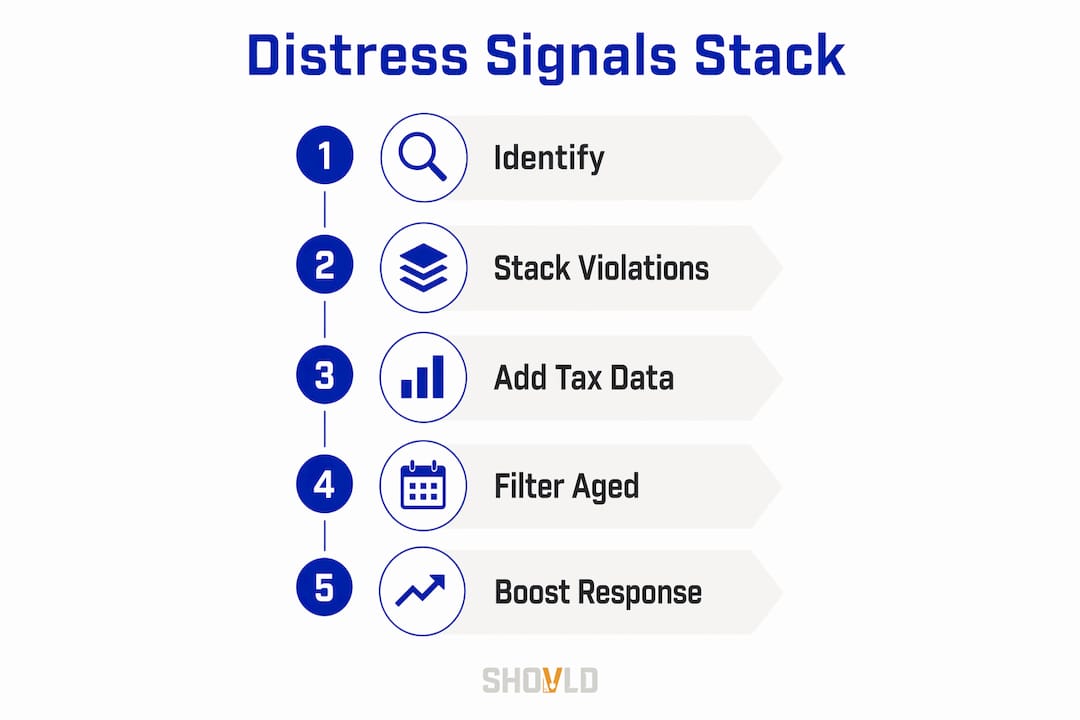
Stacking code violation lists with tax delinquency or vacancy data can increase investor outreach response rates by 2–3x. Platforms like Shovld aggregate these signals automatically, scoring properties by distress level so you prioritize the highest-probability leads instead of manually cross-referencing public records.
Pro Tip: When reviewing a lead list, filter first for properties with violations older than 12 months. Long-standing violations signal an owner who cannot or will not fix the problem, which is exactly the motivated seller profile you want.
Here is a quick framework for prioritizing leads:
SignalWhy It Matters3+ active violationsIndicates overwhelmed owner, higher discount probabilityViolation age over 12 monthsOwner has not resolved the issue, increasing motivation to sellTax delinquency overlapCompounds financial pressure on the ownerAbsentee ownershipOwner is less emotionally attached and more price-flexibleDemolition order issuedCreates urgency but compresses your timeline significantly
What are the real risks when buying properties with code violations?
Code violations almost always transfer with a property title. That single fact is what separates investors who profit from those who get buried. Purchase price is only a fraction of your true acquisition cost once you factor in remediation, legal fees, and fines.
The risk categories break down clearly:
Daily fines: Municipal fines range from $50 to $500 per day depending on violation severity. An unresolved violation running at $200 per day for six months adds $36,000 to your cost basis before you swing a hammer.
Municipal liens: Lien balances can reach six figures. Documented rehabilitation commitments have reduced lien balances as high as $150,000/comply-with-a-guilty-judgment/) down to $20,000–$40,000, but that negotiation requires proof of repair plans and municipal approval.
Open and expired permits: These require licensed professionals to inspect, correct, and close out with the municipality. Open or expired permits often cost more to resolve than the original fines because they trigger full inspections of related work.
Hidden safety deficiencies: Code-driven repairs frequently uncover structural, electrical, or plumbing issues not visible during a standard walkthrough. Budget for surprises.
Demolition orders: If a property carries a demolition order, your acquisition timeline compresses dramatically. Verify this before bidding.
“Investors often mistakenly treat foreclosure auctions as clean deals, overlooking that municipal liens and code violations transfer with title, increasing acquisition costs well beyond the hammer price.”
Pro Tip: Always request a full lien search from a title company before submitting any offer on a code enforcement property. A title commitment with a lien schedule is the only document that shows you the true financial exposure attached to the deed.
Step-by-step guide to preparing and submitting bids
Due diligence on code enforcement properties is not optional. Skipping steps here is where investors lose money. Follow this sequence before you write a number on an offer.
Pull the full violation history. Request the complete code enforcement file from the municipality. You want every open violation, every fine assessed, and every compliance deadline on record.
Order a title search with lien schedule. Confirm all municipal liens, tax liens, and any judgment liens attached to the property. This is your true cost floor.
Verify permit status. Check the building department for open or expired permits. Each one requires a licensed contractor to close out, and each one adds cost and time.
Estimate total remediation costs. Walk the property with a licensed contractor who understands code compliance work. Get a written scope that includes all repair and compliance costs, not just cosmetic repairs.
Add contingency reserves. Build a 15–20% contingency on top of your contractor estimate. Code compliance work routinely surfaces additional deficiencies once walls open up.
Draft your offer with violation liabilities factored in. Your maximum allowable offer is your after-repair value minus repair costs, minus holding costs, minus your target profit, minus the total lien and fine exposure.
Negotiate lien reductions before closing. Contact the code enforcement office directly. Municipalities often reduce fines when a buyer presents a documented rehabilitation plan. Resolution typically requires photographic proof of repairs/comply-with-a-guilty-judgment/) within 30–180 days of the agreement.
The table below shows how lien negotiation changes your deal math:
ScenarioGross Lien BalanceNegotiated SettlementNet SavingsDocumented rehab commitment$150,000$20,000–$40,000$110,000–$130,000No documentation provided$150,000$150,000$0
Timing matters here. Municipal approval processes for lien reductions can take 30–90 days. Build that into your closing timeline and include a contingency clause in your purchase agreement that allows you to exit if the lien settlement falls outside your acceptable range.
Common mistakes investors make when bidding on distressed properties
The most expensive mistake in code enforcement property investing is underestimating total cost basis. Investors see the discount and anchor on purchase price. They forget that code violations transfer with title, meaning every fine, lien, and open permit becomes your problem at closing.
The most common errors that kill deals after closing:
Assuming fines will be waived automatically. Municipalities do not waive fines without documentation and formal approval. Never assume a seller’s verbal assurance about fine forgiveness carries legal weight.
Ignoring buyer responsibility post-closing. Once you own the property, you own the violations. Any new fines that accrue before you complete repairs come out of your pocket.
Skipping permit verification. Open permits trigger full re-inspection of related work. A $5,000 electrical permit left open by a previous owner can require $30,000 in remediation to close properly.
Underestimating municipal timelines. Code compliance approvals, lien reductions, and repair verifications all run on the municipality’s schedule. Deals that look like 90-day flips often run 6–9 months when code enforcement is involved.
Bidding on single-signal leads. A property with one minor violation and no other distress indicators rarely offers the discount you need. Focus on stacked distress signals for the best probability of a motivated seller.
Pro Tip: Include a due diligence contingency in every offer on a code enforcement property. Give yourself at least 21 days to pull the full violation file, complete the title search, and get a contractor estimate before you are committed to the deal.
Key Takeaways
Profitable investing in code violation properties requires accurate cost modeling, early lead sourcing, and direct negotiation with municipal code enforcement offices before closing.
PointDetailsViolations transfer with titleEvery fine, lien, and open permit becomes the buyer’s liability at closing.Stack distress signalsCombining code violations with tax delinquency increases motivated seller probability by 2–3x.Negotiate liens before closingDocumented rehab plans can reduce six-figure lien balances by up to 87%.Verify all open permitsExpired permits require licensed contractor closeouts that often cost more than the original fines.Build in timeline buffersMunicipal approval processes add 30–90 days to deal timelines; plan for it in your offer terms.
What I’ve learned from years of bidding on code enforcement properties
The investors I’ve seen succeed in this space share one habit: they treat the municipal code enforcement office as a partner, not an obstacle. Walking into a negotiation with a documented repair plan and a realistic timeline changes the conversation entirely. Municipalities want properties fixed. They will reduce fines for buyers who demonstrate they can actually do the work.
The trap most investors fall into is treating the purchase price as the deal. It is not. The deal is the spread between your all-in cost basis, including every lien, every permit closeout, every day of fines, and your exit value. I have watched investors buy properties at 30% below market and still lose money because they did not model the full cost stack.
The other thing I would tell any investor entering this space: HOA violations and code violations often appear on the same property. When they do, you have a seller under pressure from multiple directions. That is when you get the best terms. Do not look at these signals in isolation. The more pressure stacked on a seller, the more flexibility you have on price and terms.
Early visibility into these signals is the real edge. By the time a property hits a public auction list, the discount is already priced in and you are competing with every other investor in the market. The investors who win are the ones who find the lead before it becomes a listing.
— Avi
How Shovld helps investors find and evaluate code violation properties

Shovld tracks code violations, open permits, tax delinquency, and other distress signals across multiple U.S. markets, scoring each property by opportunity strength before you spend time on manual research. Instead of filing public records requests one county at a time, investors get a verified, prioritized lead list built from stacked public-record signals.
For investors who want to move before the market reacts, Shovld’s signal intelligence turns scattered municipal data into a predictable pipeline of motivated sellers. The platform is built for professionals who need early visibility, not crowded auction lists. Review Shovld’s pricing and plans to see which tier fits your market and deal volume.
FAQ
What are code violation properties?
Code violation properties are real estate parcels flagged by municipal code enforcement for failing to meet local building, safety, or habitability standards. They often sell below market value because violations create financial and legal pressure on owners.
Do code violations transfer to the new owner at closing?
Yes. Code violations and associated municipal liens transfer with the property title at closing. The buyer assumes full responsibility for all outstanding fines, liens, and required repairs from the moment of ownership.
How much can I save by bidding on code enforcement properties?
Properties with three or more active violations trade at 15–40% below market value. The actual discount depends on violation severity, lien balances, and the seller’s financial pressure.
Can municipal fines be reduced after I buy the property?
Fines can be negotiated before closing, not after. Presenting a documented rehabilitation plan to the code enforcement office is the most effective way to reduce lien balances, with settlements sometimes reaching as low as 13 cents on the dollar.
How do I find properties with code violations before they hit the open market?
File public records requests with local code enforcement departments, search municipal online portals, or use a signal intelligence platform that aggregates and scores code violation data across multiple markets simultaneously.