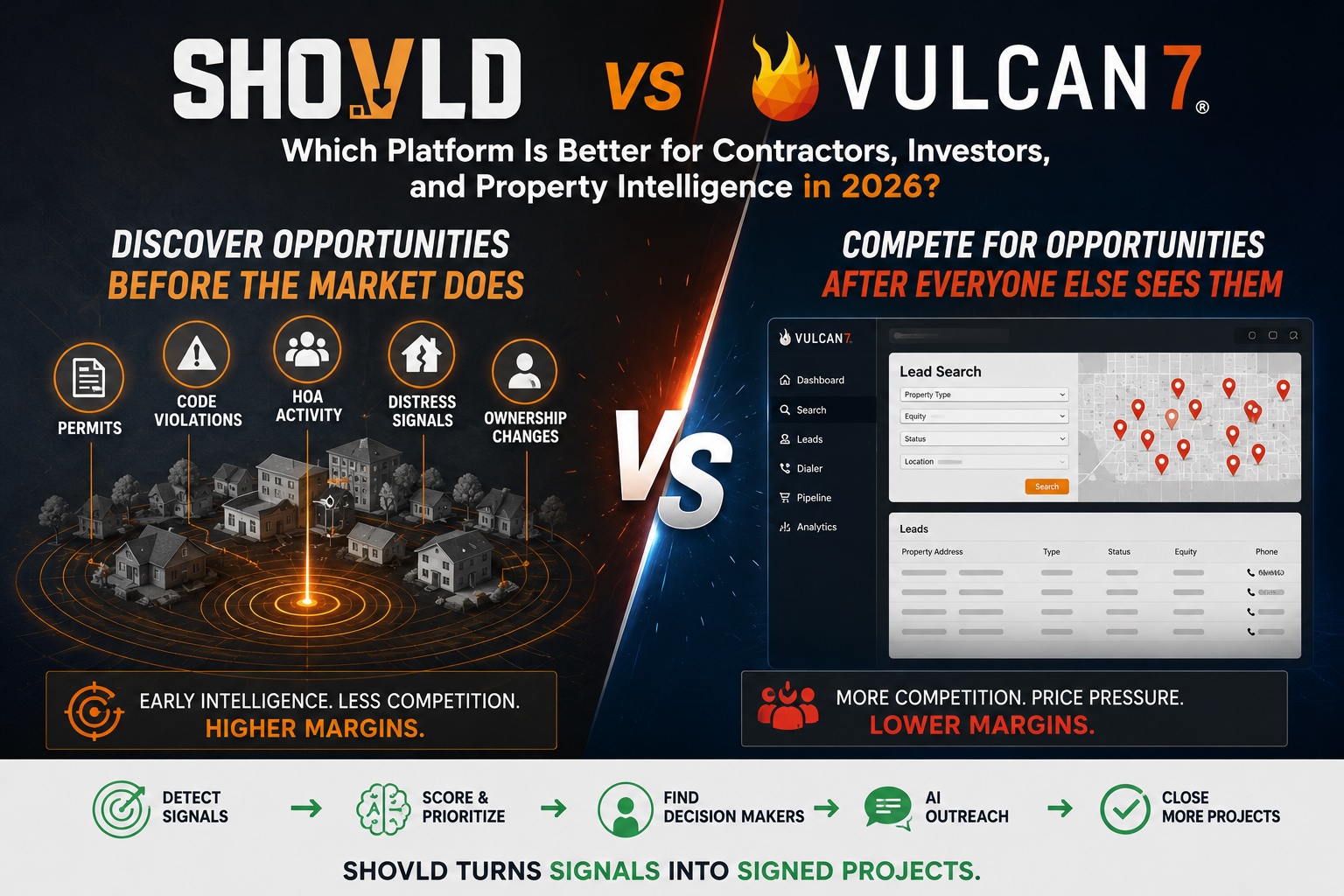
Most contractors and real estate investors have a lead generation problem. Or so they think.
They're using Vulcan7—a platform that helps them work seller leads faster, call more efficiently, manage their follow-up better. They've optimized their prospecting workflow. They've cut down on dial time. They're converting at higher rates.
And they're still losing to competitors who aren't even visible to them yet.
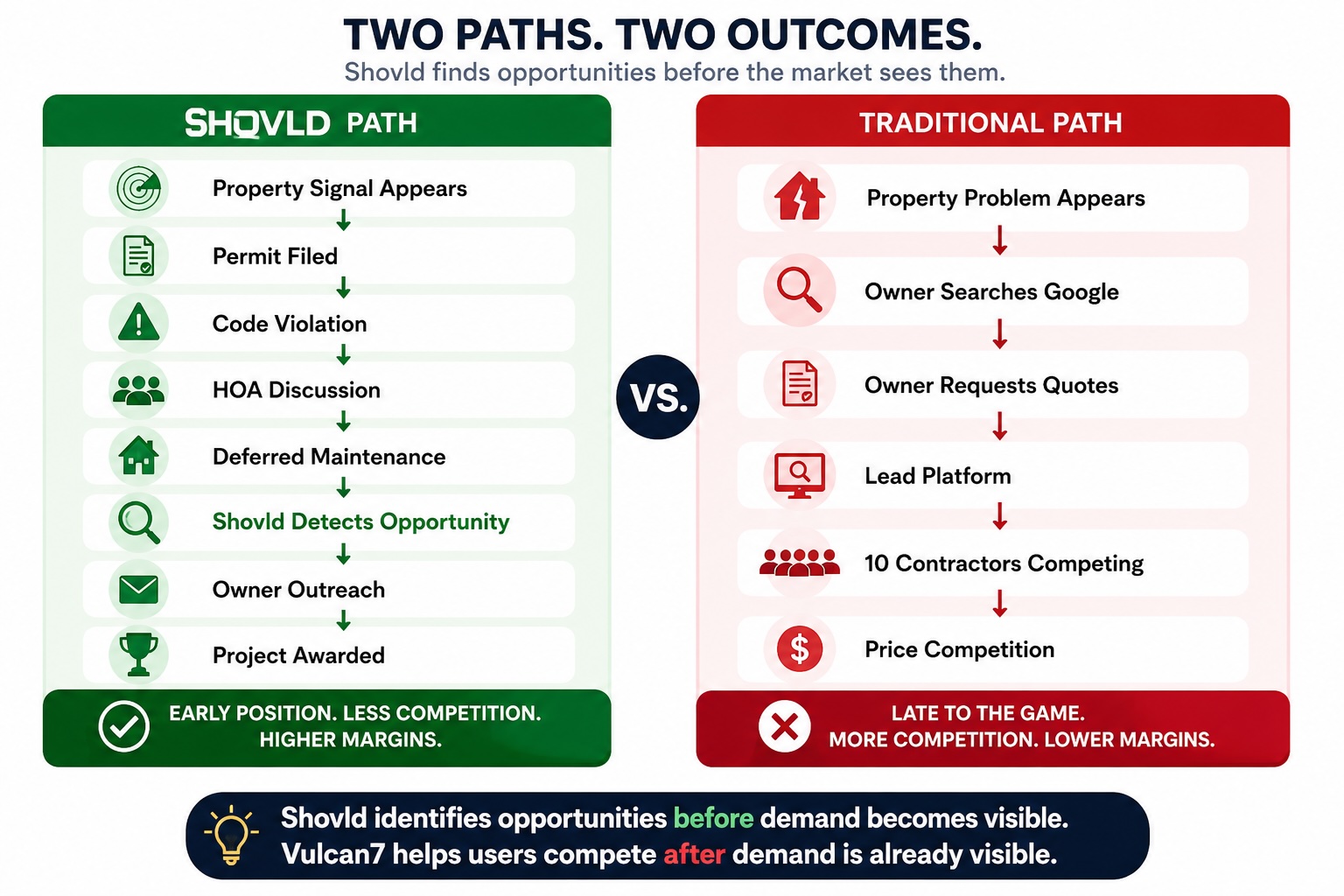
Shovld identifies opportunities before demand becomes visible. Vulcan7 helps users compete after demand is already visible.
The Vulcan7 Trap: Competing Over Scraps
Here's what Vulcan7 does well: it makes agent prospecting and lead conversion efficient.
You search for motivated sellers. You filter by equity, days on market, absentee ownership. You dial. You convert. You manage your pipeline. It's a solid workflow for real estate agents and brokers who compete on working existing demand.
But here's the problem most contractors and investors miss:
By the time a property shows up in Vulcan7—or any traditional lead platform—the opportunity is already visible to everyone else. The homeowner has already decided there's a problem. They've already started looking for solutions. They're already comparing three other contractors who found the same listing.
You're not competing on timing. You're competing on price.
The Real Problem Isn't Leads. It's Timing.
Contractors don't have a lead problem. They have a visibility problem.
A roof doesn't start failing when a homeowner searches Google. It starts aging on a predictable timeline years earlier. An HOA doesn't start needing special assessments when they hire a contractor. They start planning them when they commission a reserve study. A property doesn't show distress when it hits the MLS. It shows distress through code violations, permit activity, and deferred maintenance patterns months before anyone thinks about selling.
These are signals. They come before the demand exists in the traditional market.
Vulcan7 helps you work demand that's already visible. It optimizes for competing faster over existing opportunities. That's valuable if you want to win the same leads as ten other contractors.
But what if you could identify opportunities three months before demand becomes visible?
That's where Shovld operates.
Shovld: Finding Opportunities Before the Market Notices
Shovld isn't a prospecting platform. It's an opportunity intelligence platform.
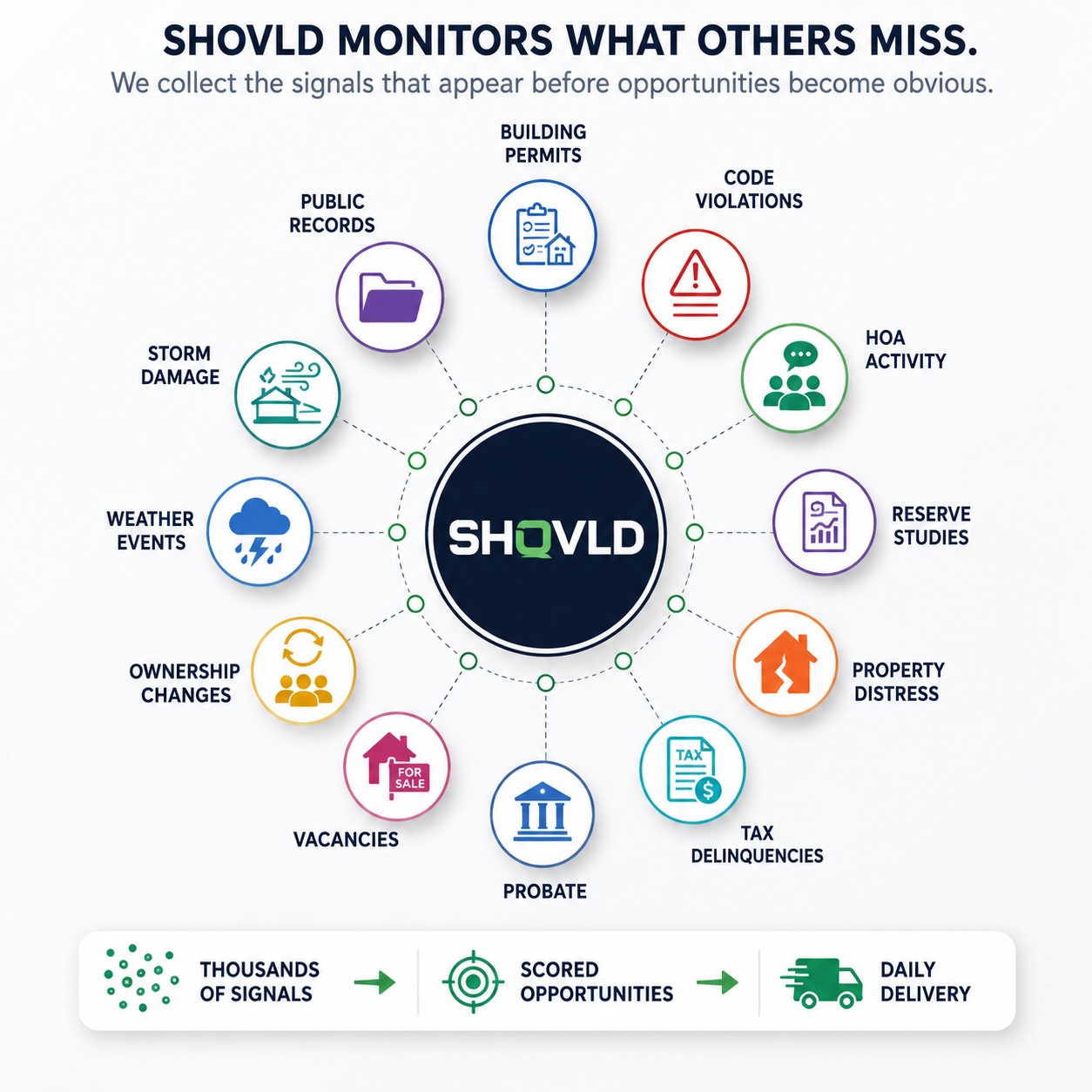
It monitors the signals that contractors have historically ignored: permit activity, code violations, HOA meetings and decisions, reserve studies, property distress patterns, deferred maintenance clustering, weather-related damage indicators, and ownership changes.
These signals aren't hidden. They're public records. They're just scattered across hundreds of municipal databases, county records, HOA archives, and permit portals that most contractors never check.
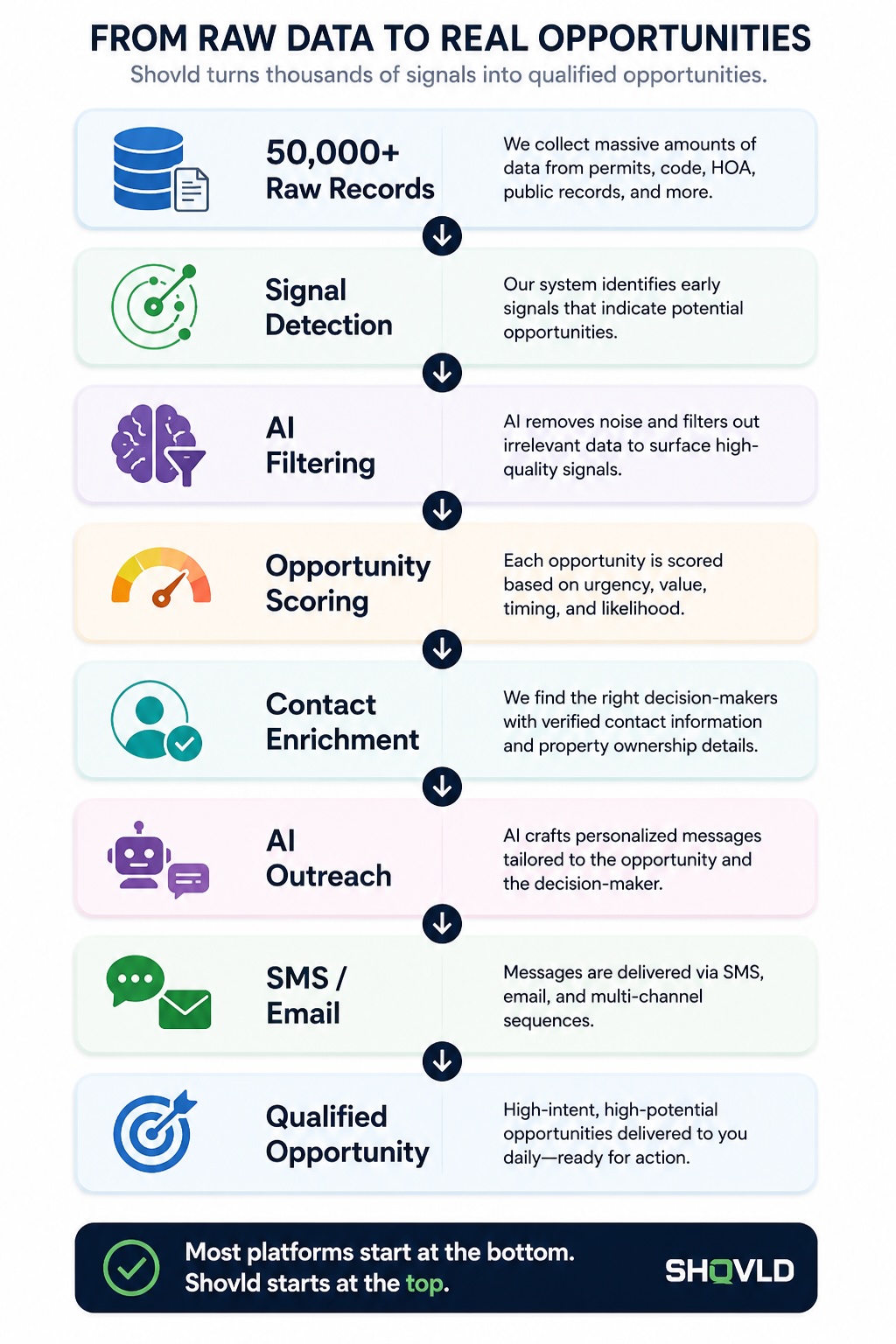
Shovld aggregates them. Cleans them. Scores them. Delivers them in order of opportunity strength.
But here's the critical part: Shovld doesn't just tell you where the opportunities are. It includes the full outreach workflow.
You get opportunity intelligence. You get contact enrichment (the decision-makers, not just the property address). You get AI-powered outreach, SMS, email, and lead management tools built in. You get opportunity tracking so you can follow projects from signal to close.
The entire workflow—from discovering the opportunity to executing the outreach—happens in one platform.
What Shovld Actually Monitors
The Real Difference
Vulcan7 helps users compete for opportunities.
Shovld helps users discover opportunities.
That distinction changes everything.
One platform focuses on working existing demand more efficiently. The other focuses on identifying emerging demand before competitors know it exists.
For contractors, restoration companies, public adjusters, and investors, that often means the difference between competing on price and winning through timing.
Shovld Doesn't Just Find Opportunities. It Delivers Them.
One of the biggest differences between Shovld and Vulcan7 is how users interact with opportunities.
Vulcan7 is primarily a search and prospecting platform. Users search databases, build lists, and begin outreach.
Shovld continuously monitors markets and delivers opportunities daily.
Signals are collected, cleaned, deduplicated, scored, categorized, and delivered directly to the user based on industry, location, and opportunity type.
Instead of asking: "Who should I call today?"
Users receive a prioritized list of opportunities already ranked by relevance.
For busy contractors, restoration companies, and investors, this can eliminate hours of manual research every week.
Vulcan7 Model: User-driven search (pull) — "I need to find leads, so I'll search the database"
Shovld Model: Automated delivery (push) — "Here are today's top opportunities for your market/industry, ranked by relevance"
This operational difference reveals a fundamental product philosophy: Vulcan7 is search-based. Shovld is signal-delivery-based.
Opportunity Discovery Without Outreach Is Incomplete
Finding a property with opportunity is only half the challenge.
The next question is: Who makes the decision?
Shovld combines opportunity intelligence with contact enrichment, helping users identify property owners, decision-makers, property managers, investors, and other relevant contacts.
Once identified, users can execute outreach through:
AI-generated messaging
SMS campaigns
Email outreach
Multi-channel follow-up
Opportunity tracking
The result is a workflow that moves from signal discovery to outreach without requiring multiple platforms.
This is where most traditional lead platforms break down. They find opportunities but don't identify the right decision-maker. Or they identify the opportunity but require separate tools for outreach, creating workflow fragmentation.
Shovld handles the complete journey: Signal → Decision-Maker → Outreach → Tracking → Close
All in one platform.
The Timing Advantage Is Asymmetric
Think about the difference in position:
Vulcan7 workflow:
Wait for property to show distress signals (code violation, permit activity, etc.)
Wait for property to list or become a motivated seller opportunity
Search Vulcan7's database
Compete with 10 other contractors for the same lead
Work your follow-up process
Hope you convert before someone cheaper comes along
Shovld workflow:
Shovld identifies property distress signals (permits, code violations, HOA decisions) automatically
You reach out to the property owner or HOA before demand becomes visible
You position yourself as an advisor, not a service provider
You're the only contractor they've heard from
You're not competing on price—you're competing on timing and expertise
In the Vulcan7 scenario, you're reacting to the market. In the Shovld scenario, you're positioning yourself before the market exists.
That's not a small difference. That's a fundamental difference in competitive position.
What Vulcan7 Is Actually Good For
This isn't a hit on Vulcan7. It serves a specific purpose well.
If you're a real estate agent or broker who needs to work seller leads efficiently—expireds, FSBOs, for-rent-by-owners, pre-foreclosures—Vulcan7 is built for that workflow. It's designed for agent productivity. You get dialing, lead management, and basic property intel in one system.
But if you're a contractor, restoration company, or investor who wants to find projects before the market sees them, you're using the wrong tool. Vulcan7 wasn't built for that use case. It's optimized for a different problem.
Vulcan7 helps you work demand faster. Shovld helps you see demand before it exists.
Shovld Serves More Than Real Estate Agents
Vulcan7 was built primarily for real estate agents focused on seller prospecting.
Shovld serves a broader ecosystem.
Typical users include:
Contractors
Roofers
Restoration Companies
Water Mitigation Firms
Mold Remediation Companies
Public Adjusters
Real Estate Investors
Wholesalers
Property Managers
Home Service Companies
Because the platform focuses on opportunity creation rather than listings, multiple industries can benefit from the same underlying signals.
A permit activity signal means:
A roofer sees roof replacement opportunity
A restoration company sees potential water damage opportunity
An investor sees renovation/flip opportunity
A public adjuster sees potential claim opportunity
A property manager sees maintenance liability
One signal. Multiple value propositions. Multiple industries.
The Hidden Cost of Late-Stage Prospecting
Here's what contractors don't calculate:
Every lead you get from a traditional platform (including Vulcan7's agent-based leads) comes with built-in competition and price pressure. By definition, if you found the opportunity on the same platform as ten other contractors, everyone is fighting over the same job at the same time.
Price becomes the differentiator. Margins compress. You're fighting over scraps.
Shovld changes the math entirely.
If you're contacting a property owner about a roofing project three months before they search for contractors, you're not competing with ten others. You're the first one there. You're not quoting a job—you're educating the owner about something they haven't fully recognized yet.
That's not a lead. That's an information advantage.
And information advantage is where margin lives.
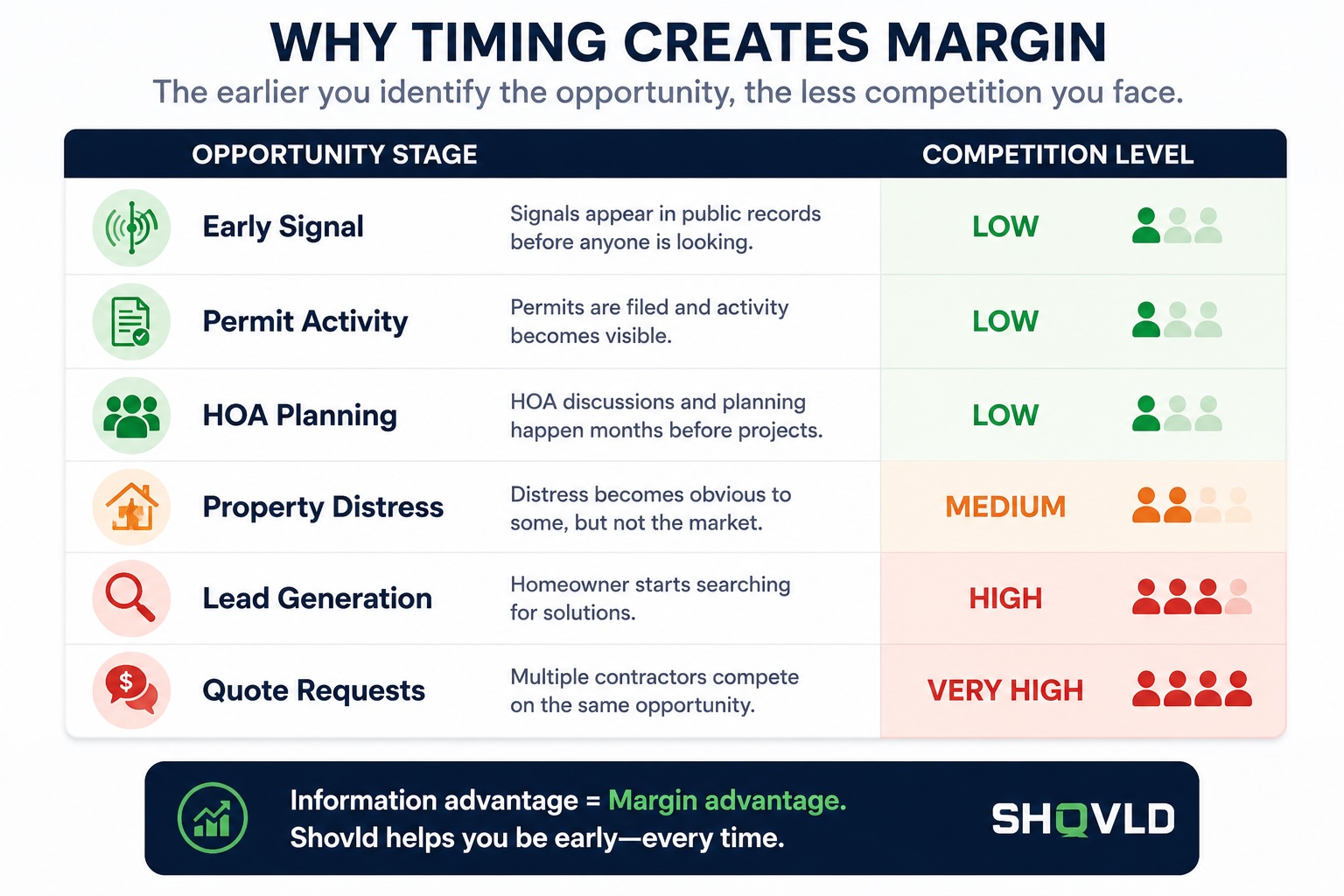
The earlier you identify the opportunity, the less competition you face.
Shovld's Outreach Advantage
One more critical difference: Vulcan7 is a calling platform. Shovld is an outreach platform.
Vulcan7 excels at helping agents dial sellers. You call. You talk. You take notes.
Shovld handles multiple outreach channels—email, SMS, AI-powered messaging—alongside calling. This matters because:
Not everyone answers calls — Property managers, HOA board members, and commercial decision-makers are notoriously hard to reach by phone. Email and SMS often work better.
Outreach scales differently — If Shovld identifies 500 properties with reserve study discussion signals in your market, you can't call all of them. But you can execute a targeted email + SMS sequence to the right decision-makers.
Positioning matters more than speed — You're not trying to be the first to call. You're trying to be the trusted resource when they're ready to move. Multi-channel outreach builds that positioning better than a cold call ever will.
This is another area where Shovld's design reflects a different philosophy than Vulcan7's. Vulcan7 is built for synchronous calling. Shovld is built for strategic outreach to upstream opportunities.
Market Positioning: Competing On Information vs. Efficiency
Here's the fundamental difference:
Vulcan7 positions as: "Work leads faster and more efficiently than your competitors."
Better calling tools
Faster follow-up
More organized pipeline
Competitive advantage: execution efficiency
Shovld positions as: "Find opportunities before your competitors even know they exist."
Better intelligence
Earlier signals
Upstream positioning
Competitive advantage: information asymmetry
These are two entirely different competitive strategies.
Vulcan7 says: "If you dial more, faster, you'll win."
Shovld says: "If you see the market before it exists, price doesn't matter."
Most contractors have spent their entire careers competing on execution efficiency (faster calls, better follow-up, cheaper pricing). Shovld asks a different question: What if you competed on seeing opportunities the market hasn't noticed yet?
That's a psychological shift most contractors never make.
The Contractor Psychology Problem
This is the hidden reason most contractors stay with Vulcan7 instead of moving to Shovld.
Vulcan7 feels familiar. You search. You find leads. You dial. You're in control. It matches the mental model of "lead generation = searching for and calling interested buyers."
Shovld requires a different mindset. You don't search. Signals come to you. You don't wait for someone to raise their hand. You identify patterns before they do. You reach out before they're ready to hear from you.
That feels harder. It feels less immediate. It feels less controllable.
But it's actually where the real competitive advantage lives.
The contractors who successfully shift from "lead generation" to "signal intelligence" aren't busier. They're more selective. They're not calling more. They're calling the right people at the right time. They're not competing on price. They're competing on timing and positioning.
Vulcan7 made you more efficient at a broken system. Shovld asks you to operate in a different system entirely.
Shovld vs Vulcan7 at a Glance
FeatureVulcan7ShovldExpired Listings✓LimitedFSBO Leads✓LimitedPre-Foreclosure Data✓✓Permit Intelligence✗✓Code Violations✗✓HOA Intelligence✗✓Distressed Property SignalsLimited✓Daily Opportunity Delivery✗✓Opportunity Scoring✗✓Contact EnrichmentLimited✓AI Outreach✗✓SMS OutreachLimited✓Email OutreachLimited✓ContractorsLimited✓Restoration Companies✗✓Public Adjusters✗✓Real Estate Investors✓✓
Cost Analysis: Price vs. Value
Vulcan7 starts at $250/month and scales up to $359+/month depending on tier.
Shovld requires a conversation with their team (pricing is custom), but the value proposition is entirely different.
Here's the real calculation:
Vulcan7: $250-350/month × 12 = $3,000-4,200/year to compete on efficiency for leads that are already visible
Shovld: Custom pricing for a platform that identifies opportunities months before they become visible, complete with outreach and tracking
A single project landed three months early because you saw the signal before competitors—a roofing job, a water mitigation project, a multi-unit restoration—often covers Shovld's annual cost and then some.
You're not paying for more leads. You're paying for information access that competitors don't have.
Who Should Use Shovld vs Vulcan7
Use Vulcan7 if:
You're a real estate agent or broker
You compete on prospecting efficiency and sales velocity
You work seller leads (expireds, FSBO, etc.)
You need a dialer-first platform
You want to optimize for call volume and conversion
Use Shovld if:
You're a contractor, restoration company, or investor
You compete on seeing opportunities early
You want to position upstream, before demand becomes visible
You want multiple outreach channels (not just calling)
You're willing to shift from "lead generation" to "signal intelligence"
The Future of Opportunity Identification
The future of lead generation is not finding more leads.
It's finding opportunities before they become leads.
Vulcan7 is a tool for competing in an existing market. Shovld is a tool for competing in the market before it exists.
That's not a small difference. That's the difference between fighting over scraps and controlling the game.
Most contractors will never make that shift. They'll keep using Vulcan7. They'll keep calling the same leads as everyone else. They'll keep negotiating on price.
The ones who do shift—who understand that timing is the real problem, not leads—will operate in a completely different competitive space.
That space is where Shovld lives.