
How Public Records Reveal Hidden Equity in Property
Hidden equity is the gap between what a property is worth today and what its owner still owes on it. Public records reveal this gap by exposing acquisition prices, mortgage balances, tax assessments, and legal encumbrances that most investors never think to cross-reference. The technique is sometimes called “equity mining” in investor circles, but the formal practice draws on document analysis methods used by title examiners and forensic real estate analysts. Knowing how public records reveal hidden equity gives you a structural advantage. You see motivated sellers before they list, and you negotiate from a position of knowledge rather than guesswork.
How public records reveal hidden equity: the core documents
Public records are the foundation of every serious equity analysis. They sit in county recorder offices, assessor databases, court systems, and Secretary of State filings. Each document type answers a different question about a property’s financial position.
The key record types and what they tell you:
Deeds and ownership records. A warranty deed signals an arm’s-length sale with a disclosed price. A quitclaim deed often signals a divorce, estate transfer, or family conveyance. Quitclaim deeds frequently relate to non-market transfers, which means the recorded price may not reflect true value. That gap is where equity hides.
Mortgage documents. The original loan amount, lender, and origination date are all public. You can estimate the current payoff balance using a standard amortization schedule. A property purchased in 2009 with a 30-year mortgage at the original loan amount has paid down a significant portion of principal by now.
Tax assessments. Assessed value is not market value, but the ratio between the two tells a story. Investors track low assessed-to-market value ratios to spot properties where the owner’s perception of value may lag behind actual appreciation.
Tax delinquency records. A property with unpaid taxes signals financial distress. The owner may have equity but lack liquidity. That combination produces motivated sellers.
Mechanic’s liens, judgment liens, and tax liens. These encumbrances reduce net equity but also signal stress. A property with a $400,000 market value, a $150,000 mortgage balance, and $30,000 in liens still carries $220,000 in net equity.
Pre-foreclosure and court filings. Lis pendens filings and foreclosure notices are public. They indicate that a lender has begun legal action, which creates urgency for the owner.
The table below maps each record type to its primary equity signal:
Record TypePrimary Equity SignalWarranty deedConfirmed market-rate acquisition priceQuitclaim deedNon-arm’s-length transfer, possible undervalued basisMortgage documentEstimated remaining loan balanceTax assessmentProperty value trend and assessment-to-market ratioTax delinquencyFinancial distress with potential equity intactLien filingsEncumbrances reducing net equityPre-foreclosure filingOwner urgency and motivated seller status

How do you interpret public records to estimate equity accurately?
Reading one document in isolation produces incomplete conclusions. The real skill is layering records to build a full financial picture of a property.
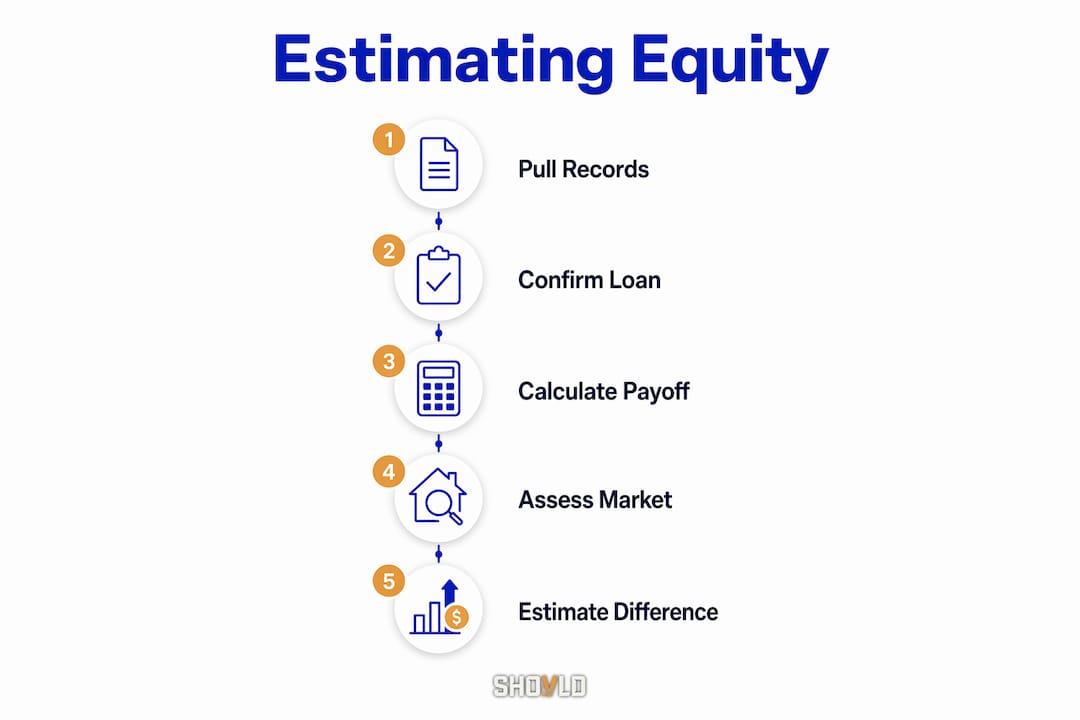
Compare acquisition price to current market value. Pull the most recent deed to find the purchase price and date. Then check current comparable sales in the same area. A property bought for $180,000 in 2012 in a market where similar homes now sell for $420,000 has substantial unrealized equity, even before you account for mortgage paydown.
Estimate the mortgage payoff balance. The original loan amount and origination date are on the recorded mortgage document. Apply a standard amortization formula using a reasonable interest rate for that origination year. This gives you a working estimate of what the owner still owes. You will not have the exact figure, but you will be close enough to assess deal viability.
Read the deed type carefully. A quitclaim deed does not guarantee clear title. It only transfers whatever interest the grantor holds. Properties with a chain of quitclaim deeds carry title risk, but they also often carry equity that the current owner does not fully understand or value.
Look for wholesale activity and rapid ownership transfers. Multiple ownership transfers within a short period can indicate wholesale flipping or distressed sales. Each transfer leaves a price record. Comparing those prices to current market value reveals whether equity has been extracted or left on the table.
Stack your indicators. Stacking multiple indicators like absentee ownership, tax delinquency, code violations, and long holding periods refines your target list. Each additional data layer increases accuracy and cuts down prospect volume. A property that shows absentee ownership, a 15-year holding period, and a tax delinquency notice is a far stronger lead than any single signal alone.
Pro Tip: When estimating mortgage payoff, use the Federal Reserve’s historical average 30-year fixed rate for the origination year as your interest rate assumption. This produces a more accurate amortization estimate than using today’s rate.
What challenges come with accessing public records for equity?
Public records are theoretically open, but the path to them is not always clear. Investors who treat this process as a simple database lookup often miss critical nuances.
Properties held by LLCs or trusts present the most common obstacle. The recorded owner is an entity, not a person. Beneficial ownership behind LLCs and trusts can be uncovered by tracking recorded deeds, business filings, UCC statements, and signatures. Nominal transaction values, such as a deed recorded for $10, often indicate a non-arm’s-length transfer and point you toward the real owner. The paper trail exists across county assessors, recorder offices, Secretary of State filings, and court records. You just have to follow it.
Recorded documents can also be defective or fraudulent. County recorder offices verify only format, not legal efficacy. A deed can be recorded and still lack legal validity if it was signed under duress, forged, or executed without proper authority. Relying on a single recorded document without verifying the full chain of title can produce a badly wrong equity estimate.
“A government agency’s resistance to releasing records is often an indicator of valuable or sensitive information. Persistence through formal requests or lawsuits is sometimes essential.” — Public records investigation principle
Government agencies at the local level sometimes delay or resist releasing records. Federal FOIA requires agencies to respond within 20 business days, but state and local timelines vary widely. New York requires 5 days to acknowledge a request; California allows 10 days for initial processing. Resistance to releasing records often signals that the information is sensitive or valuable. Persistence through formal written requests, appeals, and occasionally court orders is sometimes the only path forward.
Access costs also vary. PACER charges $0.10 per page for federal court records, with caps for quarterly low-volume users. State and county fees differ by jurisdiction. Budget for these costs when building a systematic research process.
How can investors practically use public records to find hidden property equity?
The investors who consistently find off-market deals do not rely on luck. They build repeatable systems for accessing and layering public data.
Start with tax delinquency lists. Most counties publish delinquent tax rolls or make them available on request. Tax delinquencies, pre-foreclosure filings, and code violations are high-probability indicators of motivated sellers with equity intact. Pull these lists and cross-reference them against ownership records.
Identify absentee owners. When the mailing address on a tax record differs from the property address, the owner does not live there. Absentee owner identification through public record indicators is a proven method for targeting equity opportunities. Absentee owners are statistically more likely to sell at a discount because they lack emotional attachment to the property.
Pull the full ownership history. Request the complete deed chain from the county recorder. Look for long holding periods, quitclaim transfers, and any gaps in the chain. A property held by the same owner for 20 years in an appreciating market almost certainly carries substantial equity.
Cross-reference with distressed property records. Distressed property records reveal financial stress signals that go beyond simple tax delinquency. Code violations, unresolved permits, and HOA pressure all indicate an owner who may be motivated to sell quickly.
Make formal records requests when needed. Some records require a written request under state open records laws. Submit requests in writing, reference the specific statute, and keep copies of all correspondence. If an agency delays or denies, escalate through the appeals process.
Pro Tip: Build a simple spreadsheet that scores each property on five indicators: holding period over 10 years, absentee ownership, tax delinquency, active lien, and deed type. Properties scoring 3 or higher deserve a direct outreach campaign.
Key Takeaways
Public records are the most reliable source of hidden equity signals because they expose financial stress, ownership gaps, and value disparities that no listing service will ever show you.
PointDetailsStack multiple indicatorsCombining absentee ownership, tax delinquency, and code violations produces the highest-probability motivated seller lists.Read deed types carefullyQuitclaim deeds signal non-arm’s-length transfers and often point to undervalued equity positions.Estimate mortgage payoffUse the origination date and a period-appropriate interest rate to calculate a working payoff balance.Verify beyond the recordingCounty recorders check format only; always verify the full deed chain before acting on an equity estimate.Persistence pays offAgency resistance to releasing records often signals that the information is worth pursuing harder.
What most investors miss when reading public records
I have reviewed thousands of public record chains across multiple markets, and the pattern is consistent. Most investors stop at the surface. They pull the owner’s name, check the assessed value, and move on. That approach leaves the best deals on the table.
The real work is in the document trail. A property held by an LLC named “1234 Oak Street Holdings LLC” looks like a dead end until you pull the Secretary of State filing, find the registered agent, cross-reference the agent’s name against other deed records in the county, and realize the same individual controls 14 properties with a combined tax delinquency of over $80,000. That is not a dead end. That is a portfolio acquisition opportunity.
I am also wary of investors who rely on a single data source. One database, one record type, one signal. The equity is almost never visible from one angle. It reveals itself when you layer ownership history against mortgage origination data against current market comps against lien records. That layering process is where the real edge lives.
Patience matters more than speed here. The investors who rush through records requests and accept the first response from a county office often miss the most valuable information. The ones who file formal requests, follow up in writing, and appeal denials consistently find deals that the market never sees.
Public records are a public resource. The advantage goes to whoever uses them most systematically.
— Avi
Shovld turns public record signals into scored opportunities
Real estate investors who want to move faster without sacrificing accuracy use Shovld to do the heavy lifting. Shovld aggregates tax delinquency data, lien filings, absentee ownership patterns, code violations, and pre-foreclosure signals across multiple U.S. markets. It scores each property against multiple indicators so you see the highest-probability opportunities first, not after hours of manual record pulling.

The platform is built for investors who understand that timing is the real competitive advantage. By the time a distressed property hits the MLS, the equity opportunity is already crowded. Shovld surfaces those signals weeks or months earlier. Review the available Shovld pricing plans to find the right fit for your market and deal volume.
FAQ
What is hidden equity in real estate?
Hidden equity is the difference between a property’s current market value and the total of its outstanding mortgage balance and liens. It is “hidden” because it does not appear in listing data or public market reports.
Which public records are most useful for finding hidden equity?
Deeds, mortgage documents, tax assessment records, tax delinquency rolls, and lien filings are the most useful. Cross-referencing all five produces the most accurate equity estimate.
How do I estimate a property’s mortgage payoff from public records?
Pull the recorded mortgage document for the original loan amount and origination date. Apply a standard amortization schedule using the average 30-year fixed rate for that origination year to estimate the current balance.
Can LLC or trust ownership block access to equity information?
It creates friction but not a dead end. Following the document trail through deeds, Secretary of State filings, UCC statements, and court records typically reveals the beneficial owner behind the entity.
How long does it take to get public records from government agencies?
Federal FOIA requires a response within 20 business days. State and local timelines vary: New York requires 5 days to acknowledge a request, and California allows 10 days for initial processing. Complex requests or agency resistance can extend timelines significantly.